Oklahoma Telemarketing Law for Insurance Agents (2026)
Oklahoma's 2022 telemarketing law exempts licensed insurance agents from its own consent and calling-hour rules. Federal TCPA and DNC rules still apply.
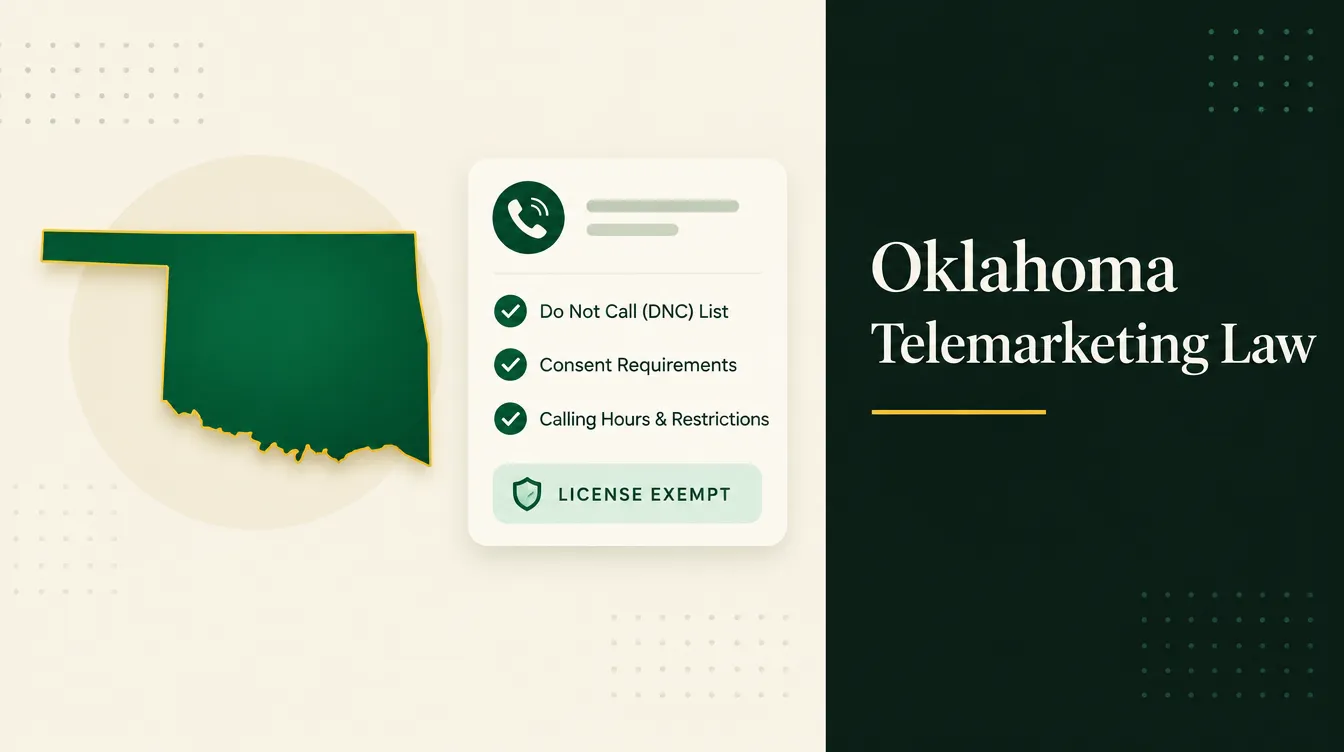
If you sell insurance in Oklahoma, the state’s own TCPA-like telemarketing law almost certainly does not apply to you. Section 775C.5 of the Telephone Solicitation Act of 2022 lists 26 categories of callers exempt from its consent requirement, its 8 a.m. to 8 p.m. calling window, and its three-call-per-day cap, and the eighth one on that list is “any licensed insurance broker, agent, customer representative, or solicitor when soliciting within the scope of his or her license.” That’s not a loophole someone found. It’s written directly into the statute the Legislature passed in 2022.
That single fact changes almost nothing about what you actually need to do, and it’s worth being honest about why up front: Oklahoma is one state out of fifty, the federal Telephone Consumer Protection Act sits on top of every state’s law regardless of what that state exempts, and Oklahoma itself runs a second telemarketing statute, its own do-not-call registry, that does not carve out insurance at all. An agent who reads “exempt” and stops there is building a compliance program on a headline instead of a statute.
The short version
- Oklahoma's Telephone Solicitation Act of 2022 (15 O.S. Sections 775C.1-775C.6) exempts licensed insurance producers, soliciting within the scope of their license, from its own consent, calling-hours, and frequency-cap rules, per Section 775C.5(8).
- The older Commercial Telephone Solicitation Act (15 O.S. Sections 775A.1-775A.5) separately exempts a person regulated by Oklahoma's insurance regulator from its registration and bonding requirement, per Section 775A.2(1)(g).
- Oklahoma's Telemarketer Restriction Act, the state's own do-not-call registry (15 O.S. Sections 775B.1-775B.7), lists no insurance exemption in its text and applies to any telemarketer initiating a commercial call.
- None of this touches the federal TCPA at 47 U.S.C. Section 227, which still requires prior express consent for an autodialed or artificial-voice call to a wireless number and still carries $500 to $1,500 in statutory damages per violation.
- The FCC ruled on February 8, 2024 that an AI-generated voice counts as an "artificial" voice under the TCPA, so an AI caller gets the federal rulebook applied to it the same way a human dialer or a prerecorded campaign does.
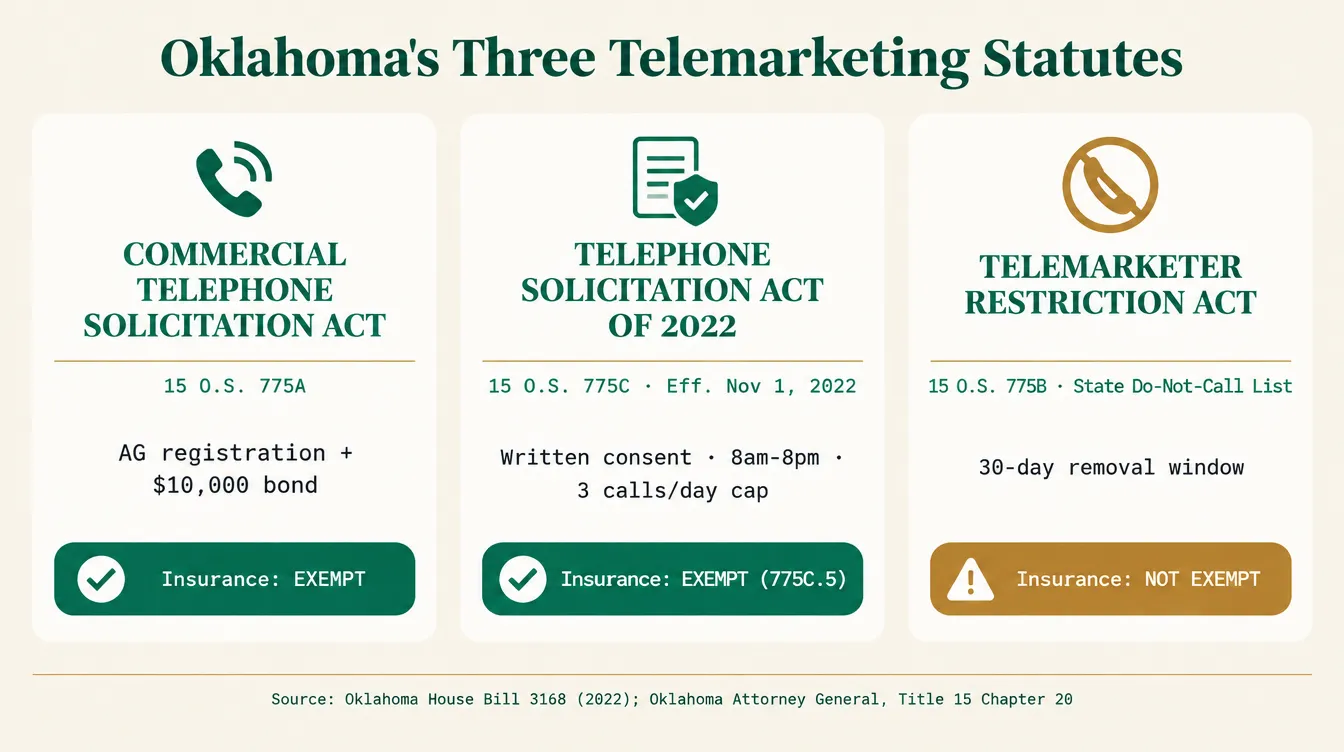
What Oklahoma actually has on the books, and there are three separate laws
Most of the coverage of state telemarketing law treats “Oklahoma’s telemarketing law” as one thing. It isn’t. Title 15, Chapter 20 of the Oklahoma Statutes contains three distinct acts, passed in three different years, each with its own scope and its own exemptions, and an insurance agent’s obligations are different under each one.
The Commercial Telephone Solicitation Act, the oldest of the three, requires a “commercial telephone seller” to register with the Attorney General at least ten days before conducting business in the state, post a $10,000 bond, and pay a filing fee, per Section 775A.3. It bans specific deceptive practices, misrepresenting a prize, faking a “free” offer, blocking caller ID, and ties any violation to the Oklahoma Consumer Protection Act. Section 775A.2(1)(g) exempts “a person or an affiliate of a person who is regulated by the Insurance Commission pursuant to Title 36 of the Oklahoma Statutes” from the entire act, which means a licensed insurance business doesn’t register, doesn’t bond, and doesn’t file with the Attorney General under this statute at all.
The Telephone Solicitation Act of 2022, created by House Bill 3168 and effective November 1, 2022, is the TCPA-shaped one, and it’s the statute most agents mean when they ask about “Oklahoma’s telemarketing law.” It requires prior express written consent before a commercial telephonic sales call uses an automated system to select or dial a number, or plays a recorded message on connection, per Section 775C.3(A). It bans calls outside 8 a.m. to 8 p.m. local time and caps solicitation calls at three per 24-hour period on the same subject matter, regardless of which number placed the call, per Section 775C.4. And per Section 775C.5, it exempts 26 categories of callers from all of it, including, at paragraph 8, “any licensed insurance broker, agent, customer representative, or solicitor when soliciting within the scope of his or her license.”
The Telemarketer Restriction Act, in force since the Attorney General built the registry by January 1, 2003 under Section 775B.3, is Oklahoma’s own state-level do-not-call list, separate from the FTC’s national one. A telemarketer cannot call a number more than 30 days after it first appears on the registry, per Section 775B.6, unless the caller and consumer have an established business relationship formed within the preceding 24 months, per Section 775B.2(3). This act’s definition of “telemarketer” is broad: any person who, for commercial purposes, initiates a telemarketing sales call to an Oklahoma consumer. Nothing in Sections 775B.1 through 775B.7, as published by the Attorney General’s office, lists an exemption for licensed insurance producers the way the other two acts do.
Terms worth knowing
Commercial telephonic sales call: under Section 775C.2, a call, text message, or voicemail transmission delivered for a commercial purpose. Prior express written consent: a signed agreement, which can be electronic, that names the specific phone number, discloses that consent isn't a condition of purchase, and authorizes the specific type of automated or recorded contact. Automated system: the 2022 act never defines this term on its own, which is the same ambiguity industry counsel flagged when the bill was moving through the Legislature. Established business relationship: under Section 775B.2, a relationship formed by a voluntary two-way exchange in the preceding 24 months, based on an inquiry, application, purchase, or transaction, that neither party has ended.
Why Oklahoma wrote the exemption in the first place
Look down the full list of Section 775C.5’s 26 exemptions and a pattern shows up fast: banks, credit unions, and securities brokers are on it too, alongside insurance producers, real estate licensees, and funeral service providers. None of that is random. Every one of those categories is already licensed and supervised by a separate state or federal regulator before a telemarketing statute ever enters the picture. A securities broker answers to the SEC and FINRA. A real estate agent answers to the Oklahoma Real Estate Commission. An insurance producer answers to the state’s own insurance regulator, which already sets licensing standards, conduct rules, and discipline procedures specific to selling insurance by phone.
The Legislature’s choice, in other words, wasn’t “insurance calls are less risky than other sales calls.” It was “this industry already has a regulator watching how it solicits, so a second, generic telemarketing statute on top of that regulator’s own rules would duplicate oversight that already exists.” That’s the same logic McCarran-Ferguson applies at the federal level for the business of insurance generally: when a state actively regulates an activity as insurance business, federal rules built for the broader marketplace step back rather than stack on top. Oklahoma’s Legislature made the same call for its own state telemarketing statute, just by naming insurance producers directly in the exemption list instead of leaving it to a McCarran-Ferguson analysis every time.
That rationale explains why the carve-out exists, and it also explains its limits. The exemption tracks the license, not the caller’s intent or the caller’s platform. A licensed producer soliciting insurance is inside the regulatory system the Legislature was deferring to. The same producer’s AI calling vendor, considered on its own, isn’t a licensed insurance entity and doesn’t inherit the exemption independently; it inherits it only through the licensed producer or agency actually placing the call under that license. That’s a distinction worth having in writing if you outsource any part of your dialing to a third party, so it’s clear whose license the exemption is actually running through.
What “soliciting within the scope of your license” actually means
The exemption’s own text does the scoping for you, and it’s narrower than “I have a license” might suggest. Oklahoma insurance licenses are issued by line of authority: life, accident and health, property, casualty, and so on. A producer licensed for life and health who calls an Oklahoma lead about a Medicare Supplement or a final expense policy is squarely within scope. The same producer calling that same lead to pitch a homeowners policy they aren’t licensed to sell isn’t soliciting “within the scope of his or her license” for that call, whatever the exemption says about insurance producers generally.
This matters most for agencies running multiple lines through one calling operation. If your agency licenses some producers for life and health and others for property and casualty, and your dialer routes leads by list rather than by the calling producer’s actual line of authority, you can end up with calls that are exempt on one line and not exempt on another, from the same campaign, on the same day. The fix isn’t complicated: tag each list by the line of authority it requires, and make sure whichever license, human or the AI platform’s disclosed principal, is placing the call actually covers that line. It’s a data-hygiene problem before it’s a compliance problem, and it’s the kind of thing worth auditing once rather than assuming is already correct.
A solicitor role adds one more wrinkle. Section 775C.5(8) extends the exemption to a “customer representative, or solicitor,” not just a broker or agent, which covers more of a typical call center’s staff than the narrower reading some agencies assume. But “licensed by an official or agency of this state or of any state” still requires an actual license behind that role. An unlicensed setter or a script-reading dialer operator without any producer license doesn’t inherit the exemption just by working for a licensed agency; Oklahoma’s statute exempts the license, not the employer.
The “automated system” problem, and why it matters more for an AI caller
Even for a caller this exemption doesn’t cover, Section 775C.3 has its own ambiguity that industry counsel flagged when House Bill 3168 was moving through the Legislature: the act prohibits an automated system “for the selection or dialing of telephone numbers” without defining what qualifies as automated selection. A traditional predictive dialer randomly or sequentially generating numbers is the obvious case the TCPA’s own federal definition was built around. Whether a system that automatically selects the next number from an indexed, previously compiled customer or lead list, the way most CRM-driven dialers and AI calling platforms actually work, counts as the same kind of “automated system” is a question the statute’s text doesn’t resolve on its own.
For a licensed insurance producer, this ambiguity doesn’t matter much; Section 775C.5(8) exempts you from the whole section regardless of how “automated system” gets interpreted. It matters more for anyone in an Oklahoma calling operation who isn’t covered by that exemption, an unlicensed setter, a lead-gen vendor calling ahead of the licensed producer, or a shared call center working multiple clients’ lists. If any part of your Oklahoma operation includes calling that isn’t happening under a licensed producer’s own scope, don’t assume the statute’s silence on “automated system” works in your favor. Build toward the stricter reading, prior express written consent before automated selection or dialing of any kind, rather than betting a court reads the ambiguity narrowly.
The exemption, in the statute’s own words
Here is Section 775C.5(8) of the Telephone Solicitation Act of 2022, exactly as the Oklahoma Legislature enrolled it in House Bill 3168:
"Any licensed insurance broker, agent, customer representative, or solicitor when soliciting within the scope of his or her license. As used in this section, 'licensed insurance broker, agent, customer representative, or solicitor' means any insurance broker, agent, customer representative, or solicitor licensed by an official or agency of this state or of any state of the United States."
15 O.S. Section 775C.5(8), Telephone Solicitation Act of 2022Two things about that wording matter for how you actually use it. First, the license doesn’t have to be Oklahoma’s own; a producer licensed by any state’s insurance regulator qualifies, which matters if you’re calling Oklahoma numbers from an agency licensed elsewhere. Second, the exemption is scoped to soliciting “within the scope of” that license. A licensed life and health producer calling about a life or health product is squarely inside the exemption. The same person cold-calling about an unrelated product line they aren’t licensed to sell is a harder argument, and it’s not one this article can settle for you; that’s a scope question for your own counsel if your book of business crosses lines you’re not licensed for.
For comparison, here’s what the older Commercial Telephone Solicitation Act says at Section 775A.2(1)(g), which is a narrower carve-out covering only that act’s registration and bonding requirement, not consent or calling hours: “a person or an affiliate of a person who is regulated by the Insurance Commission pursuant to Title 36 of the Oklahoma Statutes.”
| Statute | What it covers | Insurance producer exemption? | Penalty for violation |
|---|---|---|---|
| Commercial Telephone Solicitation Act (775A.1-775A.5) | AG registration, $10,000 bond, deceptive-practice bans | Yes, Section 775A.2(1)(g), for a person regulated by the state insurance regulator | Unlawful practice under the Oklahoma Consumer Protection Act |
| Telephone Solicitation Act of 2022 (775C.1-775C.6) | Prior written consent, 8 a.m.-8 p.m. window, 3-call daily cap, caller ID rules | Yes, Section 775C.5(8), when soliciting within license scope | Actual damages or $500, up to $1,500 if willful, Section 775C.6 |
| Telemarketer Restriction Act (775B.1-775B.7) | Oklahoma's own do-not-call registry, 30-day removal window | No exemption listed in the published text | Unlawful practice under the Oklahoma Consumer Protection Act; AG administrative fine |
Sources: Oklahoma Legislature, Enrolled HB 3168 (2022); Oklahoma Attorney General, Oklahoma Statutes Citationized, Title 15, Chapter 20.
What still applies, no matter what Oklahoma’s own statute says
This is the part that gets skipped when a state exemption makes the news. Oklahoma’s exemption changes what an Oklahoma court can hear under an Oklahoma statute. It has no power over federal law, and it has no power over the one Oklahoma statute that didn’t exempt you in the first place.
The federal TCPA still requires consent. Under 47 U.S.C. Section 227(b)(1)(A), an autodialed or artificial-voice call to a wireless number needs prior express consent, and a marketing call needs that consent in writing, according to Cornell Law School’s Legal Information Institute. The FCC enforces this independent of any state’s own telemarketing statute, and the exemption you just read doesn’t reach it. A licensed producer calling an Oklahoma cell number with an AI voice and no consent on file is exempt from Section 775C.4’s calling-hours rule and still exposed under Section 227.
The FCC already ruled that an AI voice counts. On February 8, 2024, the FCC adopted a Declaratory Ruling holding that a call placed with an AI-generated voice is an “artificial” voice for TCPA purposes, the same category that’s covered a prerecorded message for decades. An AI calling platform doesn’t get a separate, lighter rulebook because the voice on the call is synthetic rather than a human read from a script.
Oklahoma’s own do-not-call registry doesn’t carve you out. The Telemarketer Restriction Act’s exemptions, as published by the Attorney General, don’t include the insurance-producer language that shows up in the other two acts. If an Oklahoma consumer’s number has been on that registry for more than 30 days and you don’t have an established business relationship with them formed in the preceding 24 months, Section 775B.6 treats the call as an unlawful telemarketing practice regardless of your license.
Whether the federal Do Not Call Registry and the Telemarketing Sales Rule apply to a given insurance call is its own question, not a blanket yes or no. The FTC’s own Advisory Opinion 03-1, issued August 19, 2003, lays out a McCarran-Ferguson test: the Telemarketing Sales Rule doesn’t reach an activity that qualifies as “the business of insurance” under a state’s own regulatory scheme, but that’s an activity-by-activity determination, not an industry-wide exemption, and it doesn’t extend to a third-party telemarketer just because the entity that hired them is otherwise exempt. Don’t assume this settles the question for your specific setup; it’s exactly the kind of scope call worth running past counsel who’s looked at how you actually place the call.
CMS layers its own rules on top for Medicare business. None of Oklahoma’s three statutes, or the federal TCPA, touches CMS’s separate Medicare marketing framework, which carries its own TPMO disclaimer, recording-retention, and unsolicited-contact rules for Medicare Advantage and Part D business. If part of your book is Medicare, the exemption discussed in this article changes nothing about that layer.
One violation, state versus federal exposure
Illustrative: the statutory damages range for a single non-compliant call under Oklahoma's 2022 act (for a non-exempt caller) versus the federal TCPA, which applies to everyone regardless of any state exemption.
Oklahoma figures per 15 O.S. Section 775C.6. Federal figures per 47 U.S.C. Section 227(b)(3), Cornell Law School Legal Information Institute. The two exposures are independent and can both apply to a caller who isn't covered by Oklahoma's producer exemption; a licensed producer soliciting within scope is exempt from the state figure but not the federal one.
What one wrong assumption actually costs
The realistic failure mode here isn’t an agency deliberately ignoring the law. It’s an agency that reads “Oklahoma exempts insurance agents” somewhere, correctly, and stops reading. They assume that sentence covers the do-not-call registry too, because it sounds like the same subject. It doesn’t. They assume it covers a text campaign the same way it covers a call, when the exemption’s own scope language, “within the scope of his or her license,” never got checked against what’s actually being sold on that particular campaign. Or they assume a state exemption from a state statute also covers the federal TCPA, because nobody separated the two rulebooks out loud.
None of those assumptions are unreasonable to make once. They’re expensive to make in production, at volume, across a list of a few thousand numbers, because a private right of action under either 775C.6 or 47 U.S.C. Section 227(b)(3) runs per call or per text, not per campaign. A single Oklahoma consumer who was on the state do-not-call registry for 45 days, in a subject area you’d never established a relationship with, and who received an autodialed follow-up call without TCPA-compliant consent on file, is a fact pattern that could support claims under two different statutes at once, and the insurance exemption in Section 775C.5 answers for exactly none of it.
Run the arithmetic and the asymmetry is stark. A three-minute follow-up call at TheAffordableAI’s published Single Account rate of $0.20 a minute costs 60 cents to place. One federal TCPA violation on that same call, if it turns out consent wasn’t actually on file, carries a statutory floor of $500, and up to $1,500 if a court calls it willful, per 47 U.S.C. Section 227(b)(3). That’s not a rounding error against the cost of the call; it’s roughly 800 to 2,500 times the cost of the call itself, for the exact same three minutes, and it has nothing to do with whether Oklahoma’s own Section 775C.5 exemption applied to the state-law side of that same call.
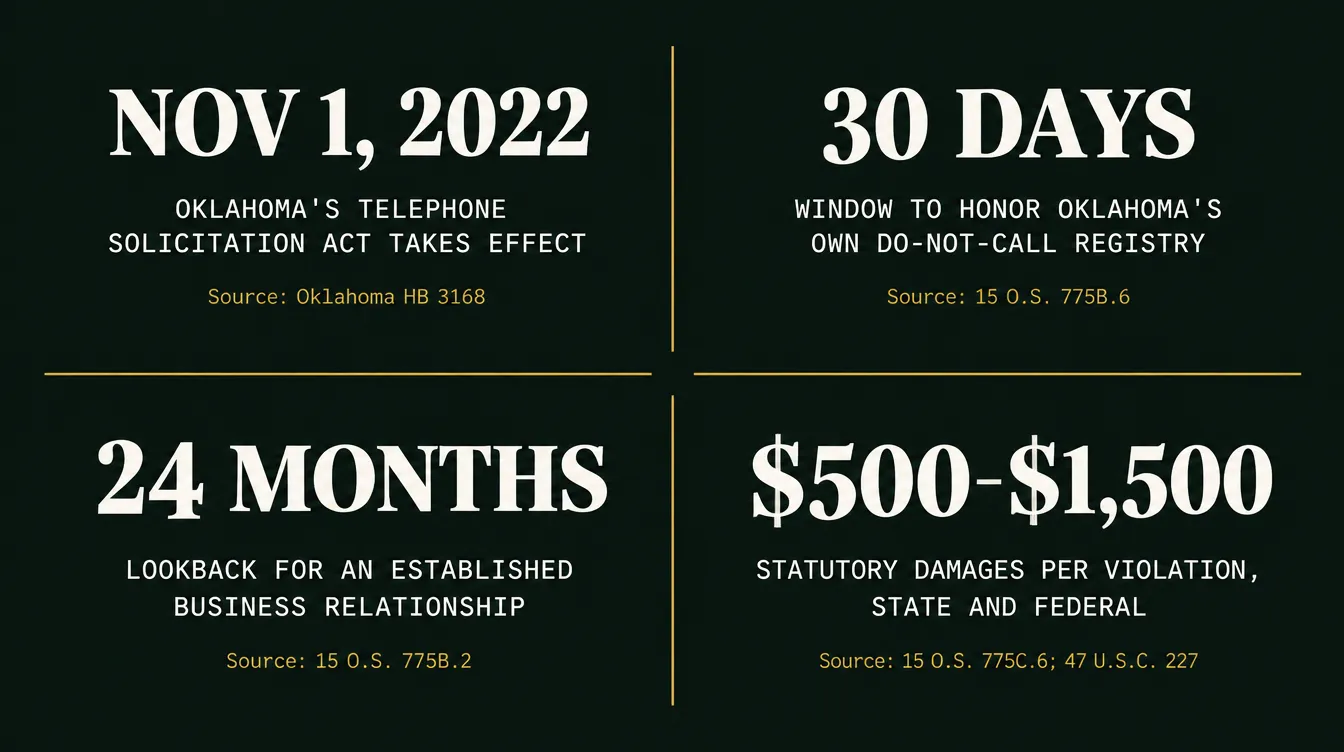
Nov 1, 2022
Effective date of Oklahoma's Telephone Solicitation Act of 2022
Source: Enrolled HB 3168, Section 7
30 days
Maximum window before a state do-not-call registration must be honored
Source: 15 O.S. Section 775B.6
24 months
Lookback window for an "established business relationship" exception
Source: 15 O.S. Section 775B.2(3)
$1,500
Maximum statutory damages per willful violation, state or federal
Source: 15 O.S. Section 775C.6; 47 U.S.C. Section 227(b)(3)
Hear it place a call
Put your own number in on the homepage and the AI calls you in seconds, so you can hear what a disclosed, consent-aware follow-up call actually sounds like before you build anything around your own Oklahoma list.
How to build the calling cadence, step by step, without buying anything yet
None of this requires new software to get right. Every step below runs on a spreadsheet, a CRM export, and a decision you make once and document.
- Confirm the license actually covers what you’re calling about. Section 775C.5(8)‘s exemption is scoped to soliciting “within the scope of” the license. Pull your own producer license and match it against the product line in the campaign before you assume the exemption applies to that specific list.
- Screen every Oklahoma number against the state do-not-call registry separately from the national one. They’re different lists, run by different agencies, and only one of Oklahoma’s three statutes is the one without a producer exemption. Treat the 775B registry as fully binding.
- Keep prior express written consent on file anyway, even though 775C doesn’t require it from you. The federal TCPA does, for any autodialed or artificial-voice call to a wireless number, and Oklahoma’s state exemption never touches that requirement. Building one consent record instead of two rulebooks in your head is simpler and it’s the one that actually protects you.
- Document the established-business-relationship basis for any repeat contact, if you’re relying on it. Under Section 775B.2(3), that’s a relationship formed by voluntary two-way communication in the preceding 24 months. Keep the date and the nature of that first contact on the lead record, not just a checkbox.
- Separate your Medicare business from everything else, in your CRM tags, not just in your head. CMS’s rules apply on top of all three Oklahoma statutes and the federal TCPA, and none of the exemptions discussed here reach Medicare marketing requirements.
- If you’re licensed outside Oklahoma and calling Oklahoma numbers, confirm your out-of-state license still qualifies. Section 775C.5(8)‘s definition covers a producer “licensed by an official or agency of this state or of any state of the United States,” which is broader than most agents assume, but it’s worth confirming against your actual license type before you rely on it at volume.
You can run all six steps with tools you already have, and plenty of agencies do exactly that instead of changing anything about how they dial.
The CMS layer sits on top, separately
If any part of your Oklahoma book touches Medicare Advantage or Part D, nothing in this article substitutes for CMS’s own Medicare marketing rules, which carry their own TPMO disclaimer language, call-recording retention period, and restrictions on unsolicited contact, independent of everything covered above. The CMS 2027 Medicare marketing rules guide on this site walks through that layer specifically, and the GoHighLevel workflow guide covers building a trigger-to-warm-transfer flow that logs consent and disposition automatically, whichever of Oklahoma’s statutes ends up governing a given campaign.
Where TheAffordableAI fits
Deciding which of Oklahoma’s three statutes governs a given call, and whether a given campaign sits within your license’s scope, is a legal and licensing judgment, and no vendor, including us, makes that call for you. Where a managed AI caller helps is in what happens once you’ve made that decision: every call TheAffordableAI places gets logged against the lead’s record automatically, including disposition, consent status, and any opt-out language spoken on the call, and that log syncs natively with HighLevel instead of sitting in a dialer’s local history that nobody exports. You can configure calling windows and frequency caps as system rules once, based on whichever rulebook you’ve decided actually applies to a given list, rather than trusting each dial to happen inside the right hours by memory. The full list of what’s included on every plan is on the features page.
Native HighLevel CRM sync
Consent status, disposition, and transcript land in the CRM automatically, the documentation trail either a state or federal inquiry would ask you to produce.
Configurable calling windows
Set the hours and frequency cap that actually apply to a given list once, rather than relying on a dialer operator to remember which statute governs which campaign.
Multi-calendar intent routing
Route Medicare, life, and P&C conversations to the right calendar and the right licensed agent instead of merging every product line into one undifferentiated list.
Number warmup and spam defense
A compliant call is still worthless if it shows up as "Spam Likely" before the lead answers. Warmup and defense run as a standing routine, not a one-time fix.
Price it against your own list
A Single Account runs $200 a month plus a $500 one-time setup fee, at $0.20 a minute, down to $0.15 a minute at bulk volume. An Agency plan runs $500 a month plus a $1,000 one-time setup fee, at $0.18 a minute, down to $0.16 a minute at bulk. No long-term contract either way. See pricing.
Where a rule change doesn’t help, and where you still need a lawyer
It would be dishonest to sell this as a technology problem, because most of it isn’t one. The genuinely hard part of Oklahoma’s exemption is a scope question: does a specific campaign fall “within the scope of” a specific producer’s license, and does a specific call fit the McCarran-Ferguson “business of insurance” test the FTC’s own advisory opinion lays out for the separate question of federal Do Not Call and Telemarketing Sales Rule coverage. No AI caller and no CRM feature answers either question. Those are license-scope and regulatory-classification calls that belong to someone who has actually looked at your book of business and your calling method, ideally counsel who’s read Sections 775A, 775B, and 775C themselves rather than a summary of them, including this one.
If your agency already runs a tight, documented consent process because you sell into other states without Oklahoma’s exemption, you likely don’t need to change much for Oklahoma specifically beyond confirming the state do-not-call registry screening is separate from the national one. Spending money on new tooling to solve a compliance gap you don’t actually have isn’t a good trade, and it’s worth ruling that out before assuming a bigger system is the answer.
Using AI does not transfer liability
A faster, better-documented calling setup is a real operational benefit. It is never a transfer of licensing liability. Prior express consent under the TCPA, disclosure that a caller is an AI where required, Do Not Call compliance under both the national and Oklahoma state registries, and correctly scoping which of Oklahoma's telemarketing statutes governs a given campaign all remain the responsibility of the licensed agent and agency, whether a human or an AI voice places the call. Medicare campaigns carry CMS's rules on top of all of it, including the TPMO disclaimer and call-recording retention requirements. An automated caller does not carry any of that responsibility away from you. This is general information, not legal advice; verify current requirements against the statutes themselves and your own counsel before running a large outbound push into Oklahoma.
Oklahoma really did write an insurance exemption into its 2022 telemarketing law, and if you’re a licensed producer soliciting within your own scope, Section 775C.5(8) means that statute’s consent rule, its calling-hours window, and its three-call cap don’t reach you the way they reach an unlicensed telemarketer. What Oklahoma didn’t do is exempt you from the federal TCPA, from its own separate do-not-call registry, or from the judgment call about whether a specific campaign actually sits inside your license’s scope. Read the exemption for what it says, not for what a headline about it implies, and the rest of your calling program looks the same as it would in a state that never wrote the carve-out at all.
Frequently asked
Are insurance agents exempt from Oklahoma's telemarketing law?
Partly, and it depends which of Oklahoma's three telemarketing statutes you mean. The Telephone Solicitation Act of 2022, at 15 O.S. Section 775C.5(8), exempts 'any licensed insurance broker, agent, customer representative, or solicitor when soliciting within the scope of his or her license' from its prior-express-written-consent rule, its 8 a.m. to 8 p.m. calling window, and its three-call-per-day cap. The older Commercial Telephone Solicitation Act, at 15 O.S. Section 775A.2(1)(g), separately exempts a person regulated by the Insurance Commission from its registration and bonding requirement. But Oklahoma's Telemarketer Restriction Act, the state's own do-not-call registry at 15 O.S. Sections 775B.1 through 775B.7, contains no insurance exemption in its text and applies to any 'telemarketer' who initiates a call for commercial purposes.
What is Oklahoma's Telephone Solicitation Act of 2022?
It's a TCPA-like state law, enacted as House Bill 3168 and effective November 1, 2022, codified at 15 O.S. Sections 775C.1 through 775C.6. For callers it covers, it requires prior express written consent before an automated system dials or a recorded message plays, bans calls before 8 a.m. or after 8 p.m. in the called party's time zone, caps solicitation calls at three per 24-hour period on the same subject matter regardless of which number placed them, and bans caller ID spoofing. It carries a private right of action for actual damages or $500, whichever is greater, tripled to $1,500 for a willful or knowing violation. Section 775C.5 lists 26 categories of exempt callers, and licensed insurance producers are the eighth one on that list.
Does the Oklahoma insurance exemption cover text messages too?
The exemption in Section 775C.5(8) exempts a licensed insurance broker, agent, customer representative, or solicitor from the entire Telephone Solicitation Act of 2022 when soliciting within the scope of the license, and the act's own definition of a covered 'commercial telephonic sales call' in Section 775C.2 explicitly includes calls delivered by telephone call, text message, or voicemail transmission. Because the exemption applies to the act as a whole rather than to one delivery channel, a licensed producer's automated texts and voicemails soliciting within the scope of that license fall outside this specific state statute the same way a voice call does.
Do I still need consent to call or text Oklahoma leads if I'm a licensed agent?
Yes, under federal law. Oklahoma's state exemption removes the Telephone Solicitation Act of 2022's own consent, hours, and frequency requirements for a licensed producer, but it does not touch the federal Telephone Consumer Protection Act at 47 U.S.C. Section 227, which the FCC enforces separately and which still requires prior express consent for an autodialed or artificial-voice call to a wireless number, written consent specifically for a marketing call. A state exemption changes what Oklahoma's own courts can hear under its own statute. It does not change what the FCC can enforce under a federal one.
What is Oklahoma's Telemarketer Restriction Act, and does it exempt insurance?
It's Oklahoma's own do-not-call registry, separate from the national one, codified at 15 O.S. Sections 775B.1 through 775B.7 and in place since the Attorney General built the registry by January 1, 2003 under Section 775B.3. A telemarketer cannot call a consumer's number more than 30 days after it first appears on the registry, per Section 775B.6, unless the caller has an established business relationship formed within the preceding 24 months. Unlike the 2022 act and the older Commercial Telephone Solicitation Act, this statute's exemptions section does not list licensed insurance producers, based on the text of Sections 775B.1 through 775B.7 as published by the Oklahoma Attorney General's office. Treat this one as applicable unless you've confirmed otherwise with counsel.
Does Oklahoma's exemption mean AI voice calls are unrestricted for insurance agents there?
No. It means one specific state statute's consent-and-hours framework doesn't bind a licensed producer soliciting within scope. The FCC's February 8, 2024 declaratory ruling already established that a call using an AI-generated voice counts as an 'artificial' voice under the federal TCPA, which applies regardless of any state-level carve-out. An AI caller placing calls to Oklahoma numbers still needs to satisfy federal consent rules, honor the national Do Not Call Registry where it applies, and disclose that it's an AI where disclosure is required.
What happens if I violate the TCPA even though Oklahoma's own law doesn't apply to me?
The same thing that happens anywhere else. Under 47 U.S.C. Section 227(b)(3), a consumer can recover actual monetary loss or $500 in statutory damages per violation, whichever is greater, and a court can triple that award, up to $1,500, if it finds the violation was willful or knowing, according to Cornell Law School's Legal Information Institute. That federal exposure exists independent of Oklahoma's own Telephone Solicitation Act of 2022 and its exemption for licensed producers. Being exempt from a state statute never means being exempt from the federal one built on top of it.
Does using an AI caller change any of this liability?
No. Consent, disclosure, honoring a revocation or a do-not-call request, and figuring out which of Oklahoma's three telemarketing statutes actually applies to a given call are decisions that stay with the licensed agent and agency, whether a human or an AI places the call. What a well-configured AI calling setup can do is enforce whatever calling window and frequency rule you decide applies, log consent and disposition against the lead automatically, and sync that record to a CRM like HighLevel so it exists somewhere other than a dialer's memory. It doesn't decide the legal question for you, and it doesn't take on your licensing liability.
Sources
- Oklahoma Legislature — Enrolled House Bill No. 3168 (2022), creating the Telephone Solicitation Act of 2022, 15 O.S. Sections 775C.1-775C.6, effective November 1, 2022
- Oklahoma Office of the Attorney General — Oklahoma Statutes Citationized, Title 15, Chapter 20, Commercial Telephone Solicitation Act (15 O.S. Sections 775A.1-775A.5)
- Oklahoma Office of the Attorney General — Oklahoma Statutes Citationized, Title 15, Chapter 20, Telemarketer Restriction Act (15 O.S. Sections 775B.1-775B.7)
- Cornell Law School Legal Information Institute — 47 U.S.C. Section 227, Telephone Consumer Protection Act
- Federal Communications Commission — FCC Makes AI-Generated Voices in Robocalls Illegal (Declaratory Ruling FCC 24-17, adopted and released February 8, 2024)
- Federal Trade Commission — Advisory Opinion 03-1, application of the Telemarketing Sales Rule and McCarran-Ferguson Act to insurance telemarketing (issued August 19, 2003)
- TheAffordableAI — Pricing
Put this on your own phone line
See the AI dial, qualify, and warm-transfer a live call in under a minute. No contract, no dev work.
Keep reading
Maryland Telemarketing Law for Insurance Agents (2026)
Maryland caps telemarketing at three calls a day, 8am to 8pm, with written consent required. Here's what insurance agents need to do to stay compliant.
Georgia Telemarketing Law for Insurance Agents (2026)
SB 73 added vicarious liability and class actions to Georgia's telemarketing law. What changed, what a violation costs, and how agents stay compliant.
GoHighLevel Insurance Workflows: Trigger to Warm Transfer
Most GoHighLevel insurance workflows stop at 'assign the lead.' Here's the trigger-to-warm-transfer build, GHL's own docs, and where TCPA rules bite.