Maryland Telemarketing Law for Insurance Agents (2026)
Maryland caps telemarketing at three calls a day, 8am to 8pm, with written consent required. Here's what insurance agents need to do to stay compliant.
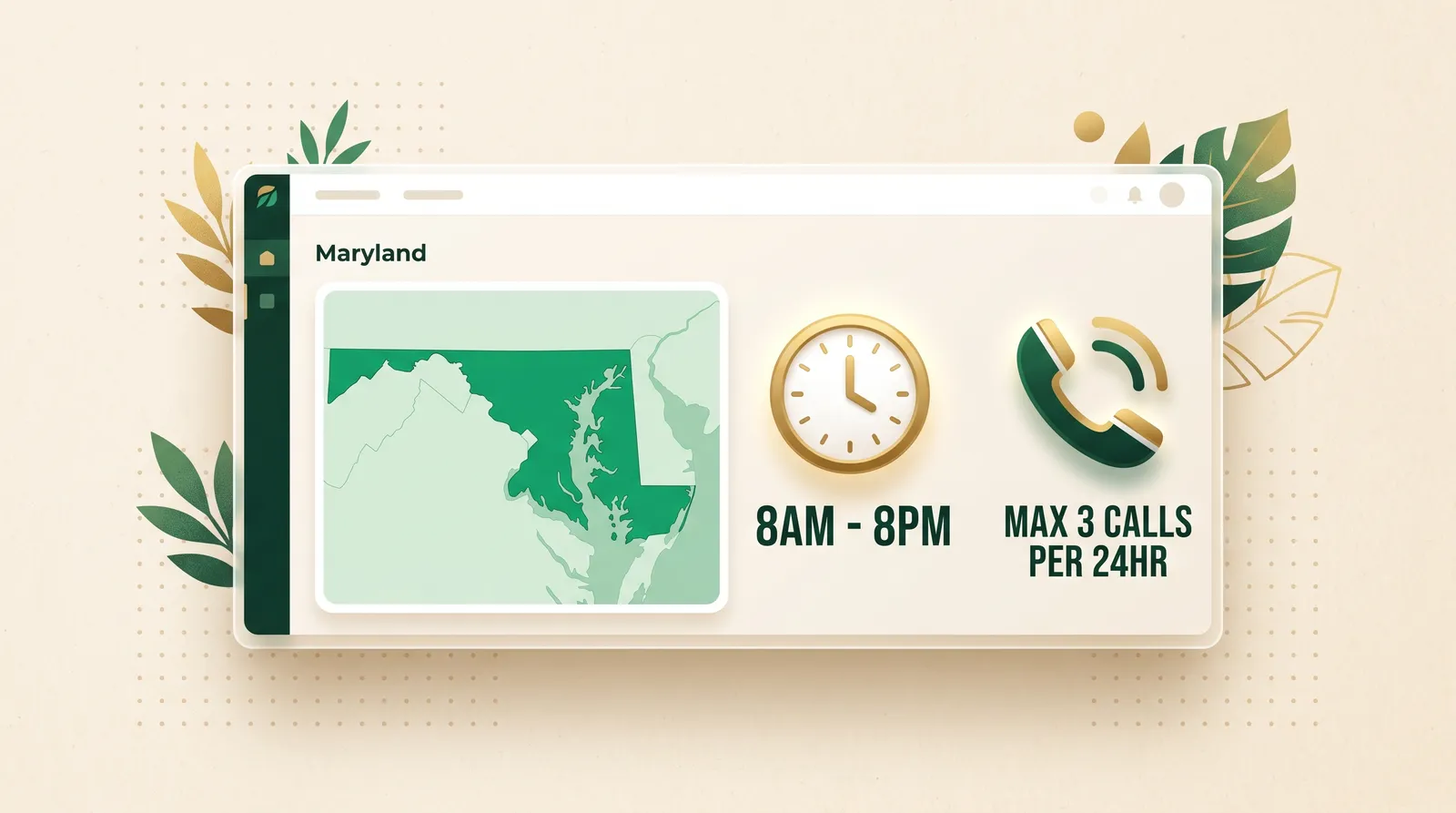
Maryland’s Stop the Spam Calls Act caps telemarketing calls at three per day to the same person, restricts calling hours to 8 a.m. to 8 p.m., and requires prior express written consent before you use an automated system, a recorded voice, or an artificial voice to reach a Maryland consumer, under Sections 14-4501 and 14-4502 of the Maryland Commercial Law Article. It’s been the law since January 1, 2024, and it applies to an insurance agent’s outbound follow-up call the same way it applies to a robocall scam, with no carve-out for “we’re just trying to reach our own leads faster.”
If you sell in Maryland, or you buy leads that include Maryland numbers, this is the rulebook your calling cadence has to fit inside, whether you dial by hand or run an AI caller. Get the hours or the frequency cap wrong and a single called party can sue you directly, on top of whatever the state’s consumer protection enforcement can add.
The short version
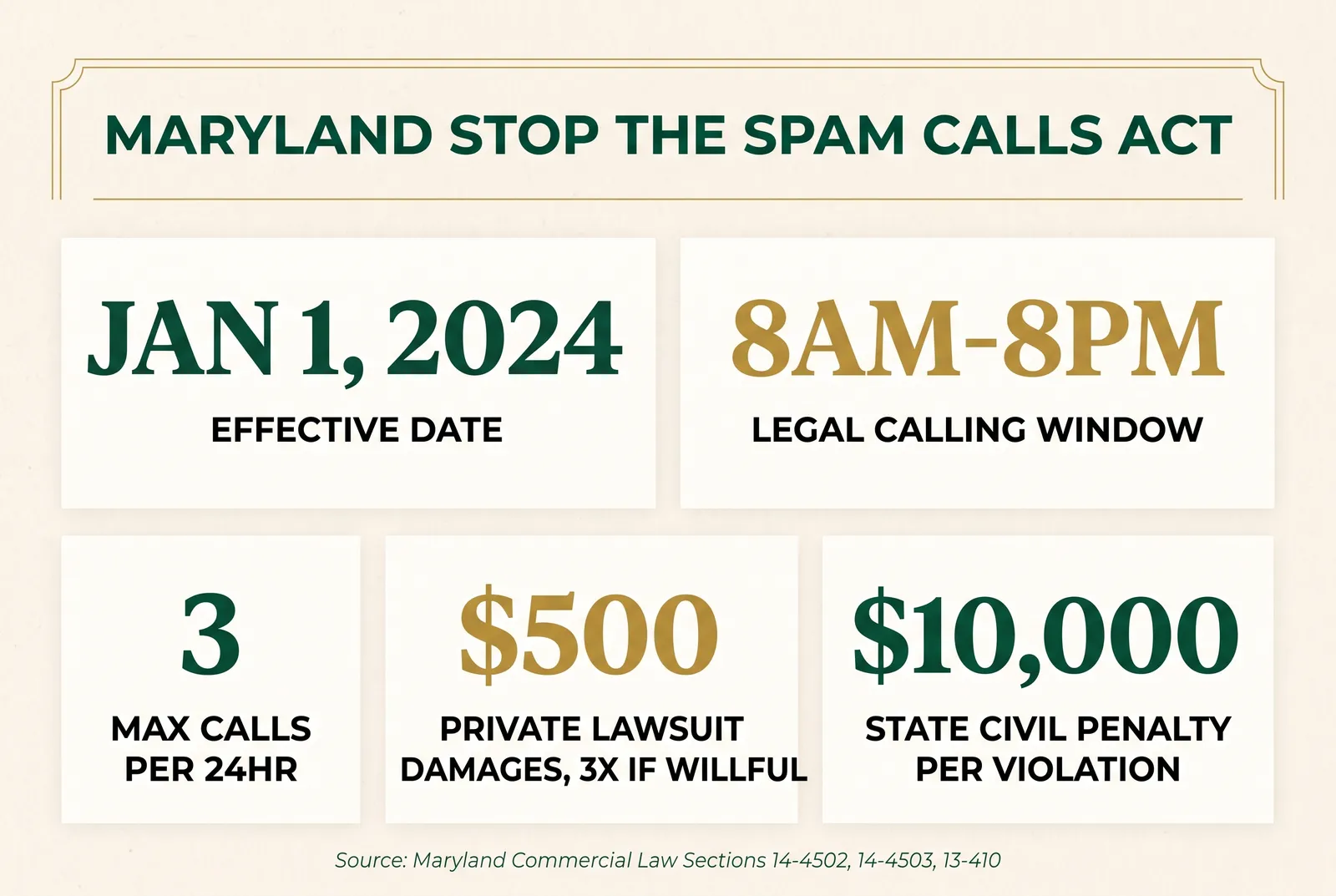
- Maryland's Stop the Spam Calls Act, in force since January 1, 2024, sets an 8 a.m. to 8 p.m. calling window and caps solicitation calls at three per 24-hour period to the same person, regardless of which number you call from.
- Automated calls, recorded or artificial voice messages, and prerecorded voicemail all require prior express written consent, defined in the statute itself, before you can use them on a Maryland number.
- Violations carry two separate exposures: a private lawsuit for up to $500 or actual damages (tripled if the court finds the violation willful), plus a Consumer Protection Act civil penalty of up to $10,000 per violation, $25,000 for a repeat.
- The FCC confirmed in February 2024 that an AI-generated voice counts as an "artificial voice" under the federal TCPA, so an AI caller doesn't get different rules here, it gets the same ones.
- The fix is mechanical: know which numbers in your list are Maryland numbers, cap the calling window and the daily attempts at the system level, and keep documented consent on file before a number goes into any automated campaign.
What Maryland’s Stop the Spam Calls Act actually says
The statute lives in the Maryland Commercial Law Article, Title 14, Subtitle 45, added by House Bill 37 in the 2023 legislative session and signed into law as Chapter 414, effective January 1, 2024, according to the Maryland General Assembly’s own bill record. It passed both chambers unanimously, 134 to 0 in the House and 46 to 0 in the Senate, which tells you how little political appetite there was to leave this alone.
Three rules do the actual work, all in Section 14-4502:
The calling window. “A person may not make or cause to be made a telephone solicitation… to a called party during the hours between 8 p.m. and 8 a.m. in the called party’s time zone.” That’s a full four hours tighter than the 8 a.m.–9 p.m. window most agents are used to from the federal Telemarketing Sales Rule. An agent who dials a Maryland lead at 8:20 p.m. out of habit, because that call would be fine in a state without its own restriction, is already outside the statute.
The frequency cap. No more than three calls to the same called party in a 24-hour period “on the same subject matter or issue, regardless of the telephone numbers used to make the call.” Read that last clause carefully. It doesn’t matter if call one came from your main line and calls two and three came from two different local-presence numbers; the cap tracks the person being called and the subject of the call, not which of your numbers dialed it.
The caller ID rule. You cannot fail to transmit your originating number, or intentionally act to prevent your name or number from reaching the called party, when your equipment is capable of sending it. A separate clause in the same section bars intentionally altering your voice to disguise your identity in order to defraud, confuse, or injure the called party, or to extract personal information under false pretenses. That second piece targets scam-style voice spoofing specifically, but the caller ID transmission requirement applies to every covered solicitation call, full stop.
Terms worth knowing before you touch your call list
Prior express written consent (PEWC): under Section 14-4501, a written agreement, which can be an electronic or digital signature valid under federal or state law, that bears the called party's signature, names the specific phone number the calls will go to, and discloses that the caller may use an automated system, a recorded or artificial voice, or a prerecorded voicemail to reach them. Called party: the regular user of the phone number that receives the solicitation, not necessarily the person you think you're calling. Telephone solicitation: the statute borrows its definition from Section 8-205 of the Public Utilities Article, and covers calls made to sell goods or services, which a follow-up call on an insurance quote or an active policy generally is.
None of this replaces the federal Telephone Consumer Protection Act. It sits on top of it. The TCPA, at 47 U.S.C. Section 227, separately requires prior express consent before you call a wireless number using an automatic telephone dialing system or an artificial or prerecorded voice, per Cornell Law School’s Legal Information Institute. Maryland’s statute adds a specific calling window, a specific daily cap, and its own private right of action that a called party can bring regardless of what they could also pursue under the TCPA. Clearing the federal bar doesn’t mean you’ve cleared Maryland’s.
What counts as “the same subject matter”
The frequency cap only bites on calls “on the same subject matter or issue,” which raises the obvious question: does a call about a new quote and a separate call about a renewal count against the same three-call limit, or do they run on independent counters? The statute itself doesn’t hand you a bright-line test, and neither Section 14-4502 nor its legislative history spells out a formula for what separates one subject matter from another. That ambiguity cuts against the caller, not in favor of them, because the safest reading, and the one a plaintiff’s attorney will push for, treats “we’re following up on your insurance” broadly enough that a quote call and a renewal call the same week look like the same subject matter to a called party who’s getting three calls from your agency regardless of which internal reason prompted each one.
Build your tracking around that conservative reading. Count every call from your agency to a given person toward the same three-call ceiling in a 24-hour window unless you have a clear, defensible reason to treat two topics as genuinely separate, such as an inbound service call the client initiated themselves versus an outbound sales solicitation you placed. A system that tracks “calls about Product A” and “calls about Product B” as separate three-call buckets to the same person is optimizing for a reading of the statute nobody has tested in Maryland court yet, and testing it is not a bet worth making with statutory damages on the other side.
Texts and ringless voicemail count too
Section 14-4501’s definition of prior express written consent doesn’t limit itself to phone calls. It explicitly covers a telephone solicitation “by telephone call, text message, or voicemail,” and separately names the playing of a recorded or artificial voice message and the transmission of a prerecorded voicemail as the specific activities that require consent. That means an automated SMS follow-up sequence and a ringless voicemail drop into a Maryland number both need the same written consent record as a live AI voice call, not a lighter-touch version of it because the medium feels less intrusive.
This matters because a lot of agencies treat text and voicemail drops as the “safe” channel precisely because they don’t ring the phone. Maryland’s statute doesn’t share that assumption. If you’re already checking whether ringless voicemail is legal for your leads more broadly, the mechanics of federal exposure are covered in our piece on number warmup and spam labeling; Maryland’s consent and frequency rules apply on top of that, specifically for Maryland numbers, the same as they do for a live call.
Why a state law like this exists on top of federal rules
Maryland isn’t alone in doing this, and it isn’t the first. Oklahoma, Florida, Texas, Georgia, Oregon, Virginia, and Pennsylvania have all layered their own telemarketing restrictions on top of the federal TCPA in recent years, each with its own combination of calling windows, consent standards, and private enforcement. The pattern is consistent enough that it has a name in compliance circles: a “mini-TCPA.” States pass them because federal enforcement is resource-constrained and slow relative to the volume of unwanted calls consumers report, and a state legislature can give its own residents a private right of action that doesn’t depend on the FCC or FTC picking their complaint out of a queue.
Complying with the federal TCPA is the floor. Maryland's statute is a narrower ceiling sitting directly on top of it, and it doesn't care which floor you thought you were standing on.
Mike MooreFor an insurance agency, the practical effect is that “compliant” isn’t one national setting you configure once. It’s a set of overlapping, state-specific rules that all apply simultaneously to the same list the moment that list includes people in more than one state, which almost every agency’s does. A campaign built around the federal Telemarketing Sales Rule’s 8 a.m.–9 p.m. window and no explicit daily cap will violate Maryland’s narrower window and three-call limit on every Maryland number in the list, even though nothing about the campaign looks aggressive by federal standards alone.
What it actually costs to get this wrong
Two enforcement tracks run independently, and getting hit by one doesn’t protect you from the other.
| Enforcement path | Who brings it | Damages |
|---|---|---|
| Private right of action (Section 14-4503) | The called party themselves, individually | Up to $500 or actual damages, whichever is greater; up to 3x that amount if the violation was willful or knowing |
| Consumer Protection Act penalty (Section 13-410, via 14-4503) | State enforcement, as an unfair or deceptive trade practice | Up to $10,000 per violation; up to $25,000 for a repeat violation |
Source: Maryland Commercial Law Article Sections 14-4503 and 13-410, via FindLaw.
Run the arithmetic on the private right of action alone. It’s a per-call, per-person exposure, not a one-time fine for the campaign. A list of 400 Maryland numbers dialed once outside the calling window, or dialed a fourth time in a day, is 400 separate potential $500-to-$1,500 claims (tripled if a court calls it willful), not one violation with one price tag. The statute’s non-waivable clause closes the obvious loophole too: you cannot bury a waiver of these rights in a sign-up form or a terms-of-service agreement unless it’s part of settling an actual legal dispute.
Put a number on the scenario that actually happens: an agency runs an end-of-month push on a 1,200-name multi-state list, and 90 of those numbers turn out to be Maryland numbers nobody flagged. If the campaign’s default calling window runs to 9 p.m. and ten of those ninety contacts get a call between 8 and 9 p.m., that’s ten separate statutory violations from one unnoticed scheduling gap, before anyone even looks at whether the frequency cap held. At the statute’s floor of $500 per claim, that’s $5,000 of exposure from a single evening’s dial session on a list most agencies would call clean. The private right of action doesn’t require the called party to prove they were harmed beyond the statutory minimum; it requires proving the call happened outside the rule, which is a matter of a timestamp and a call log.
"We didn't know it was a Maryland number" isn't a defense the statute recognizes
Section 14-4502's frequency cap and calling-hours rule apply to the called party's number, not to your knowledge of where they live when you dialed. A list scrubbed by name or by lead source rather than by area code and verified time zone will miss Maryland numbers mixed in from a multi-state buy, a referral, or an aged database. The fix is upstream of the call: know which numbers in your list are Maryland numbers before you build the campaign, not after a complaint.
Does this apply to an AI caller specifically?
Yes, and this is worth stating plainly rather than hoping the answer is different for automation than it is for a human dialer. Section 14-4502 covers “the playing of a recorded or artificial voice message when a connection is completed to a number called,” which is exactly the mechanism an AI voice caller uses. Separately, at the federal level, the FCC adopted a declaratory ruling on February 2, 2024, released February 8, 2024, confirming that the TCPA’s “artificial or prerecorded voice” prohibition covers AI technologies that generate human-sounding voices, closing off any argument that a synthetic voice is somehow outside the older statutory language written before that technology existed.
Put together, an AI caller reaching a Maryland number needs the same prior express written consent, the same 8 a.m.–8 p.m. window, and the same three-call cap as a human telemarketer running a manual dial session. Nothing about the call being automated, or sounding conversational instead of like a recorded announcement, moves it outside the statute. If anything, automation raises the stakes, because an AI caller can generate the volume to hit a frequency-cap violation across hundreds of numbers in an afternoon in a way a single human dialer physically can’t.
How to fix it: build the compliance into the campaign, not around it
None of this requires exotic tooling. It requires building your calling cadence around Maryland’s actual rules instead of your default settings, and you can do this yourself with a CRM, a spreadsheet, and some discipline before you ever touch an automated platform.
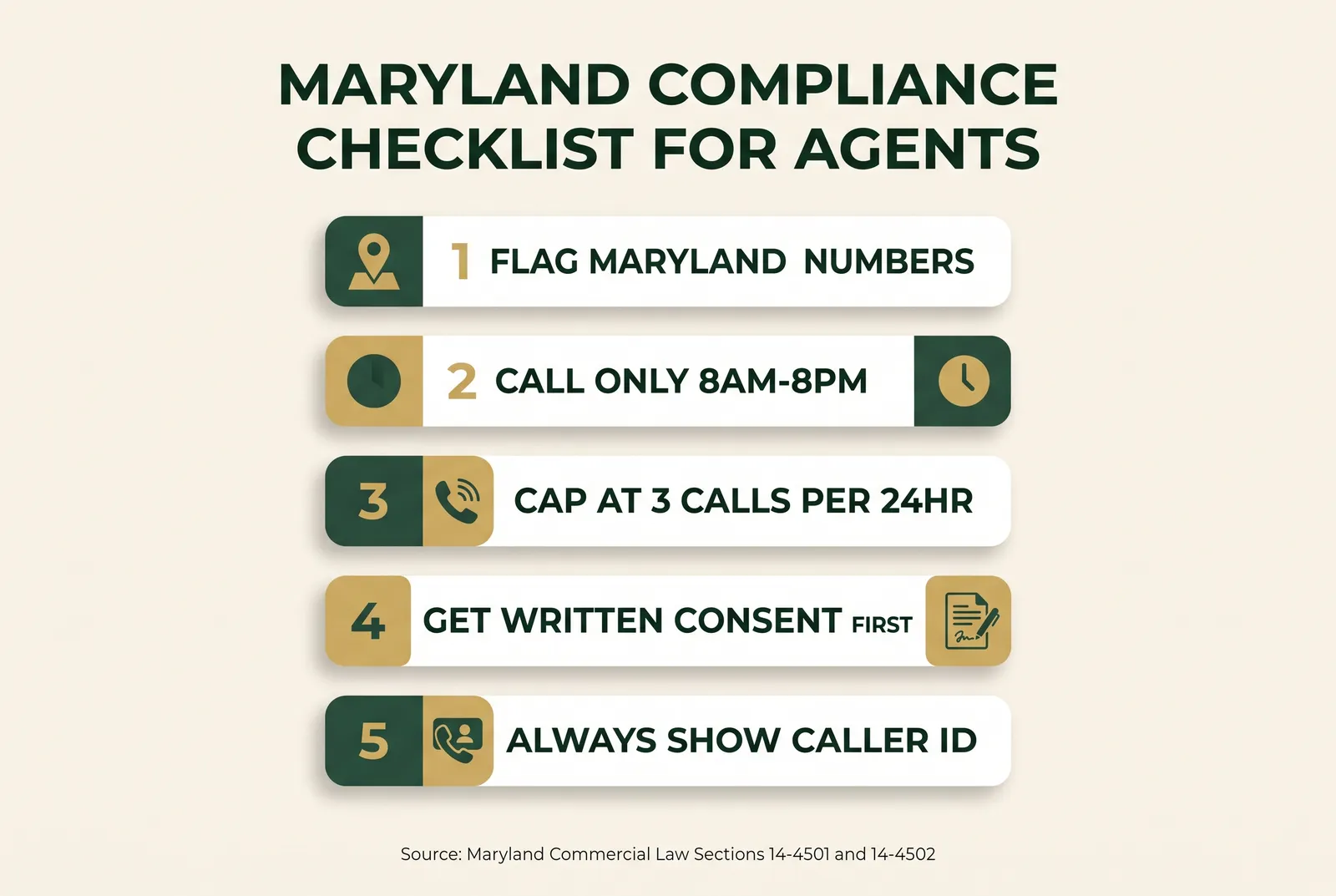
- Flag Maryland numbers in your list before you build any campaign. Area codes 240, 301, 410, and 443 cover Maryland, though the safest method is the called party’s stated or verified address, not just the area code, since ported numbers travel with people across state lines. A list that isn’t tagged by state can’t be governed by state-specific rules.
- Set your calling window to the narrowest rule that applies, not the loosest. If your list spans Maryland and looser states, run the whole batch inside Maryland’s 8 a.m.–8 p.m. window rather than maintaining two separate schedules that are easy to mix up under deadline pressure.
- Cap attempts at three per 24 hours per person, system-wide, regardless of which number placed the call. Track this against the called party, not the outbound line, since the statute explicitly says the cap applies “regardless of the telephone numbers used to make the call.”
- Collect and store prior express written consent before a Maryland number enters any automated campaign. The record needs the specific phone number and a disclosure that automated or artificial-voice calls may follow, per Section 14-4501’s own definition. A verbal “sure, go ahead” on an inbound call isn’t the same thing as a signed or e-signed written agreement.
- Never block or suppress your caller ID on outbound Maryland calls. Number warmup and spam-label management are legitimate practices for keeping your caller ID from getting flagged as spam by carriers; deliberately failing to transmit your number, or spoofing a different one to conceal your identity, is the specific conduct Section 14-4502 prohibits.
The objection you'll hear most
"We've been calling this list for years and nobody's ever sued us." That's true for a lot of agencies, and it's also exactly the logic that fails the day a called party who knows the statute, or an attorney working a volume TCPA practice, picks up the phone. Maryland's law has been on the books since January 1, 2024, long enough that plaintiff's firms specializing in TCPA and mini-TCPA claims have had time to build a practice around exactly this fact pattern in other states. The honest answer isn't "the odds are low." It's "the cost of building the calling window and the frequency cap into the system once is smaller than the cost of one bad afternoon on an untagged list."
You can build this yourself
A spreadsheet with a state column, a calling-hours filter, and a call-count formula gets a small agency most of the way there. Where it gets hard is scale: once a campaign runs across a few thousand numbers with mixed states, a shared outbound number pool, and multiple producers dialing the same list, tracking a per-person daily cap by hand stops being reliable, and a single missed count is a called party who can sue.
Hear it call you
Put your own number in and the AI calls you in seconds. It's the fastest way to hear how a calling-hours rule and a frequency cap actually sound when they're enforced automatically instead of tracked by hand.
The calling window, visualized
Maryland’s statute doesn’t leave the window ambiguous. Half the day is open for a covered solicitation call, and half is closed, with no exceptions carved out for insurance follow-up specifically.
Maryland's telephone solicitation calling window, in hours per day
Under Section 14-4502 of the Maryland Commercial Law Article, calls are permitted 8 a.m. to 8 p.m. and prohibited 8 p.m. to 8 a.m., in the called party's time zone.
Source: Maryland Commercial Law Article Section 14-4502, "Recorded Solicitations; Caller ID; Time Restrictions," via FindLaw.
How we solve it
TheAffordableAI runs outbound and inbound calling built to fit inside a calling window and a per-person frequency cap as system rules, not as a checklist a producer has to remember under deadline pressure. Number warmup and spam defense keep your caller ID transmitting cleanly, which is both a “Spam Likely” problem and, per Section 14-4502, a legal requirement in Maryland specifically. When a Maryland lead wants to talk it through, the call transfers warm to a licensed person on your team while they’re still on the line, and the call record, including consent notes, syncs back to your CRM, HighLevel included, automatically. The full rundown of number warmup, warm transfers, and CRM sync is on the features page.
Tracking Maryland's rules by hand
- A shared spreadsheet formula for a per-person daily cap, easy to break with one manual entry
- Calling-hours discipline depends on whoever's dialing remembering the narrower window
- Consent records live in whichever producer took the call, not always in the CRM
- A multi-state list needs someone to manually flag which rows are Maryland
ManualEvery safeguard depends on someone remembering it
The rules enforced at the system level
- An 8am–8pm window and a three-call cap that the platform itself won't dial outside of
- Caller ID transmits on every call by default, addressing both spam labeling and the statute
- Consent status, call disposition, and transcript land on the contact record automatically
- Warm transfer to a licensed agent the moment a Maryland lead wants to talk
AutomaticThe safeguard doesn't depend on memory under deadline pressure
Price it against your own list
Single Account runs $200 a month plus a $500 one-time setup, at $0.20 a minute. Agency runs $500 a month plus a $1,000 one-time setup, at $0.18 a minute, down to $0.16 at bulk. No contracts either way, so the cost of testing this against your own Maryland numbers is one month. See pricing.
What you get
3/day
Maryland's own frequency cap, enforced automatically per contact
$0.20
Per-minute rate, Single Account, from $0.15 at bulk
20+
Agents a warm transfer can ring on the Agency plan
0 mo
Contract length required. Cancel anytime.
Calling-window enforcement
Set the window once and the platform won't place a call outside it, no matter who's driving the campaign.
Per-contact frequency caps
The daily attempt count tracks the person, not the outbound line, matching how Maryland's statute is actually written.
Number warmup and spam defense
Caller ID transmits cleanly and consistently, addressing both carrier spam labeling and Maryland's caller ID rule.
HighLevel CRM sync
Disposition, transcript, and consent notes land on the contact record automatically, so nothing gets worked twice.
The compliance part, said plainly
Speed is not a reason to skip the rules, and automating your calling doesn’t move the responsibility off you.
Before you point any dialer, human or AI, at a Maryland list
- Automated, recorded, or artificial-voice calls to a Maryland number require prior express written consent under Section 14-4501, on top of whatever the federal TCPA already requires for a wireless number.
- The calling window is 8 a.m. to 8 p.m. in the called party's time zone, and the cap is three calls in 24 hours per person, regardless of which number placed the call.
- Never block or spoof your caller ID. Section 14-4502 requires transmitting it when your equipment is capable of doing so.
- National and internal Do Not Call obligations still apply on top of Maryland's statute; they don't replace it.
- For Medicare-related outreach, CMS marketing rules, including the TPMO disclaimer and call recording and retention requirements, apply in addition to everything above.
- Using an AI caller does not transfer liability. The licensed agent and agency remain responsible for consent, disclosure, and what's said on the call.
This is general information, not legal advice. Verify current requirements against the Maryland Commercial Law Article, the FCC's rules, and your own carrier and state obligations before running a large outbound campaign into Maryland.
Where this isn’t the right tool
An AI caller enforces the mechanical rules well: the window, the cap, the consent gate, the caller ID. It cannot tell you whether a given lead’s consent record actually meets Maryland’s written-consent standard, and it shouldn’t be trusted to make that call on its own. If your Maryland book is small enough to track in a spreadsheet you actually look at every day, that may be all you need; the cost of a platform isn’t worth it for a few dozen names a month. And if a Maryland client calls with a coverage question that needs real judgment rather than a scheduling confirmation, that conversation belongs with a licensed person, not an automated script, regardless of how well the automation handles the calling-hours math.
It’s also worth saying plainly that no calling platform, ours included, can retroactively fix a consent record that was never properly collected. If your list includes Maryland numbers pulled from an aged database or a lead source you can’t document consent for, the fix is upstream: get consent or drop the number, not find a faster way to call it anyway.
Where to start this week
- Tag every Maryland number in your active list. Area code alone isn’t reliable given number porting; cross-check against the called party’s stated or verified address where you can.
- Set your outbound calling window to 8 a.m.–8 p.m. for Maryland contacts specifically, even if your platform’s default is wider. If your list is mixed-state, the simplest fix is running the narrowest rule across the whole batch.
- Confirm your consent records actually meet Section 14-4501’s standard before any Maryland number goes into an automated campaign: a written or e-signed agreement naming the specific number and disclosing automated contact, not just a general opt-in checkbox from a lead form.
If you want to hear it before you decide anything
There's a demo call on the homepage. Put your own number in and the AI calls you in seconds, so you can hear exactly how a calling window and a frequency cap sound when they're built into the system instead of tracked in a spreadsheet. Hear a demo call, or go straight to pricing if you already know what you're testing.
Maryland’s rules aren’t complicated once you write them down: an 8 a.m.–8 p.m. window, three calls a day per person, written consent before automating anything, and your caller ID transmitting every time. What’s hard is holding all four of those at once, by hand, across a list that includes Maryland numbers mixed in with everyone else’s, every single day, without a single slip. That’s the part worth automating. The law itself isn’t going anywhere.
Frequently asked
What does Maryland's Stop the Spam Calls Act require for insurance sales calls?
It requires prior express written consent before you use an automated system, a recorded or artificial voice, or a prerecorded voicemail to reach a Maryland consumer, per Section 14-4501 of the Maryland Commercial Law Article. Beyond consent, Section 14-4502 sets three hard rules for any covered telephone solicitation: no calls between 8 p.m. and 8 a.m. in the called party's time zone, no more than three calls to the same person in a 24-hour period on the same subject matter regardless of which number you call from, and you cannot block or fail to transmit your caller ID or intentionally alter your voice to conceal who's calling.
What are the legal calling hours for telemarketing in Maryland?
8 a.m. to 8 p.m. in the called party's time zone, under Section 14-4502 of the Maryland Commercial Law Article. That is a full four hours narrower than the old default telemarketing window most agents know from the federal Telemarketing Sales Rule, which runs 8 a.m. to 9 p.m. Calling a Maryland consumer at 8:15 p.m. because you're used to a 9 p.m. cutoff elsewhere is a violation under Maryland's statute even if it would be fine in a state without its own restriction.
How many times can I call the same Maryland lead in a day?
Three times in a 24-hour period on the same subject matter, and that cap applies regardless of the telephone numbers used to make the call, according to Section 14-4502. Spreading calls across multiple outbound lines to route around the cap doesn't work under the statute's own language; the limit tracks the called party and the subject matter, not the number you dialed from.
What happens if I violate Maryland's telemarketing law?
Two enforcement paths run at once. Under Section 14-4503, the called party can sue directly to stop further violations and recover up to $500 or actual damages, whichever is greater, and a court can triple that award, up to three times the amount, if it finds the violation was willful or knowing. Separately, a violation is an unfair, abusive, or deceptive trade practice under Title 13 of the Commercial Law Article, which carries its own civil penalty of up to $10,000 per violation, or up to $25,000 for a repeat violation, under Section 13-410.
Does Maryland's telemarketing law apply to AI voice calls?
Yes. Section 14-4502 covers the playing of a recorded or artificial voice message when a connection is completed, which is exactly how an AI voice call works, and the FCC's February 2024 declaratory ruling separately confirmed that an AI-generated voice counts as an 'artificial voice' under the federal TCPA's own consent requirement. An AI caller doesn't get a different set of rules than a human dialer or a prerecorded message campaign; it gets the same rules, applied to the same mechanism.
Is Maryland's law stricter than the federal TCPA?
In some ways, yes. The federal TCPA, at 47 U.S.C. Section 227, requires prior express consent for automated or artificial-voice calls to a wireless number but doesn't itself set a calling-hours window or a daily frequency cap; those come from the FCC's Telemarketing Sales Rule and Do Not Call rules layered on top. Maryland's statute bakes a calling window, a frequency cap, and a caller ID rule directly into state law, with its own private right of action on top of whatever a called party could already pursue federally. Complying with the federal floor does not automatically mean you're compliant with Maryland's narrower window and explicit call cap.
Do I need written consent to text Maryland leads too?
The definition of prior express written consent in Section 14-4501 explicitly covers a telephone solicitation delivered by telephone call, text message, or voicemail, so yes, an automated text campaign to a Maryland consumer falls under the same consent standard as an automated call. The written agreement has to name the specific phone number being contacted and disclose that the called party may receive calls using an automated system or a recorded or artificial voice.
Can an AI caller keep me compliant automatically?
A platform can enforce a calling window and a daily frequency cap as system rules so a Maryland number simply can't be dialed outside 8 a.m. to 8 p.m. or a fourth time in 24 hours, and it can require documented consent before a number enters an automated campaign in the first place. What it can't do is decide for you whether a given contact actually has prior express written consent on file, or take on your liability if it doesn't. That judgment, and the responsibility for it, stays with the licensed agent and agency.
Sources
- Maryland Commercial Law Article Section 14-4502 — Recorded Solicitations; Caller ID; Time Restrictions (via FindLaw)
- Maryland Commercial Law Article Section 14-4503 — Violation; Construction With Other Law (via FindLaw)
- Maryland Commercial Law Article Section 14-4501 — Definitions (via FindLaw)
- Maryland Commercial Law Article Section 13-410 — Civil Penalties (via FindLaw)
- Maryland General Assembly — House Bill 37 (2023), Stop the Spam Calls Act of 2023, Chapter 414
- Kelley Drye Ad Law Access — Maryland's New Telemarketing Law Now in Effect
- FCC — FCC Makes AI-Generated Voices in Robocalls Illegal (Declaratory Ruling FCC 24-17, adopted February 2, 2024, released February 8, 2024)
- Cornell Law School Legal Information Institute — 47 U.S.C. Section 227, Telephone Consumer Protection Act
- TheAffordableAI — Pricing
Put this on your own phone line
See the AI dial, qualify, and warm-transfer a live call in under a minute. No contract, no dev work.
Keep reading
Georgia Telemarketing Law for Insurance Agents (2026)
SB 73 added vicarious liability and class actions to Georgia's telemarketing law. What changed, what a violation costs, and how agents stay compliant.

Virginia Telemarketing Law 2026: Insurance Agent Guide
Virginia's telemarketing law changed January 1, 2026: new opt-out rules, caller ID standards, and joint liability. Here's what insurance agents must do.

Why Your Outbound Number Says 'Spam Likely' — and How to Get It Clean Again
A flagged number quietly destroys a calling operation. Nobody tells you it happened; the pickups just stop. Here is what causes the label, how carriers decide, and the warmup routine that keeps a number healthy.