Washington Telemarketing Law for Insurance Agents (2026)
Washington's telemarketing law does not exempt insurance agents, and one bad call can carry a flat $1,000 penalty. Here is what actually applies to you.

Washington’s telemarketing law does not exempt licensed insurance agents. Chapter 19.158 RCW excuses agents from registering as a commercial telephone solicitor, but the two statutes that actually control how a call has to run, RCW 80.36.390 and RCW 80.36.400, apply to insurance sales calls exactly the way they apply to any other commercial solicitation, and one of them names individual insurance agents directly. A violation carries a floor of $1,000 in damages per call, with no judicial discretion to award less, on top of whatever the federal TCPA already exposes you to. If you or a vendor you use calls into Washington, the state adds its own rules on top of federal ones, and most of the compliance content written for insurance agents skips this state entirely.
The short version
- Washington exempts licensed insurance agents from registering as a telephone solicitor, but not from the actual solicitation rules.
- RCW 80.36.390 treats each individual agent's separate calling list as its own "company" for compliance purposes.
- Violating RCW 80.36.390 or RCW 80.36.400 carries a $1,000-per-violation floor, higher than the federal TCPA's $500 floor, with no discretion to award less.
- The 8am-to-8pm calling window is measured against the recipient's local time, not the caller's, which matters if you call Washington numbers from another time zone.
- Texts to Washington numbers run under a separate law, the Commercial Electronic Mail Act, with its own damages figure.
Are insurance agents exempt from Washington’s telemarketing law?
Only from one part of it. Washington actually has three separate statutes that touch telemarketing, and licensed insurance agents are treated differently under each one.
Chapter 19.158 RCW is the registration law: before doing business as a commercial telephone solicitor in Washington, a caller generally has to register with the Department of Licensing, post a bond, and pay an annual fee. That chapter carries a specific carve-out for licensed professionals, including insurance agents, so you do not need to register with the state just because you call leads for a living. This is the exemption most agents have actually heard about, usually secondhand from a lead vendor or a compliance blog post, and it is real.
RCW 80.36.390 and RCW 80.36.400 are different statutes entirely, tucked into Title 80 (public utilities) rather than Title 19 (business regulation), and neither one carries an insurance exemption. RCW 80.36.390 covers what a live telephone solicitation call has to do: identify the caller and the purpose of the call within 30 seconds, stay inside an 8am-to-8pm window, and honor removal requests. RCW 80.36.400 covers automatic dialing and announcing devices, meaning any system that dials a number and plays a recorded or artificial-voice message, and bans using one for commercial solicitation outright unless an exemption or valid consent applies. Both statutes go out of their way to say who they cover, and insurance agents are on the list, not off it.
The line most agents miss
"Exempt from registering as a telephone solicitor" and "exempt from the telemarketing law" are not the same sentence, even though they sound like they should be. Washington split those two things into different chapters on purpose, gave insurance agents the registration exemption, and kept them squarely inside the conduct rules. A compliance summary that only mentions the Chapter 19.158 exemption is telling you half of the actual law.
Why Washington treats your calling list like a company
RCW 80.36.390 contains one sentence that changes how the rest of the statute applies to an individual producer: each individual real estate agent or insurance agent who maintains a separate calling list from other agents is treated as its own company or organization for purposes of the statute. That single line means the law does not look at your agency as one entity with one obligation. It looks at your personal list, the one you or your dialer works from, as its own regulated operation, with its own 30-second identification requirement, its own calling-window obligation, and its own one-year do-not-call retention duty, independent of what any other agent at your shop is doing with their list.
A few terms are worth defining once, since the rest of this piece leans on them. An automatic dialing and announcing device, under RCW 80.36.400, is a system that dials numbers on its own and plays a recorded or artificial-voice message, and since the 2023 amendment that definition explicitly reaches a message that only lands in someone’s voicemail, not just a live pickup. Commercial solicitation means an unsolicited call made to encourage a purchase or investment, or one that otherwise tries to get something of value from the person called. A disposition is the outcome code your CRM or dialer logs against a call attempt, such as “no answer” or “left message,” and under Washington law that log is also your evidence trail if a complaint ever gets filed. Washington’s own version of these amendments took effect July 23, 2023, under House Bill 1051, which tightened the autodialer definition, added a requirement to honor the federal Do Not Call registry directly in state law, and raised the statutory damages floor from what had been $100 per violation up to today’s $1,000.
That last change is the one that changes the math most. Before 2023, a Washington solicitation violation carried a comparatively small statutory minimum. HB 1051 raised it tenfold, specifically because, as the legislature stated in adopting the bill, robocalls and abusive telephone solicitation had become common enough that the existing penalty no longer deterred anyone. The new floor applies to every call made after the effective date, regardless of how long the caller has been running the same list the same way.
What a violation actually costs
A single violation of RCW 80.36.390 or RCW 80.36.400 carries a floor of $1,000 in damages, and the court does not get to award less than that even if the actual harm was trivial. The statute reads that an injured person may recover “actual damages or $1,000 per violation of this section, whichever is greater,” which means $1,000 is not a cap, it is the minimum. Compare that to the federal TCPA, where 47 U.S.C. § 227(b)(3) sets the private right of action at $500 per violation, with courts having discretion, not an obligation, to treble that to as much as $1,500 if the violation was willful or knowing. Washington’s floor sits above the federal floor before any multiplier is even considered, and because a solicitation call to a Washington number can violate state and federal law at the same time, the exposure from one bad call is not limited to whichever statute has the bigger number.
| Law | Base damages | With willful/knowing multiplier |
|---|---|---|
| RCW 80.36.390 / 80.36.400 (Washington) | Actual damages or $1,000, whichever is greater — no judicial discretion to go lower | Up to $25,000 (treble under WA Consumer Protection Act, RCW 19.86) |
| Federal TCPA, 47 U.S.C. § 227(b)(3) | Actual monetary loss or $500, whichever is greater | Up to $1,500 (court's discretion, willful/knowing only) |
| RCW 19.190 (texts, Commercial Electronic Mail Act) | Actual damages or $100, whichever is greater | Separate statute; applies to texts, not calls |
Sources: Washington RCW 80.36.390, RCW 80.36.400, and RCW 19.190 (current text, app.leg.wa.gov); 47 U.S.C. § 227(b)(3) via Cornell Legal Information Institute. Washington's Consumer Protection Act treble-damages cap of $25,000 per violation is separate from and layered on top of the $1,000 statutory floor.
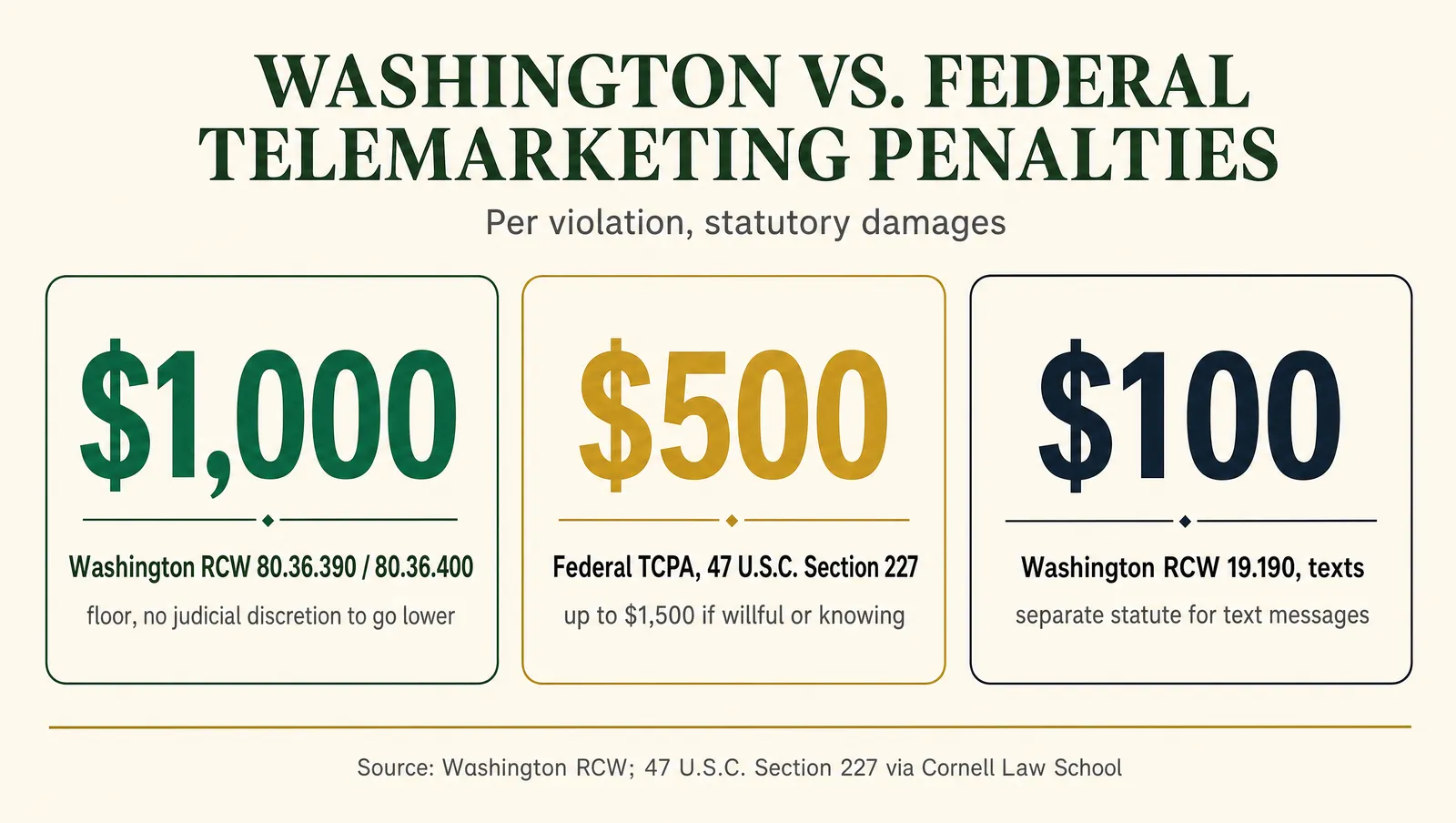
Statutory damages floor, per violation
Base damages before any willful/knowing multiplier is applied
Sources: Washington RCW 80.36.390, RCW 80.36.400, and RCW 19.190 (current text, app.leg.wa.gov); 47 U.S.C. § 227(b)(3) via Cornell Legal Information Institute. Washington's $1,000 call floor has no judicial discretion to go lower; the federal $500 floor can rise to $1,500 only if a court finds the violation willful or knowing.
Scale matters here too. The Washington Attorney General’s office reported that in 2024, the Federal Trade Commission received more than 80,000 complaints from Washington consumers about unwanted calls, a number the AG’s own consumer protection page cites when explaining why the state keeps tightening this statute rather than leaving it alone. That is complaint volume, not lawsuits, but it is also the pool a plaintiff’s attorney or the Attorney General’s office draws from when deciding which calling patterns to look at. A $1,000 floor sounds survivable on a single call. It stops sounding survivable once you multiply it across a list of a few hundred numbers dialed the same non-compliant way.
Run the arithmetic on a realistic campaign. Say an agency buys a list of 400 Washington leads and runs the same automated opening message to every one of them, without checking whether the 30-second identification rule is actually satisfied by the script. If even 5% of those calls, 20 of them, land with someone who notices the missing disclosure and files a complaint or a demand letter, the $1,000 floor alone puts the exposure at $20,000, before anyone raises the Consumer Protection Act’s treble-damages provision or before a plaintiff’s attorney aggregates the other 380 calls into the same claim. Compare that to the cost of fixing the script: rewriting one opening line so it names the caller, the company, and the purpose within 30 seconds costs nothing beyond the time it takes to say it out loud once and check the clock. The lopsided part of this math is not the $1,000 number itself, it is that the fix is nearly free and the exposure compounds per call, not per campaign.
| Scenario | Assumption | Statutory floor exposure |
|---|---|---|
| Missed 30-second ID rule only | 5% of 400 calls (20) draw a complaint under RCW 80.36.390 | ≈ $20,000 |
| Same calls, also using an unregistered autodialer | Same 20 calls also violate RCW 80.36.400's autodialer ban | ≈ $40,000 |
| Cost to prevent it | Rewrite the opening line; add a time-zone gate to the dialer | Near $0 |
Illustrative worked example using the $1,000-per-violation statutory floor set by RCW 80.36.390 and RCW 80.36.400 (app.leg.wa.gov). The 5% complaint-rate assumption is a stated illustration for this article, not a benchmark or a prediction for any specific list; actual complaint and litigation rates vary and most non-compliant calls never generate a claim at all.
Violations stack, they do not average out
A call that both skips the 30-second identification and uses an unregistered autodialer to leave a recorded message can trigger RCW 80.36.390 and RCW 80.36.400 independently, meaning $1,000 plus $1,000 as a starting point, before anyone even raises the Consumer Protection Act's treble-damages provision. If the same lead also gets a follow-up text, that is a third statute, RCW 19.190, with its own separate damages. This is general information about how the statutes are structured, not a prediction of any specific outcome, and it is not legal advice.
The rules in plain English
Washington’s solicitation rules boil down to four operational requirements, and every one of them is checkable against a call log after the fact, which is exactly how a violation gets proven.
| Rule | What it requires | Where it bites |
|---|---|---|
| 30-second identification | State your name, the company or organization you're calling for, and the purpose of the call within the first 30 seconds | A script that opens with rapport-building before the pitch can blow past 30 seconds without anyone noticing |
| Calling window | No calls before 8am or after 8pm, measured at the recipient's local time | Calling from a different time zone without mapping each number to its own local time |
| Removal request | Honor a stop request by removing the number from the calling list for at least one year | A per-channel opt-out that does not also stop a different rep or a different list at the same shop |
| National registry | Do not call numbers on the federal Do Not Call registry; written into state law directly by the 2023 amendment | A purchased list that was not scrubbed against the registry before it reached your dialer |
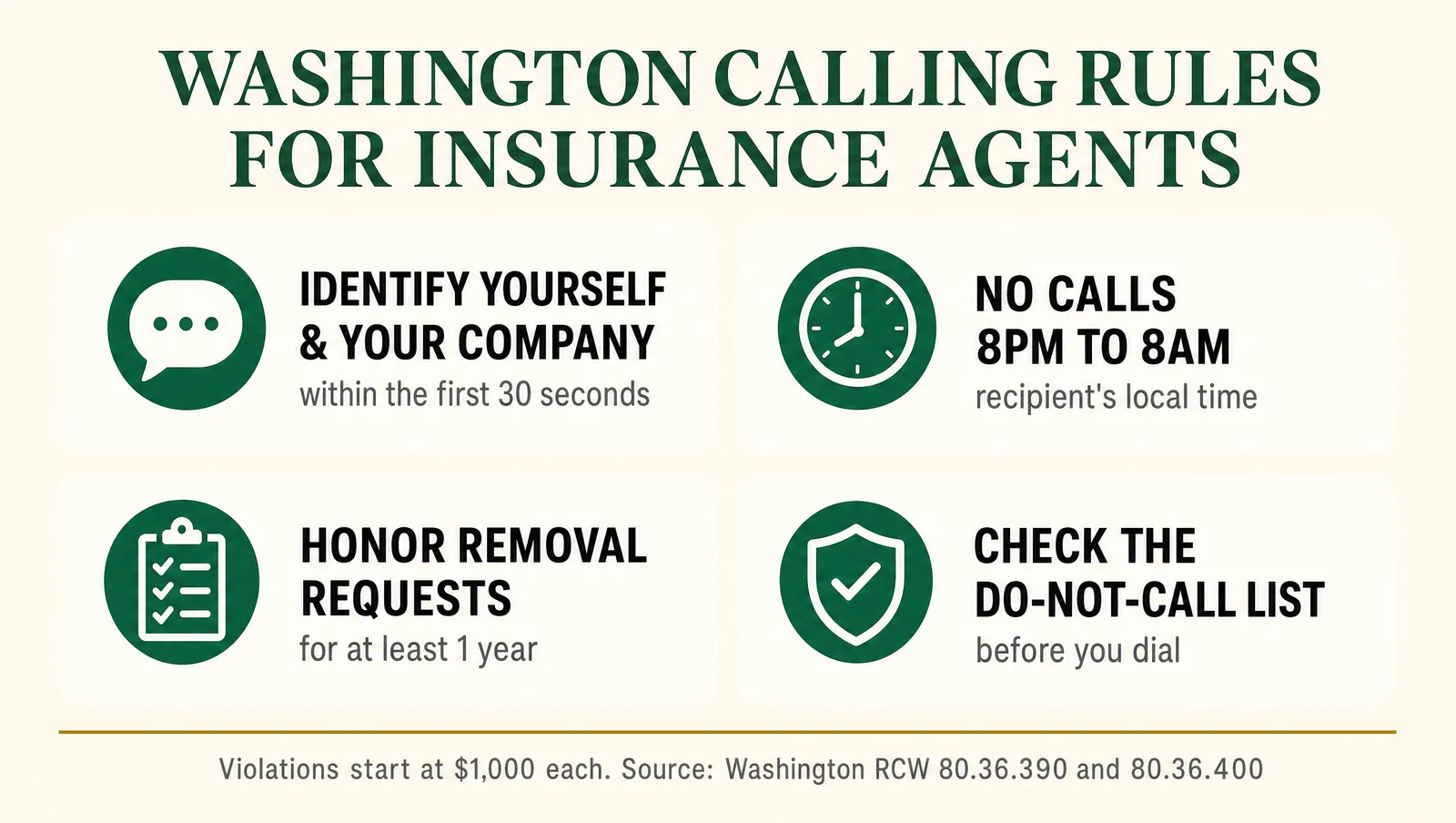
Notice that none of these four rules require an autodialer or a recorded message to be in play. They apply to a live agent making a live call off a spreadsheet just as much as they apply to an automated system. RCW 80.36.400’s autodialer ban is a separate, additional restriction that only kicks in once a recorded or artificial-voice message enters the picture. A shop that never uses prerecorded messages still has to clear all four rules in the table above on every single call.
What this means differently for a solo producer vs. an agency
The “separate list” language in RCW 80.36.390 changes who the regulated entity actually is, and that answer depends on how the calling operation is structured, not on the size of the agency.
If you are a solo producer working your own list, off your own dialer or spreadsheet, you personally are the “company” the statute is measuring. Every one of the four rules in the table above applies to your list specifically, and a clean record on your own calls does not depend on what anyone else at a larger agency you’re affiliated with is doing on theirs.
If you work at an agency where several producers share one CRM and one calling list, the analysis shifts. The statute’s “separate list” language exists to stop a company from hiding behind individual agents’ names while running what is functionally one shared operation; it does not say a shared list somehow escapes regulation entirely. In practice, a shared list run by an agency is regulated the way any other business’s telemarketing is regulated under RCW 80.36.390 and RCW 80.36.400, with the agency itself as the entity whose conduct gets measured, and with vicarious liability able to reach the agency for how its reps handle calls made on its behalf. The individual-list language mainly matters for the producer who keeps their own separate book and dials it themselves, outside any shared agency system. Either way, the compliance requirements in this article, the identification line, the calling window, the do-not-call retention, apply regardless of which structure you’re in. What changes is who ends up named if something goes wrong: you personally on a separate list, or the agency on a shared one, with individual producers still exposed depending on their own role in placing the call.
This is also where a managed calling platform earns its keep at the agency level rather than the individual level. A platform that enforces the same identification script, the same calling-window logic, and the same opt-out propagation across every producer’s calls removes the inconsistency that shows up when five different reps each interpret “identify yourself within 30 seconds” a little differently. One configured system behaving the same way for every seat is easier to defend than five people each doing their own version of “close enough.”
How to build a Washington-compliant calling operation
Start with consent, because everything downstream depends on it. Capture and timestamp the specific consent you are relying on for each Washington lead, whether that is prior express written consent for an autodialed or prerecorded call, or a lower bar of implied consent for a live agent call to an existing customer relationship, and store it attached to the record, not in a separate spreadsheet that nobody checks before dialing.
Next, build the 30-second identification into the actual opening line of the script, not as a compliance afterthought read after the pitch. “Hi, this is [name] with [agency], calling about the [coverage type] request you submitted” covers name, organization, and purpose in one breath, and it fits comfortably inside the 30-second window with room to spare.
Then fix the calling window at the number level, not the caller level. Attach a time zone to every Washington number in your list, based on area code or a lookup service, and block outbound dialing to that number outside 8am to 8pm in that zone, regardless of what time it is where the call originates. This is the single most common way an out-of-state calling operation ends up violating Washington law without realizing it, because the caller’s own clock says it’s a perfectly reasonable hour.
Scrub every purchased or aged list against the national Do Not Call registry before it reaches a dialer, and maintain your own internal suppression list separately, with removals kept for at least a year past the request, per Washington’s own retention rule. When someone asks to stop, that request should silence every future touch on every channel and every list at your shop tied to that number, not just the one the request came in on.
Finally, log every attempt with a timestamp, the disposition, and which script version ran. If a complaint or a demand letter ever arrives, the fastest way to show a court or the Attorney General’s office that a violation was isolated rather than a pattern is a clean log that shows the rest of the campaign following the rules. None of this requires a lawyer to set up once, but if you are running any real volume into Washington, a short review by counsel licensed in the state is worth the cost before you scale it, because this article is general information, not legal advice specific to your operation.
See what a compliant call actually sounds like
There is a live demo call on the homepage. Put your own number in and the AI will call you in seconds, opening line and all, so you can hear how the identification and disclosure actually sound before you decide anything.
Where AI calling helps here, and where it doesn’t
A managed calling platform is genuinely good at the part of this that is mechanical: opening every call with the same compliant identification line, refusing to dial a Washington number outside its recipient’s local 8am-to-8pm window, propagating a stop request across every remaining touch the instant it happens, and keeping a timestamped log of every attempt without anyone having to remember to write it down. That is exactly the kind of consistency a busy human operation loses first, especially once volume climbs past what one person can track by hand.
It is not good at, and cannot be good at, fixing consent that was never actually obtained. If the underlying list was bought without valid consent, or the person on it revoked consent three calls ago and nobody updated the record before it was uploaded, no platform, AI or otherwise, makes that call legal. The technology enforces the rules you configure it to follow; it does not audit whether the list you handed it was clean in the first place, and it does not change who Washington law holds responsible if it wasn’t. If you are calling a small, personal list of leads you already have a real relationship with, a disciplined agent with a written script and a calendar reminder to check the clock can follow every rule in this article by hand, and paying for a platform is not worth it yet. The case for automating this gets stronger once you are running enough volume that a missed identification line or a wrong-time-zone call becomes a when, not an if.
How we solve it
TheAffordableAI runs the mechanical half of a compliant calling operation so the rules in this article apply the same way on call one and call ten thousand. The AI caller opens every call with a scripted identification, respects calling-window rules by recipient, and syncs consent status, dispositions, and opt-outs to your HighLevel CRM automatically, so a stop request on one channel actually silences the rest instead of depending on someone remembering to update a second system. Number warmup and spam defense run in the background so the calls keep landing instead of getting flagged before the disclosure ever gets a chance to play. A Single Account runs $200 a month plus a $500 one-time setup at $0.20 a minute, down to $0.15 at bulk volume; an Agency plan that routes to 20 or more agents at once runs $500 a month plus a $1,000 one-time setup at $0.18 a minute, down to $0.16 at bulk. Both are month to month, no contracts, cancel anytime. You can build the same disclosure logic yourself with a dialer and a scripted opening line. Plenty of agencies do. It is worth pricing both before you decide, and none of this replaces getting valid consent in the first place.
What you get
30s
Identification window built into the opening line of every call, every time
1
Kill switch that silences a lead across calls, texts, and every future touch on opt-out
$0.20/min
Single Account rate, down to $0.15 at bulk volume
theaffordableai.com/pricing, verified Sept. 29, 2026
24/7
Recipient-local calling-window enforcement, not the caller's own clock
Washington did not carve out an exception for insurance agents. It carved out an exception from one paperwork requirement, and left the actual rules in place.
Mike MooreThe compliance part, said plainly
Before you call a single Washington number
- Automated or prerecorded calls and texts to a cell phone require prior express written consent for marketing under the federal TCPA, on top of whatever Washington's own rules require. Consent is the agent's obligation, and it does not transfer to a vendor or a platform.
- Washington's RCW 80.36.390 and RCW 80.36.400 do not exempt licensed insurance agents, and each individual agent's separate calling list is treated as its own company under the statute. RCW 19.158's registration exemption for licensed agents is a different, narrower carve-out and does not extend to these conduct rules.
- The 8am-to-8pm calling window is measured against the recipient's local time, and violations of either statute carry a $1,000-per-violation floor with no judicial discretion to award less, on top of possible treble damages under the state's Consumer Protection Act.
- For Medicare-related calls, CMS layers additional marketing rules on top of everything above, including TPMO disclosure obligations; review the current CMS Medicare Communications and Marketing Guidelines before running any Medicare-related campaign into Washington.
- Using an AI calling platform does not transfer liability away from the licensed agent or the business on whose behalf the call is made. The licensed producer stays responsible for consent, disclosure, and compliance.
- Honor the National Do Not Call Registry and any internal do-not-call list, and never build a Washington calling campaign around cold calling; every rule in this article assumes the person already has some relationship to the call, not that they are a cold, unconsented contact.
This is general information about how Washington's statutes are structured, not legal advice. Verify against current Washington RCW text, FCC and CMS guidance, and counsel licensed in Washington before you launch or scale a calling campaign into the state.
The questions this raises next
What if my lead list mixes Washington numbers with numbers from states that have no similar law? Build the compliance logic at the number level, not the campaign level. A calling system that checks each number’s state and time zone before dialing can apply Washington’s rules only to Washington numbers, rather than either ignoring the state entirely or slowing every call in the country down to Washington’s stricter window.
Does area code alone tell me if a number is actually in Washington? Not reliably. Ported numbers and VoIP lines can carry an area code from a state the person no longer lives in, or vice versa. A time zone or address on file from the lead’s own submission is a better signal than area code alone, and for calls near the edges of the 8am-to-8pm window, it is worth erring toward the more conservative estimate.
Is a warm, previously-consented customer relationship different from a cold solicitation under this law? RCW 80.36.390 and RCW 80.36.400 are written around “commercial solicitation” broadly, and the identification and calling-window rules do not carry an explicit exception for existing customers the way some federal consent rules do. Treat every Washington call, including to existing clients about a renewal or a new product, as subject to the same identification and timing rules, and separately confirm what level of consent that specific type of call actually requires.
What about calls to a Washington business number instead of a consumer? The statutes are written around “commercial solicitation” generally and do not limit themselves to residential lines the way some federal DNC rules do, so treat business numbers in Washington under the same identification and timing rules until you have a specific reason, backed by the actual statute language, to treat a given call differently.
Does any of this change during Medicare’s Annual Enrollment Period? The Washington-specific rules in this article do not change by season, but the CMS marketing rules layered on top of them for Medicare-related calls do get more detailed during AEP, October 15 through December 7, and OEP, January 1 through March 31. Build the Washington compliance logic once, then run it against your current CMS checklist for whichever enrollment period you’re calling during.
Washington did the opposite of what most agents assume: it left the paperwork exemption for licensed insurance agents in one narrow chapter, and kept the actual solicitation rules, the $1,000 floor, the 30-second clock, and the recipient’s-local-time calling window, fully in force everywhere else. The fix is not complicated. It is a script that identifies the caller in the first breath, a calling window keyed to the lead’s clock instead of yours, and an opt-out that actually sticks the first time. Build that once, and Washington stops being the state your compliance summary forgot.
Frequently asked
Are Washington insurance agents exempt from the state's telemarketing law?
Only partly. Chapter 19.158 RCW, the commercial telephone solicitor registration and bond law, exempts licensed insurance agents from having to register with the Washington Department of Licensing. But RCW 80.36.390 and RCW 80.36.400, the statutes that actually govern how a solicitation call has to run, do not exempt insurance agents. RCW 80.36.390 goes further and specifically states that each individual insurance agent who keeps a separate calling list is treated as its own company or organization under the statute. Registration exemption and conduct-rule exemption are two different things, and agents who only know about one of them are exposed on the other.
What is RCW 80.36.400 and does it apply to insurance sales calls?
RCW 80.36.400 bans using an automatic dialing and announcing device for commercial solicitation in Washington. Since a 2023 amendment (HB 1051, effective July 23, 2023), the definition explicitly covers a recorded or artificial-voice message even if it only reaches the recipient's voicemail. It applies to any commercial solicitation call, and nothing in the statute carves out insurance sales. A prerecorded or synthetic-voice sales message to a Washington cell or landline without the required consent is a violation regardless of who is selling what.
How much can a single violation of Washington's telemarketing law cost?
The statute sets a floor, not a ceiling: a person injured by a violation of RCW 80.36.390 or RCW 80.36.400 can recover actual damages or $1,000 per violation, whichever is greater, and courts have no discretion to award less than that $1,000 floor. Violations also count as unfair or deceptive acts under Washington's Consumer Protection Act (RCW 19.86), which allows treble damages up to $25,000 per violation for a willful pattern. Compare that to the federal TCPA, where 47 U.S.C. § 227(b)(3) sets private-action damages at $500 per violation, trebled to at most $1,500 only if the violation was willful or knowing. Washington's floor is higher than the federal floor, and a single bad call can trigger both statutes independently.
Does Washington's do-not-call rule work differently from the national registry?
They stack. Federal law already requires honoring the national Do Not Call registry, and the 2023 amendment to RCW 80.36.390 wrote that same requirement into Washington law directly, plus a state-specific rule: once someone asks a caller to stop, that caller has to remove them from the calling list for at least one year, on top of and separate from anything the national registry requires. A caller who is clean on the national registry but keeps calling someone who asked a Washington-based rep to stop three months ago is still exposed under state law.
What has to happen in the first 30 seconds of a call to a Washington lead?
The caller has to identify themselves by name, identify the company or organization they are calling on behalf of, and state the purpose of the call, all within the first 30 seconds. This is a Washington-specific rule under RCW 80.36.390 and it applies on top of, not instead of, any federal or CMS disclosure rule that might also apply to the same call. A script that opens with small talk, a pitch, or a scripted pause before identification risks missing that window.
Can I call a Washington lead before 8am or after 8pm if I'm calling from a different time zone?
No. RCW 80.36.390 measures the calling window, 8am to 8pm, against the call recipient's local time, not the caller's. An agent in Florida calling a Seattle number at what feels like a reasonable 9am Eastern is calling a Washington resident at 6am Pacific, which is outside the legal window. Any calling system pulling Washington numbers needs the recipient's time zone attached to the record, not just the caller's own clock.
Does texting a Washington lead fall under the same rule as calling?
No, texts run under a different Washington statute with different numbers. Commercial text messages to Washington cell numbers are governed by the Commercial Electronic Mail Act (RCW 19.190), which explicitly covers text messages sent to a phone or pager with SMS capability. Its private-action damages are $100 per message or actual damages, whichever is greater, separate from the $1,000 floor under RCW 80.36.390 and RCW 80.36.400 for calls. A cadence that mixes calls and texts to the same Washington lead can accumulate exposure under two different statutes at once.
Does using an AI calling platform remove my liability under Washington law?
No. Using AI to place or manage the calls does not transfer liability away from the licensed agent or the business whose behalf the call is made on. A platform can be built to enforce the 30-second disclosure, block calls outside the recipient's local 8am-to-8pm window, and propagate an opt-out across every future touch automatically, which removes the kind of human error that causes most violations. It cannot make a call legal that started from consent that was never actually obtained, and it does not change who Washington law holds responsible when something goes wrong.
Sources
- Washington RCW 80.36.390 — Telephone solicitation, current text
- Washington RCW 80.36.400 — Automatic dialing and announcing devices, current text
- Washington Chapter 19.158 RCW — Commercial Telephone Solicitation (registration, bond, exemptions)
- Washington HB 1051 (2023), enrolled session law — robocalling and telephone scams amendments, effective July 23, 2023
- Washington RCW 19.190 — Commercial Electronic Mail Act (text message coverage and damages)
- Washington State Office of the Attorney General — Robocall and Telemarketing Scams
- 47 U.S.C. § 227(b)(3), Cornell Legal Information Institute — TCPA private right of action damages
- TheAffordableAI — Pricing (verified Sept. 29, 2026)
Put this on your own phone line
See the AI dial, qualify, and warm-transfer a live call in under a minute. No contract, no dev work.
Keep reading
Georgia Telemarketing Law for Insurance Agents (2026)
SB 73 added vicarious liability and class actions to Georgia's telemarketing law. What changed, what a violation costs, and how agents stay compliant.

Oregon Telemarketing Law 2026: Insurance Agent Guide
Oregon's HB 3865 caps telemarketing calls and texts at 8am-8pm and 3 a day. What changed, what a violation costs, and how insurance agents comply.
FCC One-to-One Consent Rule Is Dead: Insurance Leads Now
The FCC's one-to-one consent rule is vacated and repealed. Here is what changed, what didn't, and how to vet an insurance lead vendor's consent in 2026.