Tennessee Telemarketing Law for Insurance Agents (2026)
Tennessee's HB 2408 caps automated insurance calls at 10,000 a month and requires reporting at 500. What changed, what it costs, and how agents comply.

Yes, it’s still legal to call an insurance lead in Tennessee. What changed on July 1, 2026 is narrower than a calling-hours law like Oregon’s or Georgia’s, but it lands squarely on any agency running automated or AI-voice outbound at real volume: Tennessee Code Annotated Section 65-4-411, created by House Bill 2408 (Public Chapter 1029), caps a person or entity at 10,000 “telephone solicitations” a month if those calls use an automated telephone dialing system to deliver an artificial or prerecorded voice message to a Tennessee residential subscriber. Cross 500 a month, and starting October 1, 2026, you owe the Tennessee Public Utility Commission a volume report twice a year. This article walks through exactly what the statute says, why it’s a live question whether an AI voice agent counts the same way a decades-old prerecorded robocall does, what a violation costs, who’s actually close to the 10,000 line, and how an agency calling Tennessee leads stays inside it.
The short version
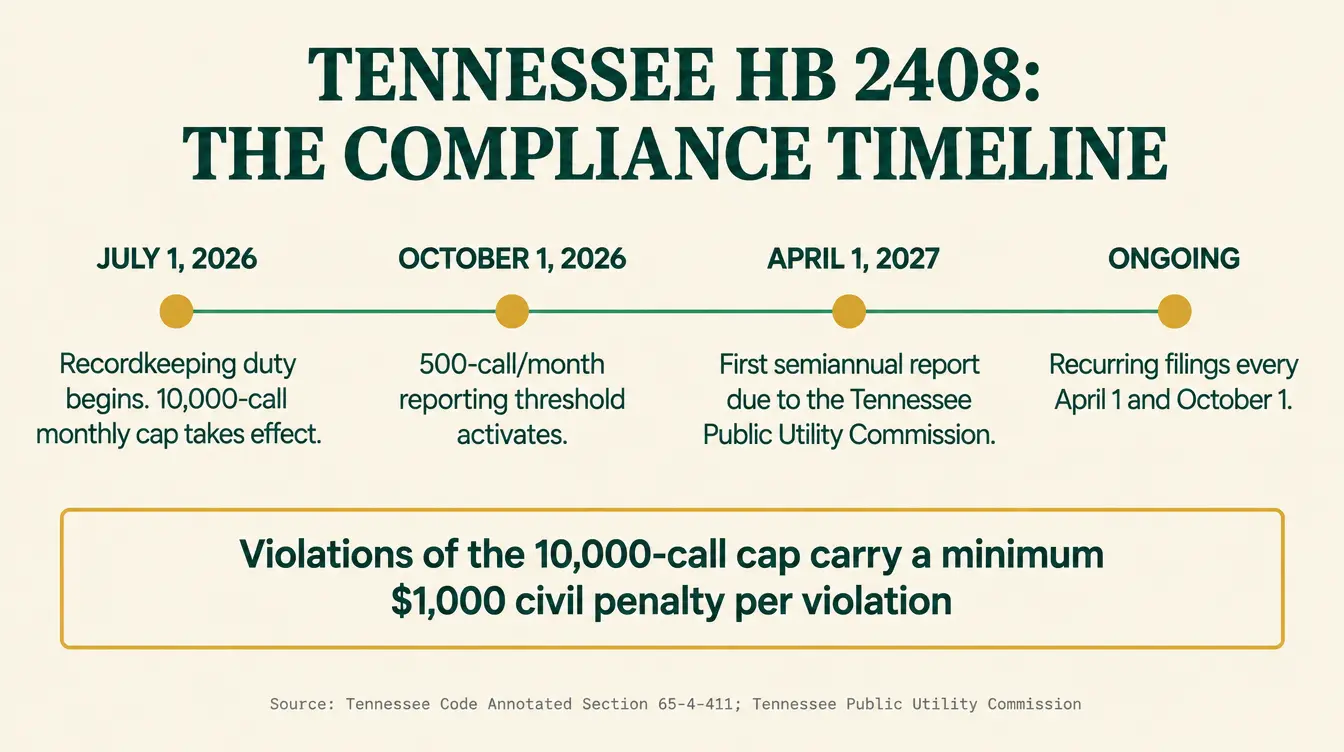
- Tennessee House Bill 2408, signed by the governor on May 26, 2026 and effective July 1, 2026, added TCA Section 65-4-411, capping automated telephone solicitations that deliver an artificial or prerecorded voice message to Tennessee residential subscribers at 10,000 a month.
- Starting October 1, 2026, anyone averaging 500 or more such solicitations a month must report volume records to the Tennessee Public Utility Commission every six months, due April 1 and October 1, with the first report due April 1, 2027.
- A violation of the 10,000-call cap is an unfair or deceptive practice under the Tennessee Consumer Protection Act of 1977, carrying a court-ordered civil penalty of no less than $1,000 per violation.
- The FCC's February 2024 Declaratory Ruling (FCC 24-17) confirms that AI-generated voice calls count as "artificial" voice under the federal TCPA's identical language, a strong signal Tennessee's statute reaches AI voice agents too, even though no Tennessee court has ruled on it yet.
- The law is written around where the call lands, not where the caller is based, and Tennessee's own producer data shows 270,378 active non-resident license holders against 51,852 resident ones, so most agents legally allowed to sell in Tennessee aren't calling from inside the state.
What Tennessee House Bill 2408 Actually Says
House Bill 2408, sponsored by Representative Charlie Baum with a Senate companion from Senator White, started as a narrow reporting bill and was rewritten in committee. The version that actually passed is House Amendment 0854, adopted by the House Commerce Committee, which struck the original bill text entirely and substituted new language adding a section to Tennessee Code Annotated, Title 65, Chapter 4, Part 4. That new section, codified as TCA Section 65-4-411, is what agencies calling Tennessee leads need to read.
Define the terms before the statute matters
Automated telephone dialing system: the statute doesn't redefine this term in the new section; it's the dialing technology that places the calls described below. Artificial or prerecorded voice message: the same phrase the federal TCPA uses, now confirmed by the FCC to include AI-generated speech, not just a recorded human voice played back. Residential subscriber: the person the call is delivered to in Tennessee; the new section doesn't carry its own definition of this term separate from the rest of Title 65, Chapter 4, Part 4. Telephone solicitation: used throughout the statute without a standalone definition inside Section 65-4-411 itself.
The statutory text, read directly from the enacted amendment, breaks into three parts. First, a recordkeeping duty: “A person or entity that makes telephone solicitations using an automated telephone dialing system to deliver artificial or prerecorded voice messages to residential subscribers in this state shall maintain a record of the number of such telephone solicitations made each month.” That duty alone, keeping your own count, isn’t tied to any threshold. Every entity making these kinds of calls into Tennessee has to track volume starting July 1, 2026, whether or not it ever has to show the number to anyone.
Second, a reporting duty layered on top, but only above a threshold: “Beginning October 1, 2026, a person or entity that makes no less than five hundred (500) telephone solicitations per month… shall provide copies of the records… to the commission no less than once every six (6) months.” The same subsection adds that the commission or the state attorney general can also demand those records on request at any time, independent of the twice-yearly schedule.
Third, and separately from the reporting duty, a hard ceiling that applies no matter what: “a person or entity shall not make more than ten thousand (10,000) telephone solicitations per month using an automated telephone dialing system to deliver artificial or prerecorded voice messages to residential subscribers in this state.” That line is written as its own standalone prohibition, not as a consequence of failing to report. An entity that dutifully reports every six months is still in violation the moment its monthly count crosses 10,000.
Does This Reach AI Voice Agents, or Just Old-School Robocalls?
This is the question that actually matters if your outbound is a managed AI caller rather than a prerecorded voicemail blast, and Tennessee’s legislature didn’t answer it directly. The statute borrows the exact phrase federal law has used since 1991: “artificial or prerecorded voice.” It doesn’t carve out real-time, interactive AI speech as something different from a static recording.
Federal law has already settled this question for the TCPA itself, and the answer points one direction. On February 2, 2024, the FCC adopted a Declaratory Ruling, released February 8, 2024 as FCC 24-17, in CG Docket No. 23-362. The ruling states plainly: “we confirm that the TCPA’s restrictions on the use of ‘artificial or prerecorded voice’ encompass current AI technologies that resemble human voices and/or generate call content using a prerecorded voice.” The Commission’s reasoning wasn’t narrow. It held that AI-generated speech counts as “artificial” specifically “because a person is not speaking them,” and it expressly rejected the idea that a live-sounding, interactive AI caller escapes the rule the way a human agent would: the ruling states the TCPA “does not allow for any carve out of technologies that purport to provide the equivalent of a live agent.”
A federal court has already used nearly identical language
The FCC's ruling cites a Ninth Circuit decision, Trim v. Reward Zone USA, 76 F.4th 1157, 1163 (9th Cir. 2023), which described an "artificial voice" under the TCPA as "a sound resembling a human voice that is originated by artificial intelligence." That's not Tennessee case law, and it doesn't interpret TCA Section 65-4-411 specifically. But Tennessee's new statute uses the same undefined phrase the federal courts and the FCC have now both read broadly. A state court interpreting "artificial... voice messages" in Section 65-4-411 has federal precedent sitting right next to it, reading nearly identical words to include AI-generated speech.
None of this has been tested against Tennessee’s statute specifically in any court. No Tennessee appellate decision, and no TPUC enforcement action, has yet addressed whether a live, conversational AI voice agent counts as delivering an “artificial… voice message” under Section 65-4-411. What exists is a federal regulator’s unanimous ruling, under materially identical statutory language, holding that it does. An agency running AI voice calls into Tennessee that assumes this statute only reaches decades-old recorded robocalls is betting against the direction every relevant authority has pointed so far.
What a Violation Actually Costs
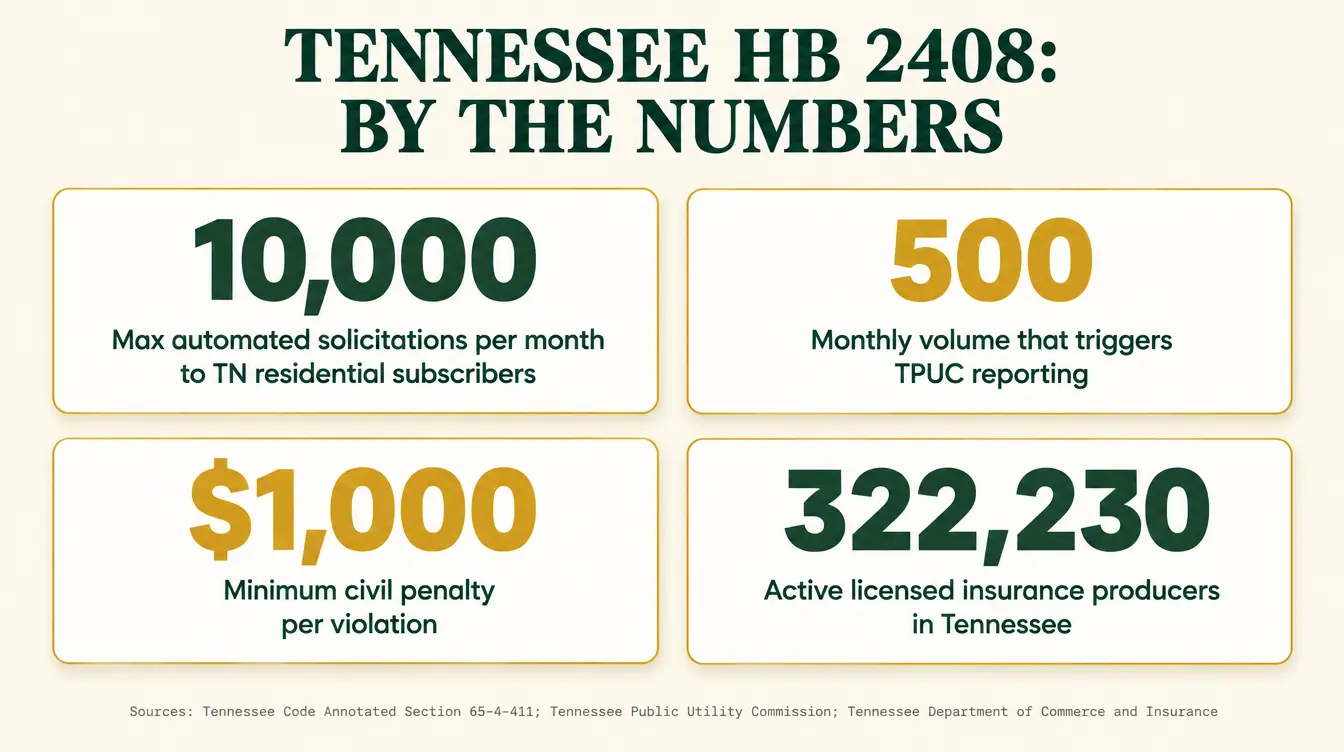
The enacted text is specific about enforcement, and it splits into two separate tracks. Failing to report, or failing to keep the underlying records, is a violation enforced by the Tennessee Public Utility Commission “under the Do Not Call Act,” per the commission’s own public notice. Exceeding the 10,000-call cap is different: the statute states that “a violation of subsection (b) is an unfair or deceptive act or practice affecting trade or commerce for purposes of the Tennessee Consumer Protection Act of 1977,” and that “a court that finds that a person or entity violated subsection (b) shall impose a civil penalty of no less than one thousand dollars ($1,000) per violation.” That’s enforced by the Tennessee Attorney General and Reporter, not the commission.
10,000
Max automated solicitations per month, statewide hard cap
Source: TCA Section 65-4-411(b)
500
Monthly volume that triggers mandatory TPUC reporting
Source: TCA Section 65-4-411(a)(2)
$1,000
Minimum civil penalty per violation of the cap
Source: TCA Section 65-4-411(c)(2)
$0.20
Per-minute cost of a managed AI caller, Single Account plan
Source: TheAffordableAI pricing, fetched 2026-10-03
The $1,000 figure is written as a floor, not a ceiling, and the statute says a court “shall impose” it on a finding of violation, which leaves no discretion to award less. Do the arithmetic on exposure the same way a plaintiff’s attorney would: a single month that runs even modestly over the 10,000-call line, say 10,500 solicitations, isn’t obviously 500 separate violations at $1,000 each under the statute’s own text, since the enacted language doesn’t spell out whether each call over the line is a separate violation or the monthly breach itself is one. What the statute does make unambiguous is that the floor per finding is $1,000, that it stacks on top of whatever federal TCPA exposure already exists at $500 to $1,500 per violation under 47 U.S.C. Section 227, and that it’s enforced by a different office, the state attorney general, than federal TCPA claims typically are.
Who’s Actually Close to the 10,000-Call Line
Ten thousand calls a month sounds like a number only a large call center would hit. Run the math against a normal business month and it’s closer than it looks. Thirty days of calling averages out to about 333 automated solicitations a day to stay under the cap; across roughly 21 to 22 business days a month, that’s closer to 455 to 476 a day if weekends are off the table. An agency running one AI voice line that dials a few hundred Tennessee numbers a day, every business day, is operating in range of the ceiling, not comfortably below it.
| Monthly automated solicitations to TN numbers | Recordkeeping duty (TCA 65-4-411(a)(1)) | TPUC reporting duty (500+/mo, from Oct. 1, 2026) | 10,000 hard cap (TCA 65-4-411(b)) |
|---|---|---|---|
| 200 / month | Applies | Not triggered | Well under |
| 800 / month | Applies | Triggered, must file by Apr. 1 / Oct. 1 | Under |
| 9,500 / month | Applies | Triggered | Within 5% of the ceiling |
| 10,500 / month | Applies | Triggered | Over the line, $1,000-per-violation exposure |
Figures illustrate statutory thresholds against hypothetical monthly volumes; the 333-455 calls-per-day range is simple division of the statute's own 10,000-per-month figure across 22 to 30 days and isn't a claim about any specific agency's actual call pace. Source: TCA Section 65-4-411.
Tennessee’s own insurance licensing numbers show why this isn’t a hypothetical limited to a handful of in-state call centers. The Tennessee Department of Commerce and Insurance reported 322,230 active licensed insurance producers as of February 2026, 51,852 of them Tennessee residents and 270,378 of them non-resident license holders based elsewhere but authorized to sell into the state. The statute’s cap and reporting duty apply based on where the call lands, “to residential subscribers in this state,” not where the licensee’s office sits. An agency in Georgia or Texas running an AI voice campaign against a purchased Tennessee lead list is exactly as exposed to the 10,000-call cap as a Nashville-based agency would be.
Tennessee’s New Law vs. the Federal TCPA
| Element | Federal TCPA | Tennessee TCA Section 65-4-411 |
|---|---|---|
| What triggers it | Any artificial or prerecorded voice call, or autodialed call, without prior express consent | Automated telephone dialing system delivering an artificial or prerecorded voice message to a TN residential subscriber |
| Volume cap | No numeric monthly cap in the statute itself | 10,000 per month, hard ceiling, effective July 1, 2026 |
| Reporting duty | No routine volume-reporting requirement to the FCC | 500+/month must report to TPUC twice yearly, from Oct. 1, 2026 |
| Covers live, human-dialed calls | Lightly touched outside DNC and consent rules | No; the statute's language is tied to automated dialing and artificial/prerecorded voice, not manual dialing |
| Covers text messages | Yes, under FCC interpretation of the TCPA | No; HB 2408 as enacted doesn't extend Section 65-4-411 to texts |
| Per-violation penalty | $500, up to $1,500 if willful, per 47 U.S.C. Section 227 | No less than $1,000 per violation of the cap, per TCA Section 65-4-411(c)(2) |
| Enforcement | FCC, state AGs, private right of action | TPUC for reporting violations; TN Attorney General and Reporter for the cap violation |
Sources: 47 U.S.C. Section 227 via Cornell Law School Legal Information Institute; Tennessee House Amendment 0854 to HB 2408, codified as TCA Section 65-4-411; Tennessee Public Utility Commission public notice.
The two laws stack rather than substitute for each other. Clearing Tennessee’s 10,000-call cap says nothing about whether the underlying calls had the prior express consent the federal TCPA already requires for an artificial or prerecorded voice call. A campaign can be fully consented under federal law and still cross the Tennessee ceiling, or stay comfortably under 10,000 calls and still violate the TCPA on individual calls that lacked consent. Both obligations apply on the same call, independently.
Where Tennessee’s Law Doesn’t Reach
Be precise about the limits, because overstating a new law is as costly as missing one. TCA Section 65-4-411 is written around two specific technical elements: an automated telephone dialing system, and an artificial or prerecorded voice message. A licensed agent manually dialing a Tennessee lead from a spreadsheet, with a human voice on the line from the first word, isn’t making a call “using an automated telephone dialing system to deliver artificial or prerecorded voice messages.” That kind of call sits outside this particular statute’s cap and reporting duty entirely, even though it’s still bound by the federal TCPA’s own consent and Do Not Call rules, which don’t require an autodialer or a recorded voice to apply.
Text messages are the other clear gap. Unlike Oregon’s HB 3865, which explicitly pulled text messages into its telemarketing definition, nothing in HB 2408 as enacted extends Section 65-4-411’s recordkeeping duty, reporting threshold, or 10,000-call cap to SMS. A Tennessee-targeted automated text follow-up sequence isn’t counted against this statute’s numbers, though it remains subject to the federal TCPA’s separate text-message consent rules.
And the statute doesn’t say anything about AI disclosure as its own obligation. It regulates volume and recordkeeping for an “artificial or prerecorded voice,” not whether that voice has to identify itself as AI. A separate, state-by-state patchwork of AI disclosure rules, covered in our guide to AI voice disclosure laws, governs that question, and it isn’t answered by HB 2408 either way.
How Insurance Agents Calling Tennessee Leads Stay Compliant
None of this requires abandoning automated or AI-voice outbound into Tennessee. It requires knowing your actual monthly count and building the reporting habit before October 1, 2026 makes it mandatory.
- Start counting automated and AI-voice calls to Tennessee numbers now, not in October. The recordkeeping duty under TCA Section 65-4-411(a)(1) took effect July 1, 2026. Waiting until the reporting threshold activates to start tracking means guessing at months you already should have on record.
- Segment Tennessee call volume from your national totals. The cap and reporting duty are specific to calls delivered to Tennessee residential subscribers. A platform or CRM that only reports total national dial counts can’t tell you whether your Tennessee-specific volume is approaching 500 or 10,000.
- Set an internal alert well below 10,000, not at it. A single busy week of AI-voice outbound can move a monthly count faster than a manual spreadsheet gets updated. An alert at 8,000 or 8,500 gives an agency room to throttle before crossing into cap-violation territory.
- Treat out-of-state status as no protection. With 270,378 non-resident producer licenses active in Tennessee against 51,852 resident ones, most agencies legally selling there are based elsewhere. The statute follows the call to where it lands, not where the dialer sits.
- Don’t assume a live-sounding AI voice is exempt because it isn’t a static recording. The FCC’s own February 2024 ruling rejected that exact argument under the federal TCPA’s identical “artificial… voice” language. Build your Tennessee compliance plan as if Section 65-4-411 reaches AI voice calls, not as if it clearly doesn’t.
- Prepare for the first filing now. The first semiannual report to the Tennessee Public Utility Commission is due April 1, 2027. An agency that’s been tracking volume since July 2026 has a clean record to submit; one that starts counting in March 2027 doesn’t.
- Remember texts and manual dials sit outside this specific statute, not outside compliance generally. Keeping an SMS sequence or a live-dialed list under 10,000 a month doesn’t matter for this law, but both still carry their own federal TCPA and Do Not Call obligations.
How TheAffordableAI Handles This
Call volume logged automatically
Every outbound attempt lands on the record with a timestamp, the raw material a monthly Tennessee-specific count and a semiannual TPUC filing both depend on.
State and number-level visibility
Call history syncs to your CRM, so volume to Tennessee numbers specifically, not just a national total, is something you can actually pull.
Opt-outs honored immediately
A stop request halts future outreach to that number without relying on a rep to update a suppression list by hand.
HighLevel CRM sync
Dispositions, timestamps, and consent records sync automatically, building the audit trail behind any volume figure your agency reports.
Warm transfers and number warmup
Volume discipline doesn't have to mean fewer connected conversations; routing and spam defense are built in regardless of monthly count.
No contracts either way
Single Account runs $200/mo plus a $500 one-time setup at $0.20/min, down to $0.15 at bulk. Agency runs $500/mo plus a $1,000 setup at $0.18/min, down to $0.16 at bulk.
None of this replaces knowing your own monthly Tennessee call count or deciding whether your agency is closer to 500 or 10,000. A platform can surface the number; it can’t decide for you whether to throttle, split volume across more licensed numbers, or file the report. If you want to hear what an actual AI call and disclosure sounds like before deciding anything, there’s a live demo call on the homepage. You can also build your own volume-tracking spreadsheet against a compliant dialer; plenty of agencies do, and it’s worth pricing against a managed platform on the pricing page either way.
What You Actually Get
Concretely, knowing the real thresholds, 500 to trigger reporting, 10,000 as a hard ceiling, both counted against Tennessee-specific volume, turns a rule an agency could easily blow past by accident into something a dialer and a CRM field can watch for. It means an AI-voice campaign running a few hundred calls a day into Tennessee gets a volume alert before it crosses into cap-violation territory, not after a $1,000-per-violation letter arrives. It means the first TPUC filing, due April 1, 2027, has eight months of clean records behind it instead of a scramble in March.
What it doesn’t do is answer every open legal question. Whether an interactive AI voice agent counts as an “artificial… voice message” under Tennessee’s specific statute hasn’t been tested in a Tennessee court. This article reflects a review of the cited statute, regulatory notice, and FCC ruling as of the publish date; it’s general information, not legal advice for your specific agency. Talk to counsel licensed in Tennessee before finalizing a compliance policy built around these numbers.
Tennessee didn't ban calling leads. It put a number on how many automated voice calls you can make before the state wants to see the math.
Mike MooreCompliance disclaimer
Prior express consent is required for automated or artificial-voice calls to a cell phone under the federal TCPA, and Tennessee's TCA Section 65-4-411 adds a separate 10,000-call monthly ceiling and, above 500 a month, a twice-yearly reporting duty to the Tennessee Public Utility Commission, specific to automated calls using an artificial or prerecorded voice to Tennessee residential subscribers. That obligation belongs to the licensed agent or agency placing the calls, not to any vendor or platform. Any AI caller must disclose it's AI where required by applicable law and honor opt-outs immediately. Medicare marketing carries CMS's additional rules, including the TPMO disclaimer and call recording retention requirements, on top of both the TCPA and Tennessee's statute. Using AI, or any calling platform, does not transfer compliance liability away from the licensed agent or agency. This article reflects a review of the cited statute, regulatory notice, and case law as of the publish date and is general information, not legal advice for your specific situation.
Tennessee’s robocall law isn’t a calling-hours rule and it isn’t a ban. It’s a number, 10,000 automated voice calls a month into the state, with a reporting duty that kicks in at 500, and it reaches further than a dusty prerecorded-voicemail statute might suggest, straight into AI voice calling, on the strength of the FCC’s own reading of nearly identical federal language. An agency running AI-voice outbound into Tennessee doesn’t need to stop. It needs an actual count.
See how volume and disclosure actually work before you decide anything
There's a live demo call on the homepage. Listen to the disclosure, the qualifying questions, and the warm transfer end to end.
Frequently asked
Is it illegal for an insurance agent to call a lead in Tennessee?
No, calling a Tennessee lead is still legal. What changed is narrower than a blanket ban: as of July 1, 2026, Tennessee Code Annotated Section 65-4-411, created by House Bill 2408 (Public Chapter 1029), caps any person or entity at 10,000 telephone solicitations a month if those calls use an automated telephone dialing system to deliver an artificial or prerecorded voice message to a Tennessee residential subscriber. Starting October 1, 2026, anyone placing 500 or more such solicitations a month also has to report call-volume records to the Tennessee Public Utility Commission twice a year. A live agent manually dialing a phone isn't the target of this particular statute. An agency running high-volume automated or AI-voice outbound into Tennessee is.
What does Tennessee House Bill 2408 actually require?
Per the enacted amendment (House Amendment 0854 to HB 2408, now codified at TCA Section 65-4-411), a person or entity using an automated telephone dialing system to deliver an artificial or prerecorded voice message to a Tennessee residential subscriber must keep a monthly record of how many such solicitations it made. Beginning October 1, 2026, anyone averaging 500 or more a month must send copies of those records to the Tennessee Public Utility Commission at least once every six months, and provide them to the commission or the state attorney general on request. Separately, subsection (b) sets a hard ceiling: no more than 10,000 such solicitations per month, full stop, effective July 1, 2026.
Does Tennessee's new robocall law apply to AI voice agents?
It almost certainly reaches further than old-school prerecorded robocalls, and an AI voice agent should plan as though it's covered. Tennessee's statute uses the same phrase federal law uses, calls that deliver an "artificial or prerecorded voice message." In February 2024, the FCC issued a Declaratory Ruling, FCC 24-17, confirming that under the federal TCPA an AI-generated voice is an "artificial" voice, because, in the Commission's words, "a person is not speaking them." The FCC's ruling even cites a Ninth Circuit decision, Trim v. Reward Zone USA, describing an artificial voice as "a sound resembling a human voice that is originated by artificial intelligence." Tennessee's legislature didn't write a narrower definition into Section 65-4-411, so a real-time AI caller generating synthetic speech on every call is a reasonable fit for "artificial voice" under the state statute too. That reading hasn't been tested in a Tennessee court yet. An agency shouldn't wait to find out the hard way.
What does violating Tennessee's robocall cap actually cost?
Exceeding 10,000 automated solicitations in a month is treated as an unfair or deceptive act under the Tennessee Consumer Protection Act of 1977, and a court that finds a violation of the cap must impose a civil penalty of no less than $1,000 per violation, enforced by the Tennessee Attorney General and Reporter. That's a statutory floor, not a ceiling, and it's separate from the reporting violation, which the Tennessee Public Utility Commission enforces under the state's Do Not Call Act. It's also on top of anything owed under the federal TCPA, which runs $500 to $1,500 per violation under 47 U.S.C. Section 227.
Who actually has to report call volume to the Tennessee Public Utility Commission?
Only entities placing 500 or more automated solicitations with an artificial or prerecorded voice to Tennessee residential subscribers in a given month, starting with volumes measured from October 1, 2026 forward. Per the Tennessee Public Utility Commission's own public notice, reports go in twice a year, due April 1 and October 1, with the first report due April 1, 2027. A smaller agency placing a few dozen automated calls a month into Tennessee doesn't trigger the reporting duty, though it's still bound by the 10,000-call monthly ceiling and by federal TCPA consent rules regardless of volume.
Does this law cover text messages the way some other states' telemarketing laws do?
No. The operative language in TCA Section 65-4-411, both the recordkeeping duty and the 10,000-call cap, is written around "artificial or prerecorded voice messages" delivered by an automated telephone dialing system. Nothing in House Bill 2408 as enacted extends that language to text messages. That's a real difference from a law like Oregon's HB 3865, which explicitly folded text messages into its telemarketing definition. A Tennessee-targeted SMS follow-up sequence isn't reached by this particular statute, though it's still subject to the federal TCPA's own text-message rules.
Does Tennessee's cap apply to out-of-state agencies calling Tennessee leads?
Yes. The statute defines what's regulated by where the call lands, not where the caller sits: it covers telephone solicitations delivered "to residential subscribers in this state." Tennessee's insurance market leans heavily on non-resident producers. The Tennessee Department of Commerce and Insurance reported 270,378 active non-resident producer licenses against 51,852 resident licenses as of February 2026, meaning most of the licensed agents legally allowed to sell insurance to Tennessee residents aren't based in Tennessee at all. An out-of-state agency running automated or AI-voice outbound into Tennessee numbers is just as exposed to the 10,000-call cap and the reporting duty as an agency headquartered in Nashville.
Does using a managed AI calling platform instead of building my own dialer change who's liable under this law?
No. Nothing in TCA Section 65-4-411 shifts responsibility to a vendor, and nothing in the federal TCPA does either. The licensed agent or agency placing, or directing, the solicitation is the "person or entity" the statute regulates. A platform can track monthly volume automatically and flag when an account is approaching 500 or 10,000 solicitations, which removes the guesswork of counting by hand. It doesn't transfer the legal obligation to file the report, pay the penalty, or obtain underlying TCPA consent away from the agency whose name is on the license.
Sources
- Tennessee General Assembly — House Amendment 0854 to House Bill 2408 / Senate Bill 2659 (114th General Assembly), enacted as Public Chapter 1029, codified at Tennessee Code Annotated Section 65-4-411
- Tennessee General Assembly — HB 2408 Bill Information (status, governor's signature date of 5/26/2026, effective date of 7/1/2026, Public Chapter 1029)
- Tennessee Public Utility Commission — A Public Notice for Telephone Solicitors (reporting thresholds, April 1 / October 1 filing dates, first report due April 1, 2027, $1,000 per-violation penalty)
- Federal Communications Commission — Declaratory Ruling, FCC 24-17, CG Docket No. 23-362, "Implications of Artificial Intelligence Technologies on Protecting Consumers from Unwanted Robocalls and Robotexts" (adopted Feb. 2, 2024, released Feb. 8, 2024)
- Tennessee Department of Commerce and Insurance — TDCI Celebrates Tennessee's Insurance Industry During Insurance Careers Month (322,230 active licensed producers: 51,852 resident, 270,378 non-resident, published Feb. 11, 2026)
- 47 U.S. Code Section 227, Telephone Consumer Protection Act — per-violation damages, subsections (b)(3) and (c)(5) (via Cornell Law School Legal Information Institute)
- Federal Trade Commission — FTC Announces 2027 Telemarketer Fees to Access the National Do Not Call Registry
- TheAffordableAI — Pricing
Put this on your own phone line
See the AI dial, qualify, and warm-transfer a live call in under a minute. No contract, no dev work.
Keep reading
FCC One-to-One Consent Rule Is Dead: Insurance Leads Now
The FCC's one-to-one consent rule is vacated and repealed. Here is what changed, what didn't, and how to vet an insurance lead vendor's consent in 2026.

TCPA Revoke-All Rule 2026: What the FCC Just Adopted
The FCC adopted a new TCPA revocation order on September 30, 2026, months ahead of the 2027 deadline. Here is what changed for insurance agents.

AI Voice Disclosure Laws for Insurance Agents (2026)
Do you have to tell an insurance lead they're talking to AI? What the FCC, Utah, California, and CMS actually require, state by state, verified in 2026.