TCPA Quiet Hours and the Area Code Trap (2026)
Quiet hours run 8am to 9pm at the lead's actual location, not their area code. Here is why that gap creates real TCPA exposure, and what changed in 2026.
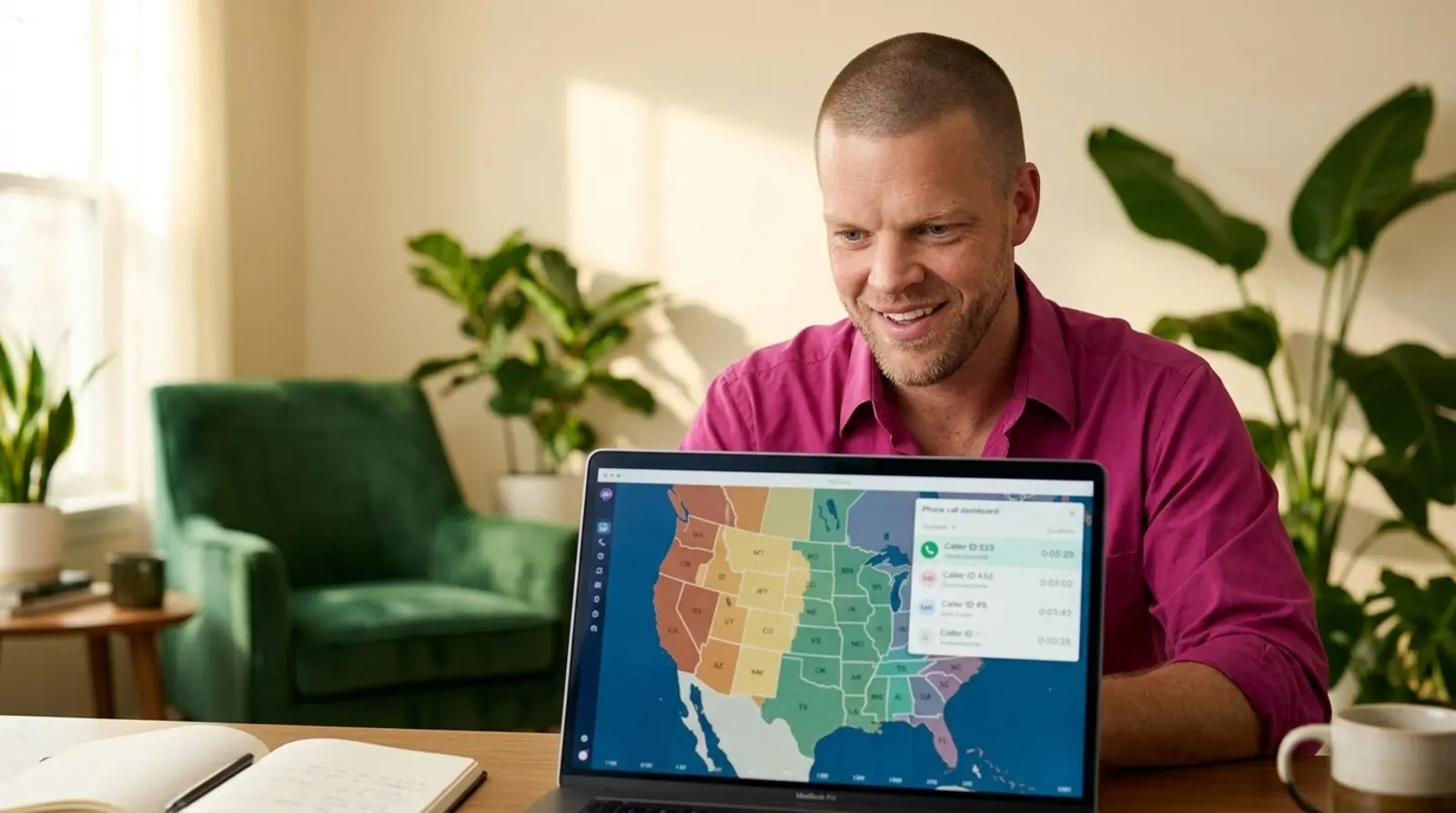
Yes, you can call that lead right now, but only if it is between 8 a.m. and 9 p.m. where they actually are, and their area code is not proof of where that is. The FCC’s TCPA rule, 47 CFR 64.1200(c)(1), and the FTC’s Telemarketing Sales Rule, 16 CFR 310.4(c), both draw the line at the called party’s local time, not the area code stamped on their phone number. A lead who submitted their information at 6:45 a.m. your time might be in a time zone where it is 6:45 a.m. too, or they might be an hour earlier, two hours earlier, or on the other side of the country entirely from what their 212 or 602 number suggests. Speed to lead is the whole game in insurance sales. It is also, on a nationwide list, the exact mechanism that puts a well-meaning agency on the wrong side of a federal calling-hours rule without anyone noticing until a demand letter shows up.
The short version
- The TCPA and the Telemarketing Sales Rule both restrict outbound calls to 8 a.m. to 9 p.m. local time at the called party's actual location, not the time zone their area code implies.
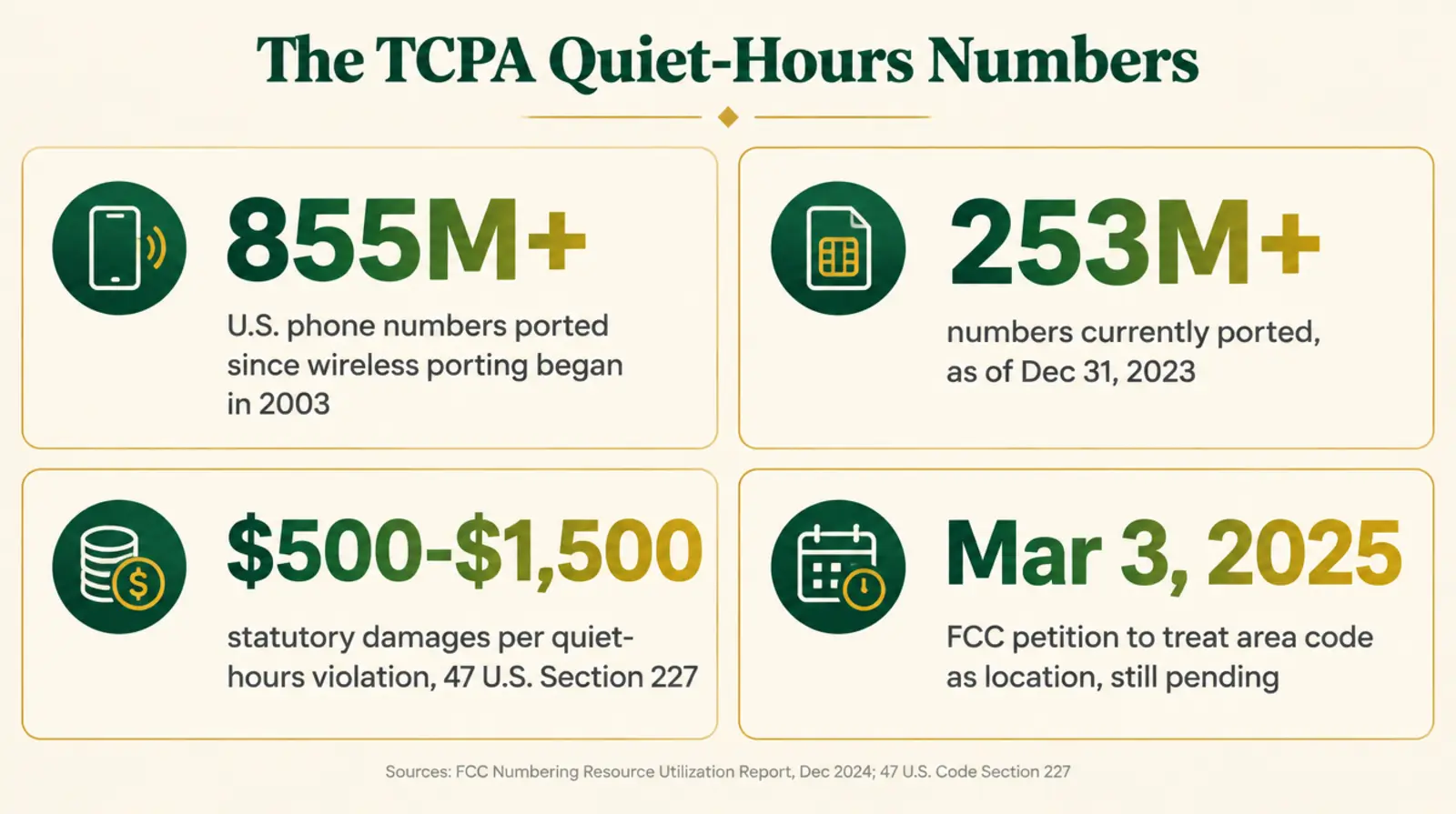
- Over 855 million U.S. phone numbers have been ported since wireless local number portability began in 2003, and more than 253 million are currently ported, per the FCC's own numbering report. An area code is a historical artifact, not a location.
- A violation carries $500 per call under 47 U.S.C. Section 227(c)(5), rising to $1,500 if a court finds it willful, and it does not require you to have meant it.
- An industry petition asking the FCC to let telemarketers treat a number's area code as its location has been pending since March 2025, with no ruling as of this article's publish date.
- A June 2025 Supreme Court ruling weakened the FCC's grip on this rule, and an April 2026 district court decision gave one specific kind of consent a real defense, but neither one makes the 8 a.m. to 9 p.m. window go away.
What the Quiet-Hours Rule Actually Says
Two federal rules say almost the same thing, and both predate text messages, VoIP, and the idea that a person might carry their childhood area code across three states. The FCC’s TCPA rule bars initiating “a telephone solicitation” to “any residential telephone subscriber” before 8 a.m. or after 9 p.m., “(local time at the called party’s location).” The FTC’s Telemarketing Sales Rule, which also reaches telemarketing calls, independently restricts “outbound telephone calls to a person’s residence” to the same window, “local time at the called person’s location.” Courts and the FCC have extended the same window to text messages sent by an autodialer or with prerecorded content, since the TCPA treats those the same as calls for this purpose.
Define the terms before the mechanism matters
Telephone solicitation: an unsolicited call encouraging the purchase of goods or services, under the TCPA's own definition. A call to a number that already has prior express invitation or permission to be contacted is not a solicitation in the first place, which matters later in this article. Local time at the called party's location: the actual physical location of the device when the call or text lands, not the area code, not the billing address on file with the carrier, and not your own office's time zone. Prior express written consent: the heightened consent standard required for an autodialed or prerecorded marketing call or text to a cell phone, separate from, and not a substitute for, the calling-hours window itself.
Both windows apply only to calls you place. Nothing in either rule restricts when a lead can call you, or when you can answer an inbound call they initiated. The exposure here is specifically about outbound dialing, which is exactly the motion a speed-to-lead program automates.
| Rule | Window | Reference point | Per-violation exposure |
|---|---|---|---|
| FCC / TCPA | 8 a.m. to 9 p.m. | Local time at the called party's location | $500 to $1,500 per call, 47 U.S.C. Section 227(c)(5) |
| FTC / Telemarketing Sales Rule | 8 a.m. to 9 p.m. | Local time at the called person's location | FTC enforcement action, separate from private TCPA suits |
Sources: 47 CFR Section 64.1200(c)(1); 16 CFR Section 310.4(c); 47 U.S.C. Section 227(c)(5).
Why an Area Code Isn’t Proof of Anything
In 2003, when wireless local number portability rolled out in the largest U.S. metro areas, an area code was a reasonably reliable proxy for where a phone actually rang. That assumption has been eroding for two decades, one move at a time, and the scale of it is bigger than most agencies assume.
The FCC’s own Numbering Resource Utilization report, covering the state of numbering resources as of December 31, 2023, states plainly that “since wireless porting began in 2003, there have been over 855 million numbers ported” and that “over 253 million numbers are currently ported.” The same report notes that 95.1% of those ports have been intramodal, meaning a number moved from one carrier to another of the same type, wireless to wireless, which is exactly the kind of move that leaves the area code untouched while the owner, and the owner’s physical location, can change entirely. A lead with a Michigan area code who moved to Arizona five years ago is still carrying that 313 or 616 prefix. Nothing about the number itself tells a dialer that.
How U.S. numbers actually move, against how often an area code is assumed to be a location
Built from the FCC's own porting data. Nearly all porting activity happens within the same service type, meaning the number itself gives no signal that the owner relocated.
Source: FCC, Numbering Resource Utilization in the United States, status as of December 31, 2023, published December 2024.
This is not a theoretical problem the industry invented to complain about. It is precisely what a federal class action alleged against Mixtiles USA in January 2025. According to the complaint, filed as Bernal v. Mixtiles USA, Inc. in the Central District of California, the plaintiff received two marketing text messages at 6:21 a.m. and 6:53 a.m. Pacific time, before the 8 a.m. start of the legal window at her actual location, despite Mixtiles operating out of the Eastern time zone. The complaint measured the violation by “the time that these text messages were received by the Plaintiff, in Plaintiff’s local time,” not by whatever time it was wherever the message originated. That case was voluntarily dismissed with prejudice about seven weeks later, which tells you the specific claim settled or was abandoned, not that the underlying legal theory was wrong. The theory is still live, and it is still being filed.
The Industry Knows This Is a Problem. The Fix Is Stuck in a Drawer.
An industry trade group has been asking the FCC to fix exactly this gap for over a year and a half. On March 3, 2025, the Ecommerce Innovation Alliance and other petitioners filed a petition asking the FCC, in the alternative, to declare a non-rebuttable presumption that a wireless number’s area code and central office prefix, together called the NPA-NXX, indicates the called party’s location for quiet-hours purposes. The FCC’s Consumer and Governmental Affairs Bureau released a public notice on March 11, 2025, seeking comment, with initial comments due April 10 and reply comments due April 25 of that year.
The petition is not a rule, and it has not become one
As of this article's publish date in October 2026, the FCC has not issued a declaratory ruling on the EIA's petition. The comment period closed in April 2025. Nothing since has made the area code a safe harbor. Treating the pending petition as if it already resolved the question is the single most common way an agency convinces itself it has solved a problem it has not touched.
The Ecommerce Innovation Alliance’s own advocacy material gives a sense of why it is pushing so hard: the organization states that a single South Florida law firm has initiated “over 343 class action litigations or demand letters since November 2024” over quiet-hours and related claims, a figure the EIA uses to argue the current rule invites what it calls meritless litigation against legitimate businesses. That is the petitioner’s own characterization, not a neutral court finding, and it is worth reading as the industry’s side of an active fight rather than a settled fact. What is not in dispute is that the petition exists, that the FCC accepted it for comment, and that it has sat without a ruling for a year and a half.
An area code tells you where a number was born. It does not tell you where the phone is right now.
Mike MooreTwo Things Just Changed the Legal Landscape Under This Rule
Two developments in the last sixteen months changed how exposed an agency actually is under the quiet-hours rule, in opposite directions, and neither one makes the rule disappear.
The first is McLaughlin Chiropractic Associates, Inc. v. McKesson Corp., decided by the Supreme Court on June 20, 2025 by a 6-3 vote. The case was about unsolicited faxes, not quiet hours, but its holding reaches every FCC rule issued under the TCPA, including this one. The Court held that the Hobbs Act does not require a district court to accept the FCC’s interpretation of the statute as binding in a private TCPA suit; the court has to work out the statute’s own meaning, giving the agency’s interpretation appropriate but not automatic weight. The quiet-hours rule exists only in FCC regulation, built on the FCC’s own implied authority to issue it, not in the TCPA’s text. After McLaughlin, a defendant can argue directly to a district court that the FCC lacked the authority to write that specific rule in the first place, an argument a court previously had little room to even consider. No controlling appellate decision has struck the rule down on that basis as of this article’s publish date. The argument is newly available. It has not yet won.
| Date | Event | What it means for an agency |
|---|---|---|
| Mar. 3, 2025 | EIA petition filed, CG Docket Nos. 02-278 and 21-402 | Asks FCC to let area code stand in for location; still unresolved |
| Mar. 11, 2025 | FCC releases Public Notice DA-25-216 seeking comment | Comment period opened; closed Apr. 25, 2025 with no ruling since |
| Jun. 20, 2025 | Supreme Court decides McLaughlin v. McKesson, 6-3 | Courts no longer must defer to the FCC's reading of the TCPA |
| Apr. 30, 2026 | King v. Bon Charge decided, D. Del. | Voluntarily-provided numbers may fall outside "solicitation" entirely |
| Oct. 2026 | This article's publish date | 8 a.m. to 9 p.m. local-time rule remains the operating standard |
Sources: FCC CG Docket Nos. 02-278, 21-402; FCC Public Notice DA-25-216; Supreme Court of the United States, No. 23-1226; King v. Bon Charge, No. 25-cv-00105-SB (D. Del.).
The second is King v. Bon Charge, decided by the U.S. District Court for the District of Delaware on April 30, 2026. The plaintiff had voluntarily subscribed to the defendant’s marketing texts to get a discount, later added her number to an internal do-not-call list, and kept receiving messages, some at odd hours, until she texted STOP. The court held that because she had voluntarily provided her number for that purpose, she had given “prior express invitation or permission,” which removes the resulting messages from the TCPA’s definition of a “telephone solicitation” entirely, and a quiet-hours claim only reaches an actual solicitation. That is a real, usable defense, for a real kind of consent, that a company can document: a consumer who directly and knowingly handed over their own number for that specific purpose. It is one district court’s reasoning, not binding outside Delaware, and it says nothing about a lead bought from a third-party aggregator whose consent trail is thin, resold, or several steps removed from the person actually dialed.
What a Mistimed Call Actually Costs
The dollar figure per call looks small until you run it against volume, and the mechanism that creates the exposure, an automated dial firing the instant a lead lands, is the same mechanism a fast-growing agency depends on for everything else.
$500
Statutory damages floor, per violation
Source: 47 U.S.C. Section 227(c)(5)
$1,500
Statutory damages ceiling, if a court finds the violation willful
Source: 47 U.S.C. Section 227(c)(5)
855M
U.S. numbers ported since wireless porting began in 2003
Source: FCC Numbering Resource Utilization report, Dec. 2024
253M
Numbers currently ported, as of Dec. 31, 2023
Source: FCC Numbering Resource Utilization report, Dec. 2024
Put the per-violation figure next to what the call itself costs to place, and the asymmetry is the whole argument for building the time-zone check in rather than skipping it.
What one mistimed call costs to place, against what it can cost if the time zone was wrong
Illustrative, built from this article's sourced figures: a 2-minute outbound call at TheAffordableAI's published Single Account rate, against the federal statutory damages range for one TCPA quiet-hours violation.
Per-minute rate from TheAffordableAI's published pricing, fetched 2026-10-05. Statutory damages per 47 U.S.C. Section 227(c)(5). This is illustrative, not an estimate of your own exposure, which depends on your actual call volume, lead sourcing, and consent documentation.
Neither statute requires a pattern. A single call, to a single lead, whose actual location at that moment didn’t match the time zone implied by their area code, is enough to be the violation a demand letter cites.
How to Stay Inside the Window Without Slowing Down Speed to Lead
None of this is a reason to stop calling leads fast. It’s a reason to make the system that calls them fast actually check the one thing that decides whether the call is legal to place at all. Here’s the method, in full, whether you build it yourself or buy it.
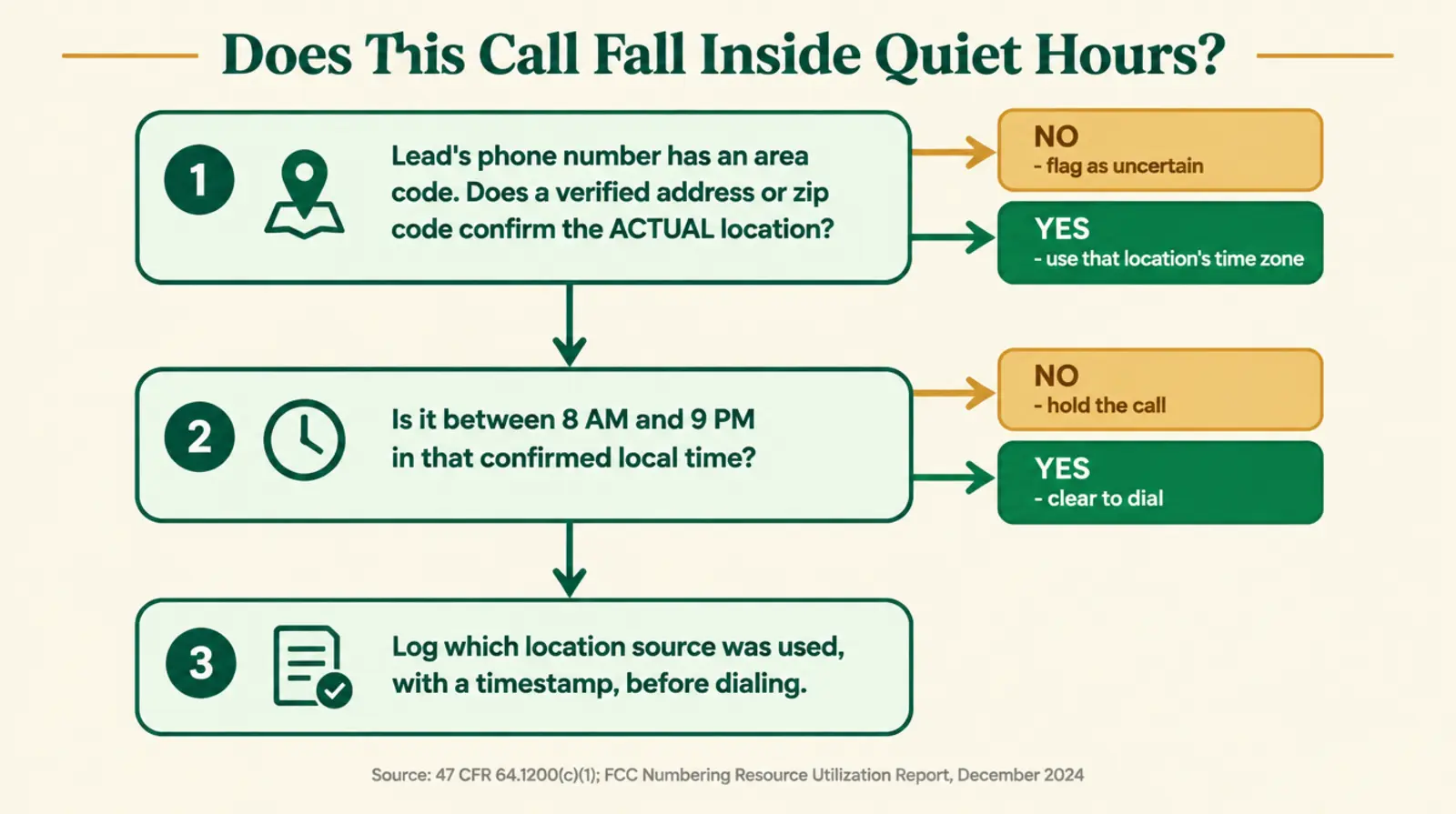
- Capture a real location signal at the point of lead intake, not just a phone number. A submitted address, a verified zip code, or an IP-based location at the moment of form submission all beat an area code. If your intake form or lead vendor doesn’t supply one of these, that’s the first gap to close, before anything else on this list.
- Treat the area code as a fallback, never a primary source. When a verified address exists, use its time zone. When it doesn’t, flag the lead as location-uncertain rather than assuming the area code is correct, and route it to a human reviewer or a wider calling window rather than an instant auto-dial.
- Build the 8 a.m. to 9 p.m. window into the dialer’s queue logic, keyed to the confirmed location, not your own office clock. A lead that comes in at 6 a.m. your time in Texas might be 4 a.m. for a lead who moved their 915 number to California. The system has to hold the call, not fire it the instant the lead lands, when the confirmed window hasn’t opened yet.
- Log which location source you used for every call, with a timestamp, separate from the call itself. If a claim ever surfaces, the question a court will ask is what you knew and what you relied on when you placed the call. “We used the area code because that’s all we had” is a weaker answer than “we used a verified address and the area code disagreed, so we held the call until the confirmed window opened.”
- Revisit consent documentation with King v. Bon Charge’s distinction in mind. A lead who typed their own number into your own form, for the specific purpose of being contacted, is a materially stronger fact pattern than a shared or resold lead whose consent trail runs through a third party you’ve never audited.
- Track the EIA petition’s docket, CG Docket Nos. 02-278 and 21-402, rather than assuming it resolved. If the FCC eventually rules, whichever way it rules, your process needs to change with it. Until then, build for the rule as it stands today, not the rule an industry group is asking for.
Where This Doesn’t Protect You
Be precise about the limits of all of this, the same way it’s worth being precise about the rule itself. McLaughlin gives a defendant a new argument to make in district court. It does not, by itself, invalidate the quiet-hours rule anywhere it hasn’t been specifically challenged and struck down, and no appellate court had done that as of this article’s publish date. King v. Bon Charge is one district court’s reading of one specific kind of voluntary, direct consent; it says nothing about a lead you bought from an aggregator, and nothing about a lead whose number was never verified against an actual address. The EIA’s pending petition is a request, not a rule, and treating it as settled before the FCC rules is the fastest way to build a process around a presumption that doesn’t yet exist.
And none of this touches the separate, heightened consent requirement for an autodialed or prerecorded marketing call to a cell phone under the TCPA’s prior express written consent standard, which is a different question from calling-hours entirely. A call placed inside the legal window, with no valid consent, is still a violation of a different rule. Clearing the quiet-hours question answers exactly one thing: whether the clock, at the lead’s actual location, said it was legal to dial.
How TheAffordableAI Handles This
Outbound queued inside the legal window
Automated callback and first-dial attempts are scheduled inside the 8 a.m. to 9 p.m. window at the location on file, rather than firing the instant a lead lands regardless of the clock.
Every call timestamped and logged
A record of when a call went out, and what location signal it was keyed to, is the raw material behind proving a call fell inside, or outside, the exemption window.
Opt-outs honored immediately
A stop request halts future outreach to that number across voice and text, the same consent discipline King v. Bon Charge's facts turned on.
HighLevel CRM sync
Consent and dispositions sync automatically, building the documentation trail a quiet-hours or consent question would actually test.
Warm transfers and number warmup
Holding a call for the legal window doesn't have to mean fewer connected conversations on the calls that do go out.
No contracts either way
Single Account runs $200/mo plus a $500 one-time setup at $0.20/min, down to $0.15 at bulk. Agency runs $500/mo plus a $1,000 setup at $0.18/min, down to $0.16 at bulk.
None of this decides, for your specific lead list, whether a given number’s area code actually matches where the phone is, or whether a specific consent record would survive a motion to dismiss. A platform can hold the call and log the source; it can’t verify an address you never collected. If you want to hear what a disclosure and a scheduled callback actually sound like before deciding anything, there’s a live demo call on the homepage. You can also build this scheduling logic yourself against any compliant dialer without a managed platform; plenty of agencies do, and it’s worth pricing that build against the pricing page either way.
What You Actually Get
Knowing the actual mechanism, an 8 a.m. to 9 p.m. window keyed to an address, not an area code, turns a rule an agency could blow past without noticing into something a lead-intake form and a queue rule can check before a single number gets dialed. It means a nationwide lead list stops being a blind guess at forty-eight separate clocks and starts being a list with a location source attached to every number, logged the moment the call goes out. It means the gap between “we call fast” and “we call legally” closes at the intake step, not after a demand letter arrives asking why a text landed at 6 a.m.
It doesn’t answer every open question. Whether the FCC ever grants the EIA’s petition, and what exactly it grants if it does, is genuinely unresolved as of this article’s publish date, and this article reflects a review of the cited statutes, regulations, court dockets, and FCC filings as of that date. It is general information, not legal advice for your specific agency. Talk to counsel before finalizing a compliance policy built around any of this, especially while the McLaughlin fallout and the EIA petition are both still moving.
Compliance disclaimer
The FCC's TCPA rule, 47 CFR 64.1200(c)(1), and the FTC's Telemarketing Sales Rule, 16 CFR 310.4(c), restrict outbound telephone solicitations to between 8 a.m. and 9 p.m. local time at the called party's actual location, not the time zone implied by their area code. Prior express written consent is separately required for an automated or artificial-voice call or text to a cell phone under the TCPA, 47 U.S.C. Section 227. A violation of the calling-hours rule can carry $500 to $1,500 in statutory damages per violation under Section 227(c)(5), regardless of intent. That compliance obligation belongs to the licensed agent or agency placing the calls, not to any vendor or platform. Any AI caller must disclose that it's AI where required by applicable law and honor opt-outs immediately. Medicare marketing carries CMS's additional rules, including the TPMO disclaimer and call recording retention requirements, on top of all of the above. Using AI, or any calling platform, does not transfer compliance liability away from the licensed agent or agency. This article reflects a review of the cited statutes, regulations, court dockets, and FCC filings as of the publish date and is general information, not legal advice for your specific situation.
An area code was never a location. It just used to be close enough that nobody checked. With 253 million U.S. numbers currently carrying an area code that may no longer match where the phone actually rings, and a federal rule that puts the called party’s actual clock, not yours, at the center of the question, “close enough” is the assumption a fast-growing agency can least afford to keep making.
See how scheduled, compliant outbound actually works
There's a live demo call on the homepage. Listen to the disclosure, the timing logic, and the warm transfer end to end.
Frequently asked
What time can I legally call an insurance lead?
Between 8 a.m. and 9 p.m., but the clock that matters is the one at the called party's actual location, not yours and not the time zone their area code suggests. The FCC's TCPA rule, 47 CFR 64.1200(c)(1), bars a telephone solicitation to a residential subscriber before 8 a.m. or after 9 p.m. local time at the called party's location. The FTC's Telemarketing Sales Rule, 16 CFR 310.4(c), sets an identical window. Both windows are about where the person actually is when the phone rings, which is not always where their area code says they are.
Does a lead's area code tell me their time zone?
Not reliably, and that gap is the entire subject of this article. Area codes were assigned to geographic regions, but a phone number keeps traveling with its owner after they move, thanks to local number portability. The FCC's own Numbering Resource Utilization report puts the number of U.S. telephone numbers that have been ported since wireless porting began in 2003 at over 855 million, with more than 253 million numbers currently ported as of December 31, 2023. A 212 number can ring in Arizona. A 602 number can ring in Ohio. Treating the area code as the time zone is a guess, not a verification.
What actually happens if I call outside the legal window by mistake?
You become eligible for a private lawsuit under 47 U.S.C. Section 227(c)(5), which lets a called party recover actual damages or $500 per violation, whichever is greater, rising to as much as $1,500 per violation if a court finds the violation willful or knowing. The Telemarketing Sales Rule carries its own separate enforcement exposure through the FTC. Neither statute requires you to have meant it. A single mistimed call to a lead whose number was ported to a different time zone than its area code suggests is enough to trigger the claim.
Is the FCC actually going to fix the area code problem?
Maybe, eventually, but not yet. On March 3, 2025, the Ecommerce Innovation Alliance and other petitioners filed a petition asking the FCC to declare, among other things, a non-rebuttable presumption that a wireless number's area code and prefix, its NPA-NXX, indicates the called party's location for quiet-hours purposes. The FCC sought public comment on March 11, 2025, with comments due April 10 and replies due April 25 of that year. As of this article's publish date in October 2026, the FCC has not issued a ruling on that petition. Until it does, area code is not a safe harbor; it is an open question sitting in a docket.
Does getting consent protect me from a quiet-hours lawsuit?
It can, depending on how the consent was obtained and what a specific court decides. In King v. Bon Charge, the U.S. District Court for the District of Delaware held on April 30, 2026 that a consumer who voluntarily provided her phone number to receive marketing messages had given prior express invitation or permission, which takes the resulting messages outside the TCPA's definition of a telephone solicitation entirely, and a quiet-hours claim only reaches a solicitation. That is one district court's reasoning on one set of facts. It is not a blanket rule that any consent anywhere defeats any quiet-hours claim, and a shared or resold insurance lead with thin, undocumented consent is a different fact pattern than a consumer who typed her own number into a company's own signup form.
Did the Supreme Court kill the quiet-hours rule?
No, but it changed who gets the final word on it. In McLaughlin Chiropractic Associates, Inc. v. McKesson Corp., decided June 20, 2025, the Supreme Court held 6-3 that the Hobbs Act does not require district courts to treat the FCC's interpretation of the TCPA as binding in a private enforcement suit; a court now has to work out the statute's meaning itself, giving the FCC's view appropriate but not automatic weight. The quiet-hours rule exists only in FCC regulation, not in the TCPA's own text, which means a defendant can now argue to a district court that the FCC lacked the authority to write that specific rule. Some court, somewhere, may eventually agree. None has issued a controlling appellate ruling striking the rule down as of this article's publish date, so it remains the operating rule everywhere it has not been successfully challenged.
Does using a managed AI calling platform fix the time zone problem for me?
A platform can hold a call until the window opens at a verified address, flag a lead whose only location signal is its area code, and log which time zone source it used and when. None of that is automatic unless the platform is built to check it, and none of it transfers the underlying legal obligation to call inside the window away from the licensed agent or agency placing the call. The question worth asking a vendor, including us, is not whether it dials fast. It is what location source it uses to decide when 8 a.m. starts for a specific lead.
Sources
- 47 CFR Section 64.1200(c)(1), FCC TCPA rules, telephone solicitation calling-hours restriction (via Cornell Law School Legal Information Institute)
- 16 CFR Section 310.4(c), FTC Telemarketing Sales Rule, calling-time restriction (via Cornell Law School Legal Information Institute)
- 47 U.S. Code Section 227, Telephone Consumer Protection Act, private right of action and statutory damages, subsections (b)(3) and (c)(5) (via Cornell Law School Legal Information Institute)
- FCC, Numbering Resource Utilization in the United States: Status as of December 31, 2023 (Office of Economics and Analytics, published December 2024) — porting activity statistics
- FCC Public Notice DA-25-216, Consumer and Governmental Affairs Bureau seeks comment on petition for declaratory ruling and/or waiver, released March 11, 2025
- Mintz — Telephone and Texting Compliance News: Regulatory Update, FCC Seeks Comment on Petitions Focused on Quiet Hour and Utility Robocalling Rules (March 27, 2025)
- Ecommerce Innovation Alliance — The FCC Accepts EIA's Petition and Requests Public Comments
- Ecommerce Innovation Alliance — The EIA Continues Advocacy at FCC on Critical 'Quiet Hours' Litigation (litigation and demand-letter count, EIA's own figures)
- CourtListener — Ana Bernal v. Mixtiles USA, Inc., Case No. 5:25-cv-00006 (C.D. Cal.), docket
- National Law Review (Troutman Amin, LLP) — It's Past That Time: Mixtiles Sued for Violating Time Zone Specific Provisions of the TCPA (January 6, 2025)
- Supreme Court of the United States — McLaughlin Chiropractic Associates, Inc. v. McKesson Corp., No. 23-1226, decided June 20, 2025 (opinion)
- Gibson Dunn — Supreme Court Holds That District Courts Are Not Bound By Agency Interpretations In Enforcement Proceedings
- TCPAWorld — Wave of Litigation Ended? Are the TCPA's Quiet Hour Rules Dead After Friday's Supreme Court Ruling? (June 23, 2025)
- Nixon Peabody — A Loud Decision on TCPA Quiet Hours: King v. Bon Charge, No. 25-cv-00105-SB (D. Del., decided April 30, 2026)
- TCPAWorld — Quiet Hour Killer: Court Holds TCPA Quiet Hours Claims Cannot Be Brought By Plaintiff Who Voluntarily Provided Their Phone Number to Caller (May 1, 2026)
- TheAffordableAI — Pricing
Put this on your own phone line
See the AI dial, qualify, and warm-transfer a live call in under a minute. No contract, no dev work.
Keep reading
Speed to Lead in 2026: Why the First 60 Seconds Decides Who Writes the Policy
The lead you paid for is not lost to a better agent. It is lost to a faster one. Here is what response time actually does to contact and conversion rates, and how to get to sixty seconds without hiring a dialer team.
Call Abandonment Rate Rules for Insurance Agencies
The FTC and FCC cap abandoned calls at 3%: what counts as abandonment, what a violation costs, and how AI voice agents change the math for agencies.
FCC One-to-One Consent Rule Is Dead: Insurance Leads Now
The FCC's one-to-one consent rule is vacated and repealed. Here is what changed, what didn't, and how to vet an insurance lead vendor's consent in 2026.