Medicare Advantage Leads in 2026: What They Cost
Medicare Advantage leads run $5 to $125 each, and Congress is scrutinizing how lead generators sell senior data. What they cost and how to follow up fast.
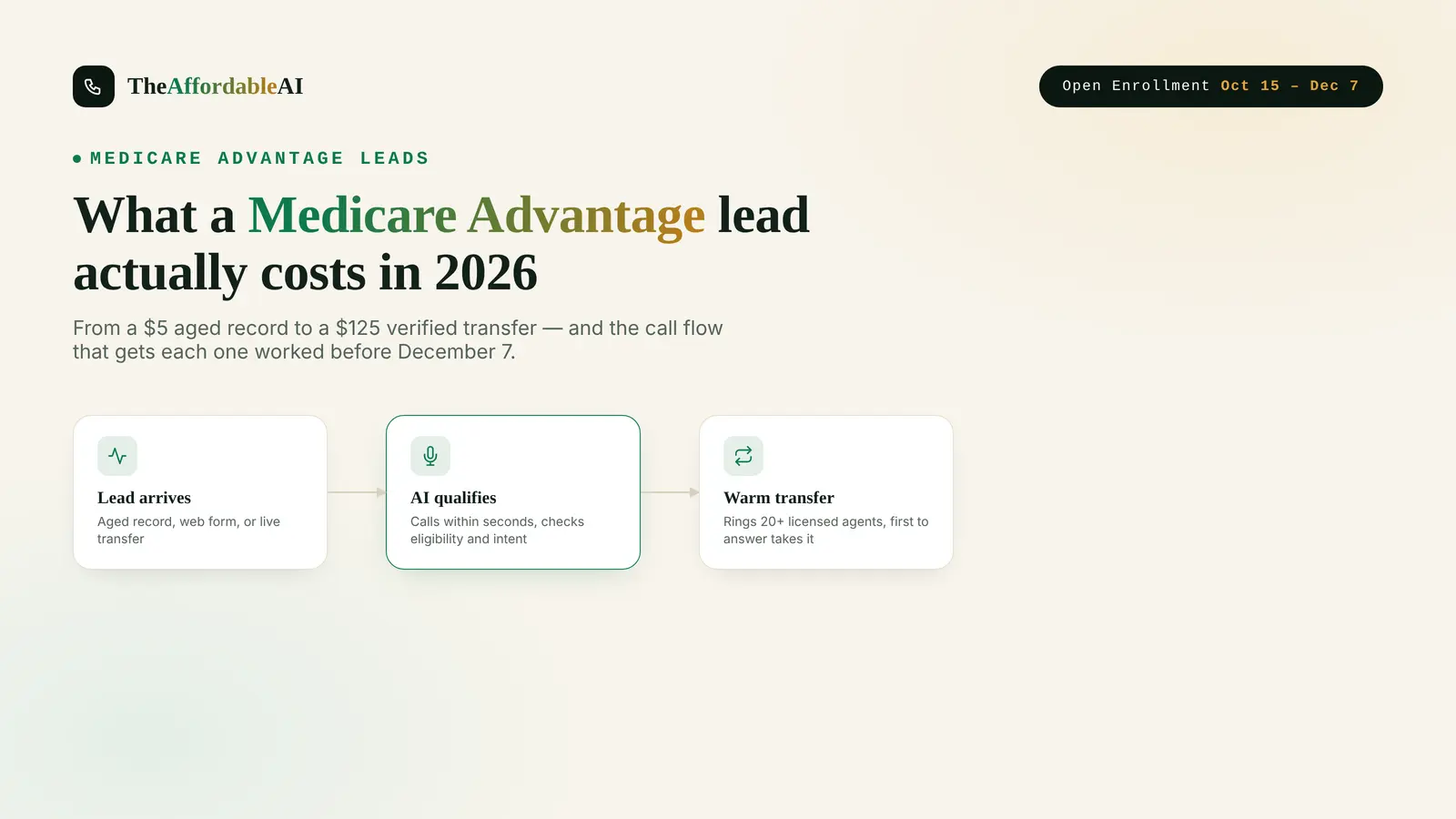
A Medicare Advantage lead in 2026 costs anywhere from a few dollars for an aged record to $125 for a verified live transfer, per vendor pricing fetched for this article, and the real number for your agency depends on format, state, and how close you’re buying to December 7. That’s the easy part to answer. The harder part is that the Senate Finance Committee has spent two years asking named Medicare marketing companies, in writing, exactly where that per-lead price comes from and whose data is behind it. If you’re buying Medicare Advantage leads this AEP, you’re buying into both of those facts at once: a real, sourced cost per contact, and a lead-generation industry that a sitting Congressional committee has publicly called out for selling senior contact data “indiscriminately and in bulk.” This article covers what MA leads actually cost right now, why that scrutiny exists, what the compliance rules require regardless of where the lead came from, and how to follow up fast enough that the cost per lead stops being the thing that decides whether you write the policy.
Today is October 15, 2026. CMS’s Open Enrollment window for 2027 coverage opened this morning and runs through December 7. Whatever leads you buy or already have sitting in a queue right now are on a 54-day clock, no extensions, no do-overs.
The short version
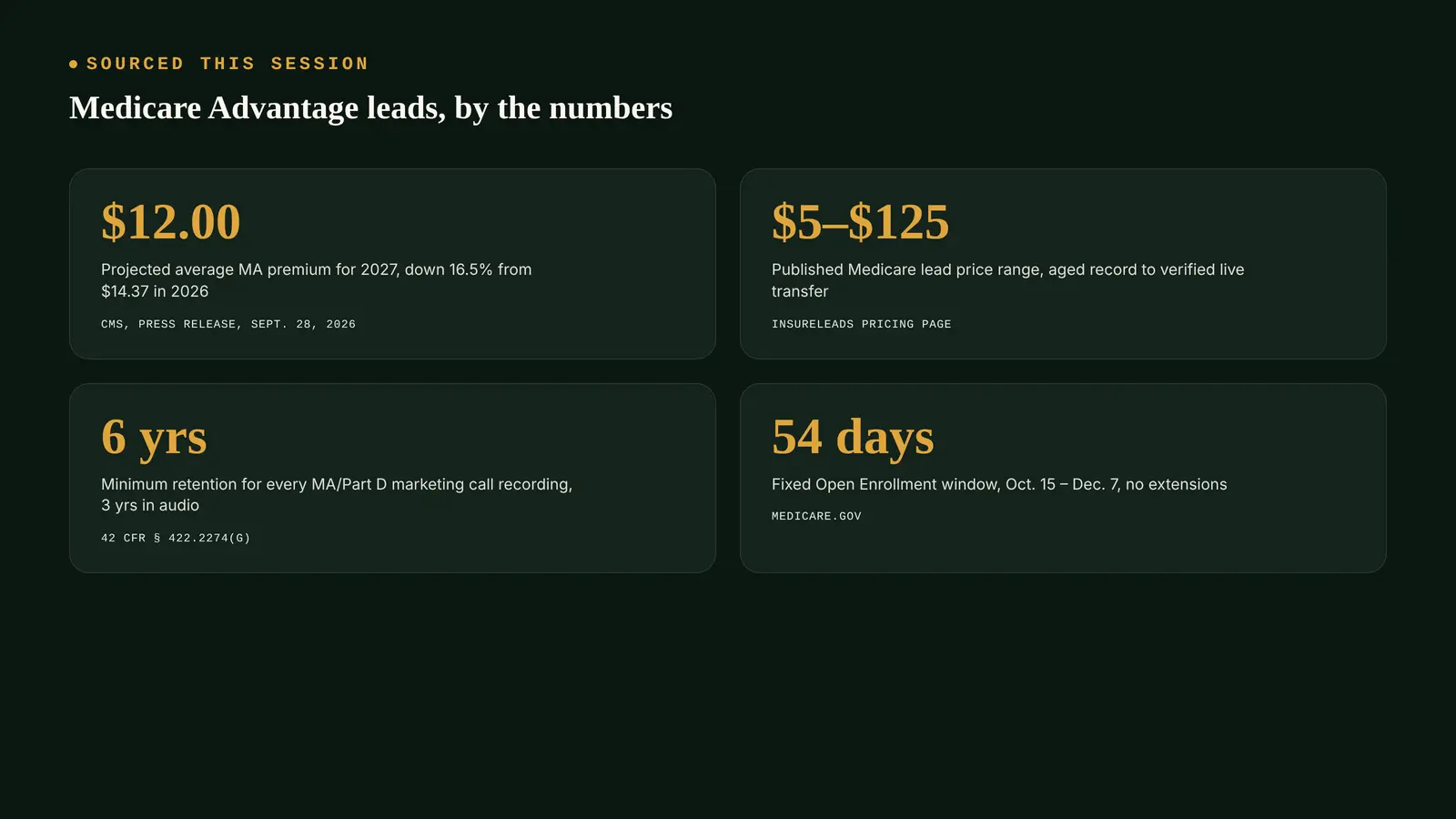
- Published Medicare lead pricing runs from about $5 for an aged record to $70 for an exclusive web lead to $125 for a verified live transfer, per InsureLeads' own pricing page, fetched for this article. The page prices Medicare as one category; it does not publish Medicare Advantage pricing separately from Medicare Supplement or Part D.
- CMS projects the weighted average Medicare Advantage premium will fall 16.5%, from $14.37 a month in 2026 to $12.00 in 2027, with about 34 million people, roughly 47.4% of all Medicare beneficiaries, expected to be enrolled in MA in 2027, per CMS's September 28, 2026 press release.
- The Senate Finance Committee's January 11, 2024 letter to a major Medicare marketing organization cited a 2022 Committee investigation that found "widespread evidence of unfair tactics like fraudulent mailers, misleading TV advertisements, and unending sales calls," and asked the company to disclose its average price paid per lead by enrollment period.
- Every marketing and sales call touching Medicare Advantage or Part D, human or AI, must be recorded in its entirety and retained for a minimum of 6 years, the first 3 in audio format, under 42 CFR § 422.2274(g)(2)(ii). Agents must also score 85% or higher on carrier testing under § 422.2274(b)(2).
- Open Enrollment for 2027 coverage runs October 15 through December 7, 2026, per Medicare.gov, a fixed 54-day window with no extensions.
What Makes a Medicare Advantage Lead Different From Any Other Insurance Lead
A Medicare Advantage lead isn’t just an older auto or life lead with a bigger commission attached. It’s a person deciding, inside a fixed calendar window, whether to keep their current plan, switch carriers, or move back to Original Medicare, and that decision touches their actual doctors, their actual prescriptions, and a plan year that doesn’t reopen until the following fall. CMS’s own guidelines govern how that lead can legally be marketed to, through what’s called the Medicare Communications and Marketing Guidelines, and the entity selling you that lead is, in almost every case, something CMS has a specific name and rule set for: a TPMO.
TPMO stands for Third-Party Marketing Organization. It’s the regulatory term for any organization other than the Medicare Advantage or Part D plan itself that markets or sells on that plan’s behalf, and it covers most of the lead generators, call centers, and digital marketing shops an independent agent buys leads or live transfers from. TPMOs are directly regulated at 42 CFR § 422.2274, which sets the recording, retention, and disclosure rules this article covers below. The reason that distinction matters for lead buying specifically: when you buy a lead from a TPMO, you’re not just buying contact information. You’re buying whatever marketing and consent practices that TPMO used to generate it, and if those practices don’t meet the CMS standard, the exposure doesn’t stay with the TPMO. It attaches to the call you make next.
Terms worth defining before you buy a list
Aged lead: contact information collected weeks or months ago, resold at a steep discount, with no guarantee the person still wants to talk or that original consent is still valid. Exclusive lead: sold to one buyer only, typically generated from a real-time web form. Live transfer: a call where a vendor's own team has already reached the person and confirmed interest before connecting you. Scope of Appointment: a CMS-required document confirming what specific products a beneficiary agreed to discuss, obtained before a personal marketing appointment, not after.
The 2027 Medicare Advantage Market You’re Selling Into Right Now
Every lead you buy this AEP is a bet on a market CMS already published numbers for. Per CMS’s September 28, 2026 press release, the weighted average monthly Medicare Advantage premium is projected to fall from $14.37 in 2026 to $12.00 in 2027, a 16.5% drop, and the average Part D total premium for MA plans that include drug coverage, after MA rebates, is projected to fall even further, from $11.32 to $7.00, a 38% decrease. Standalone Part D plans move the opposite direction, rising from $35.09 to $36.00, an increase CMS attributes in part to the scheduled end of a premium stabilization program after 2026.
On enrollment, CMS projects about 34 million people, roughly 47.4% of everyone enrolled in Medicare, will be in a Medicare Advantage plan in 2027. CMS also states that more than 99% of Medicare beneficiaries will have access to at least one MA plan, and 97% will have access to 10 or more. The number of available plans is projected to hold roughly steady, from 5,553 in 2026 to about 5,532 in 2027. Read those two facts together: falling premiums and near-universal plan access, and you get a market where a beneficiary has every incentive to shop, which is exactly the behavior that makes speed to contact matter during a 54-day window.
| Metric | 2026 | 2027 (projected) |
|---|---|---|
| Weighted avg. MA premium (all plans) | $14.37/mo | $12.00/mo (-16.5%) |
| Avg. Part D premium, MA plans w/ drug coverage | $11.32/mo | $7.00/mo (-38%) |
| Avg. standalone Part D premium | $35.09/mo | $36.00/mo |
| Number of MA plans nationally | 5,553 | ~5,532 |
| MA enrollment, share of all Medicare | ~48% | ~47.4% (~34M people) |
Source: CMS, "Medicare Advantage and Medicare Prescription Drug Programs Expected to Remain Stable in 2027," press release published September 28, 2026. These are CMS projections, not final enrollment figures; CMS notes its enrollment projections have historically run conservative relative to actual enrollment.
What Medicare Advantage Leads Actually Cost in 2026
Here’s the number everyone actually wants. Per InsureLeads’ own published Medicare leads pricing page, fetched directly for this article, an aged lead starts around $5, an exclusive real-time web lead runs $70, and an interest-verified live transfer, where the vendor’s own team confirms the person is real and engaged before connecting the call, runs $125. The page states AEP pricing can run above baseline without publishing a specific multiplier, and it offers volume discounts starting at $5,000 a month in committed spend.
Worth saying plainly: that page prices “Medicare” leads as one bucket. It doesn’t break Medicare Advantage out from Medicare Supplement or standalone Part D pricing, which is itself a useful data point. A lead vendor that can’t or won’t tell you which Medicare product a given contact actually wants is a vendor whose qualification process you should be asking harder questions about before you buy at volume, not after.
What $500 buys at each Medicare lead tier
Approximate lead count per $500, using InsureLeads' published per-lead prices
Source: InsureLeads (GetInsureLeads.com), Medicare Leads pricing page, fetched October 2026. Illustrative arithmetic on published per-lead prices, not a vendor-published conversion table. Actual counts depend on state, filters, and AEP-period pricing adjustments the page does not itemize.
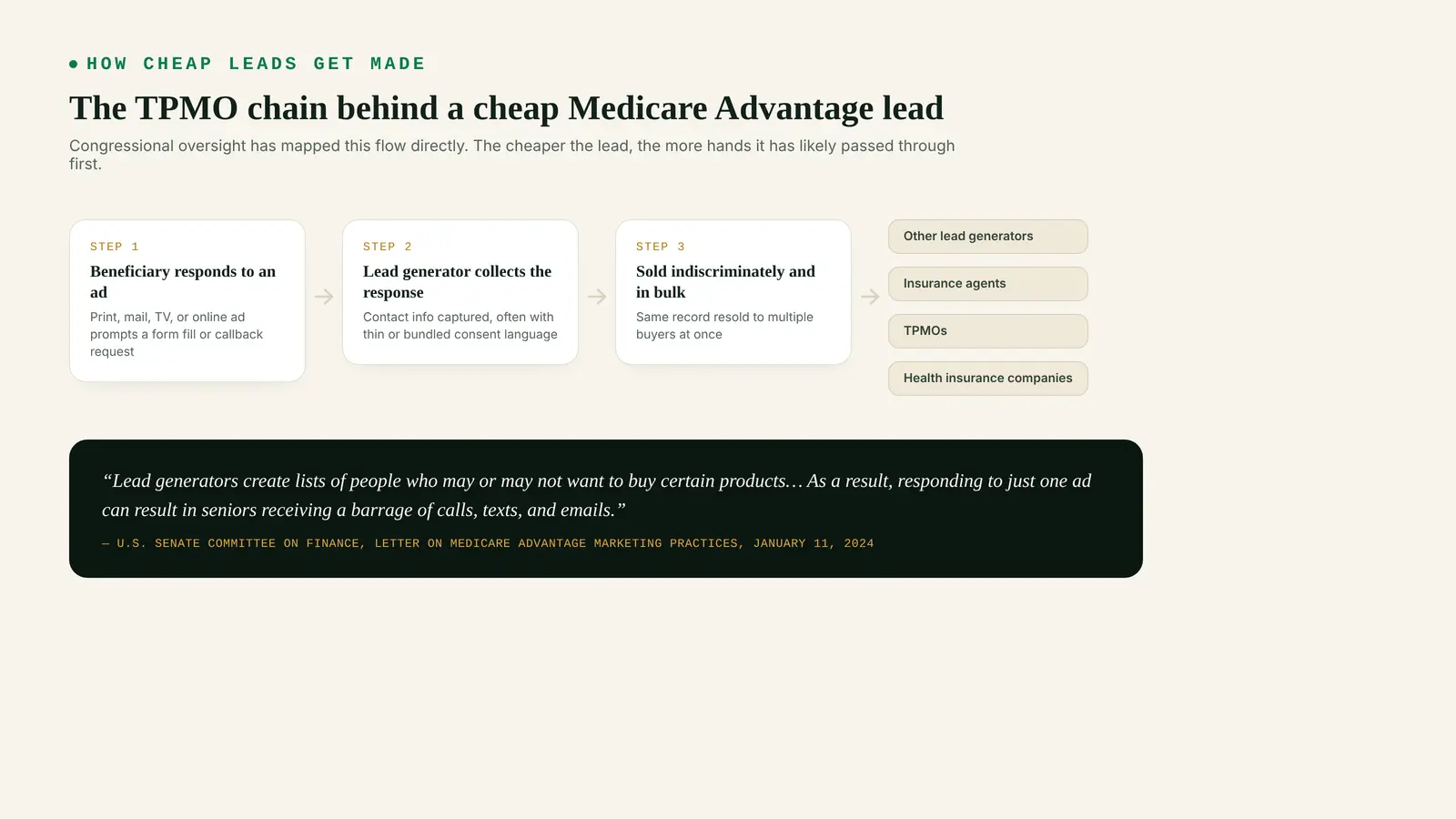
That cheap aged lead is cheap for a reason, and the reason is the flow in the graphic above. A $5 aged lead has typically already been sold once, sometimes several times, to other agents and TPMOs before it reaches you, which is a large part of why the price is low: you’re not buying exclusivity, you’re buying a shot at reaching someone before three other agents already did.
Why Congress Is Watching How You Get These Leads
This is the part most lead-pricing articles skip, and it’s directly relevant to anyone buying Medicare Advantage leads right now. On January 11, 2024, the Senate Finance Committee, then chaired by Senator Ron Wyden, sent a letter to the CEO of a major Medicare marketing organization requesting detailed information about one of its lead-generation subsidiaries’ business practices. The letter cites a prior Committee staff investigation, published November 3, 2022, that “found widespread evidence of unfair tactics like fraudulent mailers, misleading TV advertisements, and unending sales calls,” undermining “the seniors’ ability to navigate and trust the Medicare plan marketplace.” It also cites Committee testimony describing the MA enrollment period as effectively “open season on seniors.”
The letter is specific about the mechanism: “Lead generators create lists of people who may or may not want to buy certain products by tricking seniors into responding to print, mail, television, and online advertisements,” and then that contact data gets sold “indiscriminately and in bulk to other lead generators, insurance agents, TPMOs, and health insurance companies,” with a senior who responds to “just one ad” potentially receiving “a barrage of calls, texts, and emails from marketers and brokers who have purchased the seniors’ information from the lead generator that placed the ad.” The Committee asked the company, among a dozen other items, to disclose “the average price per lead during the Annual Enrollment period before Thanksgiving, from Thanksgiving day to December 7th, and outside the Annual Enrollment Period,” broken out by digital ad, inbound call, and outbound list pricing.
What this means for a buyer, not just a seller
You don't have to be the company receiving a Senate oversight letter for this to matter to your agency. If a vendor you're buying Medicare Advantage leads from is part of the resale chain the Committee describes, bulk data moving through multiple TPMOs before it reaches an agent, the underlying consent for every one of those calls may be thinner than the lead price suggests. A cheap lead with murky consent provenance is not a bargain; it's deferred risk with your license attached to it.
This is also precisely where the speed-and-coverage argument for a managed calling process connects to the compliance argument, not just the economics one. An agency that builds its own disciplined consent, disclosure, and documentation process around every lead it works, rather than depending entirely on an upstream TPMO’s practices, is the agency least exposed if that TPMO’s name ends up in the next oversight letter.
What Moving Slowly Costs, in Real Numbers
Put a per-minute cost against the lead prices above. At TheAffordableAI’s published Single Account rate of $0.20 a minute (from $0.15 at bulk volume), per TheAffordableAI’s pricing page fetched for this article, a four-minute qualifying call, enough to confirm interest, check basic eligibility, and route to the right calendar, costs about 80 cents. Against a $125 verified live transfer, that’s negligible. Against a $5 aged lead, it’s real money relative to the lead cost, which is exactly why aged leads only make financial sense worked at volume and speed, not called one at a time with the care you’d give an expensive live transfer.
Now put that against what an unfilled seat actually costs you. Per the U.S. Bureau of Labor Statistics’ Occupational Outlook Handbook, the May 2025 median pay for an insurance sales agent was $62,280 a year, or $29.94 an hour, across 572,600 jobs nationally, with 3% projected employment growth from 2025 to 2035. A licensed producer earning roughly $30 an hour spending that hour re-dialing an aged list by hand, instead of handling warm transfers a system already qualified, is $30 of producer time spent on a task a per-minute AI caller does for a fraction of that cost. That’s not a claim about close rates or conversion lift; it’s the same per-minute arithmetic every lead type on this site runs, applied to a product where the buying window happens to close on a fixed date in seven weeks.
Hear how the follow-up actually sounds
There's a live demo call on the homepage if you want to hear an AI caller qualify a Medicare Advantage inquiry and hand off a warm transfer before you commit to anything.
The Compliance Rules That Apply Regardless of Where the Lead Came From
These rules don’t change based on lead price, lead age, or whether a human or an AI placed the call.
Scope of Appointment. Under 42 CFR § 422.2274(b)(3) and (c)(9)(ii), an agent must secure and document a Scope of Appointment before a personal marketing appointment, confirming which specific products the beneficiary agreed to discuss. This is a documentation requirement independent of how the lead was sourced.
Recorded calls, retained for 6 years. Under § 422.2274(g)(2)(ii), “all marketing and sales calls, including the audio portion of calls conducted via web-based technology, must be recorded” and “retained in their entirety for a minimum period of 6 years.” The first 3 years must be kept in audio format; years 4 through 6 may be audio or a complete, accurate transcript. An AI caller doesn’t change this requirement; it has to be built to meet it.
Agent testing. Under § 422.2274(b)(2), agents and brokers must “achieve an 85 percent or higher on all forms of testing” required by the carriers they represent, before they can market or sell MA and Part D products.
TCPA consent. Automated or prerecorded calls and texts to a cell phone for marketing purposes require prior express consent under 47 U.S.C. § 227(b)(1)(A)(iii). Per Cornell Law School’s Legal Information Institute, a consumer can recover $500 per violation, or actual damages if greater, under § 227(b)(3)(B), with a court able to raise that to as much as $1,500 per violation for a willful or knowing violation. Consent is the agent’s obligation; it does not transfer from a vendor or lead generator to the agency that bought the lead.
Do Not Call. Per the FTC’s own Consumer Advice page, companies that call numbers on the National Do Not Call Registry or place illegal robocalls can be fined up to $50,120 per call, and the FTC states telemarketers who made illegal calls have paid the agency more than $290 million in judgments. Scrub every calling list, aged or fresh, against the Registry and your internal do-not-call list before every session.
AI does not transfer liability. Using an AI voice agent to place or answer a call does not move responsibility for TCPA consent, Do Not Call compliance, CMS marketing rules, Scope of Appointment, or recording retention away from the licensed agent whose name ends up on the sale. The technology that places the call never absorbs that liability; the license does.
Not legal advice
CMS marketing rules, TCPA requirements, and state insurance regulations change, and the specific requirements that apply to a given call depend on the product, the state, and the carrier contract involved. Confirm current requirements with your compliance department, your carrier partners, or counsel before building a calling program around anything in this article.
How to Fix Follow-Up Without Buying Anything
None of this requires a new vendor. It requires discipline most agencies don’t staff for during a 54-day surge.
- Call every new lead inside minutes, not hours. A lead who filled out a form or answered an inbound call during AEP is almost certainly comparing you against whoever else they contacted the same day. The agency that calls back first gets the conversation.
- Separate your lead sources by documented consent quality, not just price. A $5 aged lead and a $125 verified transfer deserve different handling: work the cheap volume fast and in bulk, and give the expensive, pre-qualified transfer the immediate, careful attention its price implies.
- Get the Scope of Appointment documented before the sales conversation, every time, not as a formality after the fact.
- Record and retain every marketing and sales call for the full 6-year window, 3 years in audio, and build that into your process now rather than discovering a gap during an audit.
- Scrub against the Do Not Call Registry before every calling session, no exceptions for leads that feel urgent because the window is closing.
- Log every disposition, answered, not interested, Scope of Appointment completed, enrolled, both for follow-up quality and as your own compliance record of who was called, when, and under what consent.
- Track December 7 as a hard stop on your calendar, not a soft target. A lead who calls on December 5 and doesn’t hear back by the 7th has effectively lost the window for that plan year.
An agency that reads this and thinks “we can build a disposition log and a Scope of Appointment checklist ourselves” is right. Plenty of smaller books run exactly that way with a shared spreadsheet and disciplined staff. The tradeoff is the one it always is: doing it at AEP volume, with every lead called inside minutes and every call documented to the 6-year standard, without burning out your licensed staff on dial time instead of sales conversations, is a capacity problem, not a willpower problem.
Licensed staff dial everything, including aged volume
- A new lead sits until whoever's free gets to it, sometimes hours later
- Aged leads get worked inconsistently, if at all, once live transfers pile up
- Scope of Appointment and call recording depend on each rep remembering the steps
- December 7 arrives with uncalled leads still in the queue
Volume gets dialed fast; licensed staff take the warm handoff
- Outbound fires within seconds of a new lead arriving, any hour
- Aged volume gets worked at scale without consuming producer dial time
- Every call records automatically, routed into the 6-year retention requirement
- Qualified, interested prospects warm-transfer to a licensed agent live
A Worked Example: $3,000 of AEP Lead Spend
Picture an agency that puts $3,000 into Medicare leads for this AEP: $1,000 into aged leads at roughly $5 each (about 200 leads), $1,000 into exclusive web leads at $70 each (about 14 leads), and $1,000 into verified live transfers at $125 each (about 8 leads), using InsureLeads’ published per-lead prices. Worked manually by two licensed agents splitting dial time between live transfers, web leads, and whatever aged volume they can get to, the 200 aged leads realistically get partial coverage; dial time gets consumed by the higher-value live transfers and web leads first, which is the right prioritization for a two-person team, but it means a chunk of that $1,000 in aged spend goes uncalled before December 7.
Worked with an AI caller qualifying and dispositioning the aged and web-lead volume, firing outbound within seconds of each live transfer or web lead arriving, and warm-transferring anyone who shows real interest, the same $3,000 in lead spend gets a documented attempt against effectively all 222 leads inside the window, not just the highest-priced tier. The lead spend is identical in both scenarios. What changes is how much of it actually gets worked before the clock on this plan year runs out.
Where We Fit, and Where We Don’t
TheAffordableAI is a managed AI caller, not a lead-generation company, and it doesn’t sell or broker Medicare leads. What it does, per TheAffordableAI’s own published Features page: dial outbound within under a second of a lead landing, answer every inbound call in under a second around the clock, and ring 20-plus licensed agents at once so the first one available takes a qualified, interested prospect on a warm transfer; if nobody picks up within a few rings, it books a meeting against real-time calendar availability instead. One assistant can detect caller intent and route to the matching calendar, useful if your book spans Medicare Advantage, Medicare Supplement, and ACA leads at the same time. It syncs two-way with HighLevel when a call ends, writing tags, custom fields, a call summary, full transcript, and the recording back into the CRM you’re probably already running, which is also the record a 6-year retention requirement expects you to have.
Volume without added dial time
Aged and web-lead volume gets called fast without pulling a licensed agent off a live transfer.
Warm transfer to a licensed human
A qualified, interested beneficiary reaches a licensed agent live, while the 54-day window is still open.
Call recording that fits the retention rule
Every call records and syncs to HighLevel automatically, feeding the documentation CMS requires for 6 years.
A cheap aged lead and an expensive verified transfer have the same deadline. Only one of them usually gets called before it.
Pricing, restated since the per-lead math above depends on it: Single Account runs $200 a month plus a $500 one-time setup fee, at $0.20 a minute (from $0.15 at bulk volume). Agency runs $500 a month plus a $1,000 one-time setup fee, at $0.18 a minute (from $0.16 at bulk volume), and adds routing to 20-plus agents, round-robin across numbers, and team availability toggles, useful when AEP volume from multiple licensed producers is landing at once. Both plans are month to month with no long-term commitment, per TheAffordableAI’s pricing page fetched for this article. You can build the aged-lead-triage and call-recording piece yourself with a dialer, a documented process, and disciplined staff; plenty of agencies do. It’s worth pricing that approach against a managed option before December 7 forces the decision for you.
Where AI Calling Is the Wrong Tool Here
Say this plainly: if a prospect needs a real comparison between two specific MA plans’ networks, drug formularies, or star ratings, that conversation belongs to a licensed agent from the first sentence, not an AI qualifying call. A voice AI confirming interest and routing to a calendar is not the same thing as advising someone on a decision that affects their actual doctors and actual prescriptions, and no vendor, including this one, should ever suggest otherwise. If your book is small enough that a disciplined manual process already covers every lead inside minutes with full documentation, the economics in this article may not move the needle enough to justify a new line item. Run the numbers for your own volume before deciding either way.
What You Get When Cost and Speed Work Together
A sourced cost per lead only matters if the lead actually gets a documented, timely call. Knowing a verified live transfer costs $125 is only useful information if that transfer gets answered inside seconds, not minutes; knowing an aged lead costs $5 is only a bargain if enough of those 200 leads in a $1,000 budget actually get dialed before December 7, instead of half of them aging out of relevance while staff work the pricier tiers first. The lead price and the follow-up speed are the same decision, not two separate ones, and this AEP window gives you exactly 54 days to get both right.
Frequently asked
How much does a Medicare Advantage lead cost in 2026?
It depends entirely on format. Per InsureLeads' own published Medicare leads pricing page, an aged lead starts around $5, an exclusive real-time web lead runs $70, and an interest-verified live transfer, where the vendor's team confirms the person is real and engaged before connecting the call, runs $125. The page notes AEP pricing can run higher than baseline, though it doesn't publish a specific AEP multiplier. The page prices Medicare leads as a single category rather than breaking out Medicare Advantage from Medicare Supplement or Part D, so treat these as general Medicare lead benchmarks, not an MA-exclusive number.
Why is Congress looking at how Medicare Advantage leads get generated?
Because the data-reselling chain behind a lot of cheap MA leads has drawn direct Senate scrutiny. In a January 11, 2024 letter to a major Medicare marketing organization, the Senate Finance Committee, under then-Chairman Ron Wyden, wrote that a 2022 Committee staff investigation "found widespread evidence of unfair tactics like fraudulent mailers, misleading TV advertisements, and unending sales calls" and that lead generators "create lists of people who may or may not want to buy certain products," then sell that contact data "indiscriminately and in bulk to other lead generators, insurance agents, TPMOs, and health insurance companies." The letter demanded, among other things, the company's average price paid per lead by period, by source, and by whether the lead converted. That's not an abstract compliance worry; it's a sitting Senate committee asking named companies to show their receipts.
What is a TPMO, and why does it matter for lead buying?
TPMO stands for Third-Party Marketing Organization, the CMS term for any entity that isn't the Medicare Advantage or Part D plan itself but that markets or sells on the plan's behalf, including most lead generators and call centers an independent agent might buy leads or transfers from. CMS regulates TPMO conduct directly at 42 CFR § 422.2274, covering recorded-call requirements, data handling, and marketing standards. If a TPMO you buy from is cutting corners on consent or disclosure to keep its lead price low, that exposure doesn't stay with the TPMO. It follows the lead into your calling program.
Is it legal to call an aged Medicare Advantage lead?
It can be, but consent is the determining factor, not how the lead is labeled. The TCPA's consent requirement for automated or prerecorded calls and texts to a cell phone, codified at 47 U.S.C. § 227(b)(1)(A)(iii), doesn't expire on a schedule tied to how old the lead is; it turns on whether valid consent exists and whether that consent has been revoked. An aged lead that never had documented consent, or where consent was revoked, is not safe to auto-dial just because it is six months old and cheap. Scrub every list against the National Do Not Call Registry and your internal do-not-call list before calling, regardless of lead age.
What does Medicare marketing compliance actually require on a recorded call?
Under 42 CFR § 422.2274(g)(2)(ii), all marketing and sales calls for Medicare Advantage and Part D, including the audio portion of calls conducted over web-based technology, must be recorded and retained in their entirety for a minimum of 6 years, with the first 3 years specifically in audio format. Agents and brokers must also secure and document a Scope of Appointment before a personal marketing appointment, per § 422.2274(b)(3) and (c)(9)(ii), and pass carrier testing at 85% or higher, per § 422.2274(b)(2). None of that changes because an AI placed or answered the call instead of a human.
Does using an AI caller transfer any compliance liability away from the licensed agent?
No. Using AI to place or answer a call does not transfer liability for TCPA consent, Do Not Call compliance, CMS marketing rules, or any state insurance disclosure requirement away from the licensed producer whose name is on the eventual sale. The agent stays responsible for consent, disclosure, recording retention, and suitability regardless of what software placed or answered the call.
Can an AI voice agent actually enroll someone in a Medicare Advantage plan?
No, and it shouldn't try to. Comparing plan benefits, explaining a star rating, or walking a beneficiary through a Scope of Appointment are licensed-agent decisions that depend on the person's specific health needs, providers, and drug list. What a managed AI caller can do is call the moment a lead arrives, work a volume of inquiries a small team can't dial fast enough during a 54-day window, and warm-transfer an interested, qualified prospect to a licensed human while they're still on the phone. The comparison, the recommendation, and the enrollment itself stay entirely human.
When does the window to shop Medicare Advantage plans for 2027 coverage close?
December 7, 2026. Medicare.gov states Open Enrollment "happens from October 15 to December 7," and any change made in that window takes effect January 1 of the following year, with the plan needing to receive the request by December 7. There's no extension built into the calendar; a lead that calls in on December 5 and doesn't get a return call by the 7th has, in practical terms, run out the clock for that plan year.
Sources
- CMS — Medicare Advantage and Medicare Prescription Drug Programs Expected to Remain Stable in 2027 (press release, published September 28, 2026)
- Medicare.gov — Open Enrollment (dates and what you can change)
- U.S. Senate Committee on Finance — Letter regarding Medicare Advantage lead generation and marketing practices (January 11, 2024)
- Cornell Law School Legal Information Institute — 42 CFR § 422.2274, Medicare Advantage marketing, call recording, and agent/broker training and testing
- Cornell Law School Legal Information Institute — 47 U.S. Code § 227, Telephone Consumer Protection Act
- Federal Trade Commission — National Do Not Call Registry FAQs (Consumer Advice)
- U.S. Bureau of Labor Statistics — Occupational Outlook Handbook, Insurance Sales Agents (May 2025 data, 2025-2035 projections)
- InsureLeads (GetInsureLeads.com) — Medicare Leads pricing page
- KFF — Medicare Advantage 2026 Spotlight: A First Look at Plan Premiums and Benefits (published December 9, 2025)
- TheAffordableAI — Pricing
- TheAffordableAI — Features
Put this on your own phone line
See the AI dial, qualify, and warm-transfer a live call in under a minute. No contract, no dev work.
Keep reading

Surviving Medicare AEP 2026 Without a Seasonal Hire
Medicare AEP runs October 15 to December 7. Real math on staffing that window without hiring and licensing seasonal reps you don't have time for.

Medicare Supplement Leads: Why They Don't Wait for AEP
Medigap has no annual enrollment period. 16 states run birthday-rule windows year-round, and leads don't wait for AEP. What they cost and how to follow up.

CMS 2027 Medicare Rules: The 48-Hour Wait Is Gone
CMS eliminated the 48-hour Scope of Appointment wait, changed the TPMO disclaimer timing, and cut call retention to 6 years ahead of AEP 2027.