Medicare Advantage Forced Disenrollment: 2027 Agent Guide
1 in 10 Medicare Advantage members lost their plan in 2026, per a JAMA study. Here's what the 2027 exits mean and how to work the list fast.

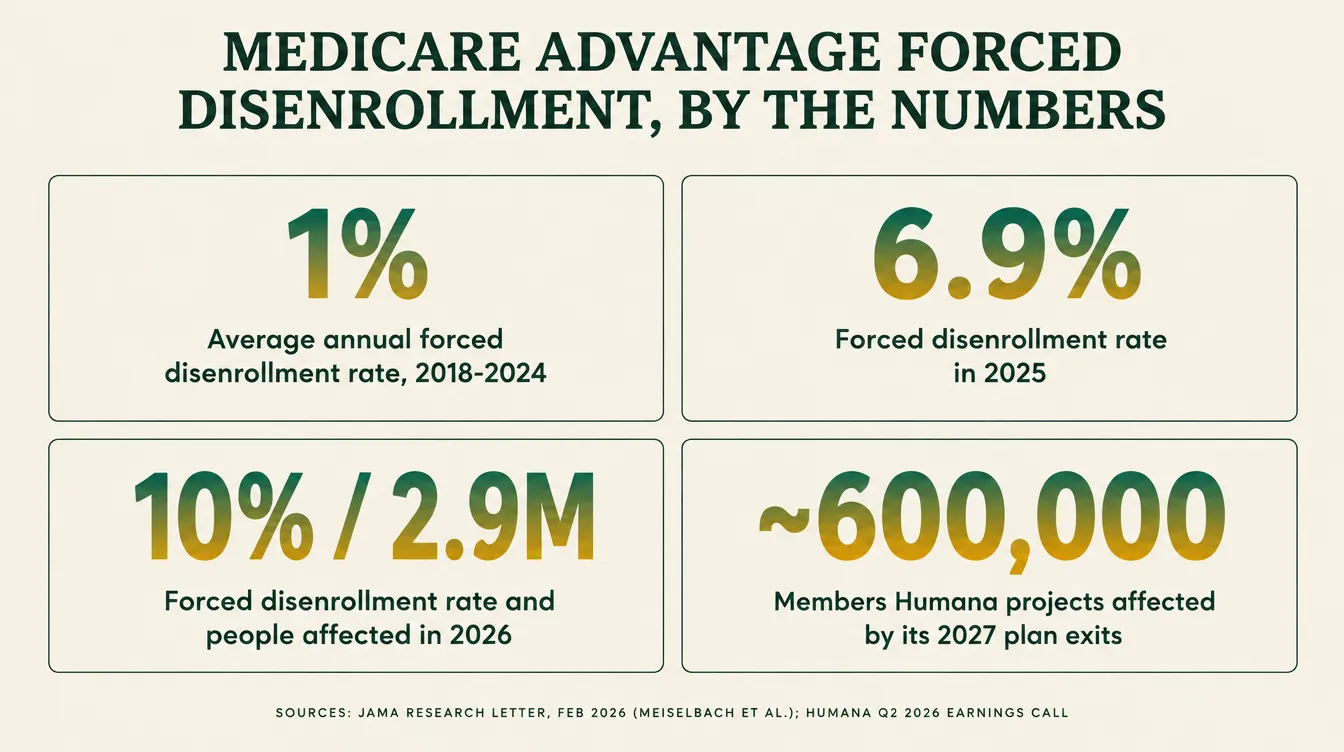
About 1 in 10 Medicare Advantage members are being pushed out of their plan in 2026, whether they wanted to leave or not, according to a peer-reviewed research letter published in JAMA in February 2026. That’s roughly 2.9 million people whose plan exited their county, non-renewed its CMS contract, or got terminated outright, up from a rate that sat near 1% a year for most of the last decade. Humana has already told investors it expects a similar wave for 2027, affecting around 600,000 of its own members. None of those people asked to shop for new coverage. They’re getting a letter that makes the decision for them, on a clock the federal government sets.
That’s the pain point this article opens on: you have clients whose plan is about to disappear out from under them, a small window to reach them before a call center or a competing agent does, and a compliance framework around Medicare marketing that doesn’t relax just because the client already knows your name. Everything below covers what’s actually driving the surge, the exact notice and enrollment timelines CMS enforces, what it costs an agency that works this list slowly, and how to work it fast without cutting a compliance corner. Where a managed AI caller fits into that, and where it doesn’t, comes at the end, pointed at a demo and pricing, not before.
The short version
- Forced Medicare Advantage disenrollment averaged about 1% a year from 2018-2024, jumped to 6.9% in 2025, and hit roughly 10%, or 2.9 million people, in 2026, per a JAMA research letter from Johns Hopkins Bloomberg School of Public Health.
- Humana's CFO told analysts on its Q2 2026 earnings call that 2027 exits will affect about 600,000 members, with roughly 40% expected to be recaptured into other Humana plans.
- A non-renewing plan must notify CMS by the first Monday in June and mail enrollees at least 90 days before the exit date, which lands around October 1-2 for a December 31 contract end, per 42 CFR 422.506.
- The Special Enrollment Period for a plan non-renewal runs December 8 through the last day of February, separate from the windows that apply when CMS or the plan itself ends a contract mid-cycle, per Medicare.gov.
- A member losing coverage this way gets a guaranteed-issue right to buy select Medigap plans without medical underwriting, but only within 63 days of the old coverage ending, per the Center for Medicare Advocacy.
What Forced Disenrollment Actually Means
“Forced disenrollment” isn’t a term CMS uses in its own regulations, but it’s the accurate name for what happens across three distinct legal events, and the difference between them changes the calendar every client is on. Define them once, because the rest of the article depends on keeping them straight.
Non-renewal. A Medicare Advantage organization decides, on its own schedule, not to renew its annual contract with CMS for a specific plan or in a specific county for the next plan year. This is the most common route and the one behind most of the 2026 and 2027 volume. It’s governed by 42 CFR 422.506.
Termination. CMS itself ends a plan’s contract, usually for a compliance failure, mid-cycle rather than at year’s end. This is rarer and carries its own, different enrollee notification and Special Enrollment Period rules than a routine non-renewal.
Service area reduction (SAR). A plan keeps operating but stops covering one or more counties it used to serve, effectively non-renewing for the members in the dropped counties while continuing to sell the same plan everywhere else. From the affected member’s seat, this looks and functions exactly like a full non-renewal.
Terms worth knowing before the rest of this article
Special Enrollment Period (SEP): a window outside the normal Annual Enrollment Period during which a specific life event, like a plan non-renewal, lets a Medicare beneficiary change plans. Guaranteed issue: the right to buy a Medigap policy without answering health questions or facing a higher price for pre-existing conditions, available only in specific triggering situations. Non-SNP: a Medicare Advantage plan that isn't a Special Needs Plan, meaning it's open to the general Medicare population rather than a specific eligibility group like dual-eligible or chronic-condition beneficiaries.
Every one of these events produces the same downstream fact for an agent: a member who did nothing wrong and made no decision now has a deadline to pick new coverage, and they’re going to make that decision with or without you. Whoever calls first, explains the options clearly, and helps them act inside the window usually keeps the relationship. Whoever doesn’t usually finds out later that the client auto-enrolled into whatever CMS’s default crosswalk assigned them, or called the number printed on the notice and ended up with a call-center agent instead.
The Numbers Behind the 2027 Surge
Researchers at Johns Hopkins Bloomberg School of Public Health, in a research letter published online in JAMA on February 18, 2026, linked CMS county-level Medicare Advantage enrollment data from 2017 through 2025 with the plan crosswalk files that capture terminations and the landscape files that document service areas, covering 752,091 plan-county observations and 192.7 million enrollee-years. Their finding: the forced disenrollment rate, which had averaged close to 1% a year from 2018 through 2024, jumped to 6.9% in 2025 and reached about 10% overall in 2026, or 12.4% among non-SNP plans specifically. In raw numbers, that’s roughly 2.9 million Medicare Advantage members losing their plan through no choice of their own in a single year.
The distribution isn’t even. Vermont recorded the most extreme state-level rate in the JAMA data, 92.2% of its Medicare Advantage enrollees facing forced disenrollment, and the researchers counted 12 states overall where more than 20% of enrollees were affected. Rural counties with thin insurer competition tend to sit at the high end, because a single carrier’s exit can wipe out most or all of the local Medicare Advantage market at once, leaving Original Medicare as the only remaining option for anyone who doesn’t want to switch to a different plan sight-unseen.
Forced Medicare Advantage disenrollment rate, 2018-2026
Share of MA enrollees whose plan exited, non-renewed, or was terminated
Source: Meiselbach et al., "Forced Disenrollments Among Medicare Advantage Beneficiaries Following 2026 Plan Exits," JAMA, published online February 18, 2026, via PubMed Central. Bars scaled to the 12.4% maximum reported.
For 2027, the clearest early number comes not from a research letter but from a carrier’s own mouth. On Humana’s Q2 2026 earnings call, held July 29, 2026, CFO Celeste Mellet told analysts the company’s 2027 plan exits would affect “approximately 600,000 members,” concentrated in plans rated 3.5 stars or lower for the 2027 bonus year, and that Humana expects to recapture “just over 40%” of them into its other plans, matching its 2025 recapture rate. That’s a single insurer’s own projection, not a verified industry total, and it’s worth treating it that way in front of clients: real, sourced, and specific to one company’s book, not a universal number for every carrier or every county.
| Measure | What it shows | Source |
|---|---|---|
| Total plan count | ~5,600 plans in 2026, down slightly from 5,633 in 2025; over 99% of beneficiaries keep access to some plan | CMS press release, September 26, 2025 |
| Forced disenrollment rate | 10% of MA enrollees (2.9 million people) lost their specific plan involuntarily in 2026 | JAMA research letter, February 2026 |
Both figures describe 2026. A market can hold a roughly stable total plan count while a record share of individual members still lose the specific plan they were on, because exits and new entries happen in different counties at the same time.
That tension is worth naming out loud with a client rather than glossing over. CMS’s own September 2025 release projected 2026 would look stable at the market level. The people actually losing their plan don’t experience a stable market. They experience one letter, with their name on it, telling them their coverage ends soon.
Hear how a plan-exit call actually sounds
Put your own number in and the AI calls you in seconds, so you can hear what a client on a non-renewal list would hear if you pointed this at your book today.
The Clock: Notice Dates and Enrollment Windows
Here’s the mechanism that actually creates the speed-to-lead problem: three different federal timelines, all triggered by the same underlying event, and a member who has no reason to know which one applies to them.
Under 42 CFR 422.506(a)(2), a Medicare Advantage organization that decides not to renew its CMS contract has to notify CMS in writing by the first Monday in June of the year the contract would end, and has to mail a written notice to every affected enrollee at least 90 calendar days before the nonrenewal takes effect. For the overwhelming majority of MA contracts, which run on a calendar year and end December 31, that 90-day math lands the mailed notice around October 1 or 2. The Center for Medicare Advocacy describes this as the standard timing plans use specifically so that Medigap guaranteed-issue rights apply consistently across the country, regardless of which carrier or state a member happens to be in.
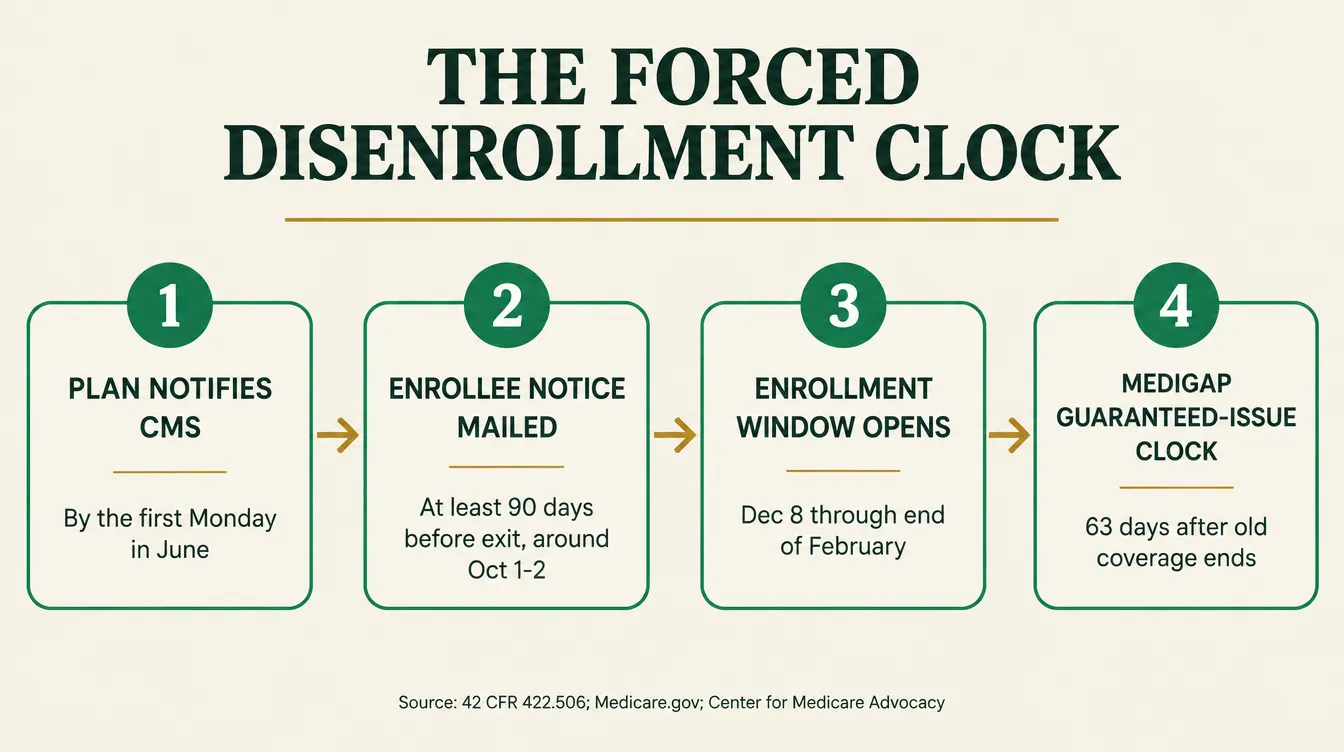
Once that notice goes out, the enrollment clock that actually matters to the member starts. Medicare.gov’s own rules on Special Enrollment Periods lay out three separate windows depending on why the plan is ending, and they are not interchangeable:
| Why the plan is ending | SEP window | Who controls the timing |
|---|---|---|
| Plan doesn't renew (most 2026-2027 cases) | December 8 through the last day of February | Fixed calendar window, same every year |
| CMS terminates the contract | 1 month before the contract ends through 2 months after | Tied to CMS's termination date |
| Plan voluntarily ends its own contract mid-cycle | 2 months before the contract ends through 1 month after | Tied to the plan's own exit date |
Source: Medicare.gov, Special Enrollment Periods.
Layered on top of the enrollment window is a separate, shorter clock for Medigap. According to the Center for Medicare Advocacy, an enrollee whose plan terminates its Medicare contract, exits their service area, or is found to have violated its contract gets a guaranteed-issue right to buy Medigap Plan A, B, C, F, K, or L without medical underwriting, but only if they apply within 63 days of the old coverage ending. That window is materially shorter than the enrollment SEP, and it’s the one clients are least likely to know exists on their own, which is exactly where a licensed agent’s explanation earns its keep.
What Waiting Costs
Run the actual math on a book of a few hundred affected clients, because “call them eventually” and “call them this week” produce very different outcomes here. Say your agency has 400 clients sitting on a plan that just got a non-renewal notice. The SEP is fixed at roughly 12 weeks, December 8 through the end of February. Every one of those 400 people is also getting outreach from the plan’s own retention team, from competing agents who bought the same aggregated non-renewal list, and from whatever call-center number is printed on the notice itself. The underlying mechanism is the same one covered in our guide to speed to lead: whoever calls first tends to keep the relationship, and a forced-switch list compresses that race into a fixed calendar window instead of the usual few hours.
Working the non-renewal list reactively
- Notices go out in early October; agency starts calling in November once AEP volume slows
- Clients who called the number on the letter are already re-enrolled with a call-center agent
- Nobody flagged which clients have a 63-day Medigap guaranteed-issue clock running
- Staff working the AEP surge and the non-renewal list off the same call queue
WeeksTypical delay before the first outbound call
Working the list the day the notice mails
- Non-renewal list pulled and called the same week the October notice goes out
- Guaranteed-issue Medigap clients flagged and called ahead of the general list
- Outbound volume for the non-renewal book runs in parallel with AEP, not queued behind it
- Every client hears from their own agent before they hear from a call center
DaysTypical delay with a parallel outbound campaign
Price the fix against that same 400-client list. Using TheAffordableAI’s published Single Account rate of $0.20 a minute, a 5-minute plan-change explanation call runs $1.00, or $400 to call the full list once. At the Agency plan’s bulk rate of $0.16 a minute, the same 400 calls run about $320. Both plans are month to month with no long-term contract, which matters here specifically because a non-renewal list is a seasonal spike, not a standing monthly volume, and neither plan locks you into paying for capacity you only need for twelve weeks a year.
The letter doesn't wait for your call schedule. Neither does the call center number printed at the bottom of it.
Mike MooreHow to Work the List
None of this requires new software to start. You can do the first four steps with a spreadsheet and the notices your carrier relationships already surface.
- Identify which of your carriers have filed 2027 non-renewals or service area reductions in your counties. Watch for the first-Monday-in-June CMS notification date and carrier earnings calls, like Humana’s, that flag exits ahead of the formal landscape files. If this list lands on top of your normal AEP call surge, plan the staffing for both at once rather than queuing one behind the other.
- Cross-reference your own book against the affected plans and counties the moment you know them, rather than waiting for CMS’s landscape files in September. A carrier’s own investor disclosures are a real, sourced early signal, even before the specific counties are public.
- Flag every client on an affected plan with the date their notice will legally have to mail, roughly 90 days before their plan’s contract end date, so you’re calling ahead of the letter landing in their mailbox, not after.
- Separate the guaranteed-issue Medigap candidates from the rest of the list. Anyone planning to drop Medicare Advantage entirely and go to Original Medicare plus a Medigap policy is working against the shorter 63-day clock, not the full SEP window, and needs to hear that distinction explicitly.
- Call before the SEP opens if you already know the plan is exiting, using the notice period itself to educate and schedule, then confirm and complete the actual plan change once the December 8 window opens.
- Document the call basis and consent for every contact, especially for clients reached by automated or AI-voice calls, since a prior relationship helps the compliance picture but doesn’t erase the underlying TCPA consent requirement.
- Track who called the number on the letter before you got to them. That’s not a failure to fix retroactively; it’s a data point for narrowing next year’s list to the clients who actually wait for their own agent.
The one thing worth automating first
If you do nothing else, build the cross-reference in step 2. A spreadsheet that flags every client on a carrier and plan combination that's publicly signaled a 2027 exit turns a vague sense of "some of my book might be affected" into a specific, callable list before CMS's official files even publish. That step costs nothing but the time to build it.
How TheAffordableAI Handles This
Fires the moment a list is ready
Outbound calling starts when your non-renewal list is loaded, not when a staff member finds a gap in the AEP schedule to start dialing it.
Runs the seasonal spike separately from AEP volume
A non-renewal campaign can run in parallel with your standing AEP and renewal calling instead of competing with it for the same staff hours.
Warm transfer to the right licensed agent
A client ready to talk specifics, especially one working against the 63-day Medigap clock, gets handed to a live agent while they're still on the phone.
HighLevel CRM sync
Call disposition, consent basis, and whether a client mentioned already calling the number on their notice all land on the contact record automatically.
The full breakdown of routing, warm transfers, and CRM sync lives on the features page.
Price it against your own non-renewal list
The math above uses $0.20 a minute because that's what a Single Account costs, down to $0.16 a minute at Agency bulk rates. Run it against your own affected client count before deciding anything. See pricing.
What You Get
$0.20
Per-minute rate, Single Account, from $0.15 at bulk
20+
Agents a warm transfer can ring on the Agency plan
24/7
Coverage while the SEP clock runs, nights and weekends included
0 mo
Contract length required. Cancel anytime.
The Compliance Part, Said Plainly
A forced plan exit doesn’t relax anything about how you’re allowed to contact a client.
Before you point outbound calling at a non-renewal list
- Automated or artificial-voice calls to a wireless number still require the called party's prior express consent under 47 U.S.C. Section 227, the TCPA. An existing client relationship can support that consent depending on how it was documented, but it isn't an automatic exemption.
- Medicare marketing calls carry CMS's own rules on top of the TCPA, including the TPMO disclaimer and required disclosures covered in [our breakdown of the CMS 2027 marketing rule changes](/blog/cms-2027-medicare-marketing-rules/), whether the client is new or a plan you've served for years.
- Disclose that a call is AI where required, and honor an opt-out immediately, every time.
- Using an AI caller does not transfer liability. The licensed agent and agency remain responsible for consent, disclosure, and every recommendation made about a client's coverage.
This is general information, not legal advice. Confirm current requirements against 42 CFR Part 422, CMS's Medicare Communications and Marketing Guidelines, and your own state obligations before running a large outbound campaign.
Where This Isn’t the Right Tool
An AI caller is built for volume against a list you already have and a message you already know how to deliver. It’s not a substitute for the actual coverage conversation a client whose Medicare Advantage plan just disappeared needs to have with a licensed human being about their specific health needs, prescriptions, and provider network. If your affected book is a few dozen clients, call them yourself; a small, high-stakes list like that rewards a personal conversation more than automation.
It also can’t tell you which of your carriers are actually exiting which counties for 2027. That’s a research and relationship problem, tracking earnings calls, carrier notices, and eventually CMS’s own landscape files, that a faster caller doesn’t solve by itself. Build the list first. Decide whether speed is still the bottleneck once you actually know who’s affected.
If you want to hear it before you decide anything
There's a demo call on the homepage. Put your own number in and the AI calls you in seconds, so you can hear exactly what a client on a non-renewal list would hear. Hear a demo call, or go straight to pricing if you already know what you're testing.
The 2.9 million people who lost their Medicare Advantage plan in 2026, and the roughly 600,000 more Humana alone expects to affect in 2027, aren’t shopping because they want to. They’re shopping because a letter told them their coverage is ending on a date they didn’t pick. The agent who reaches them first, explains the 90-day notice, the SEP window, and the 63-day Medigap clock clearly, and helps them act inside it, keeps the relationship. The one who waits for AEP volume to slow down finds out later that the client already called the number printed on the letter.
See a compliant plan-exit call flow before you decide anything
There's a live demo call on the homepage. Listen to the disclosure, the qualifying questions, and the warm transfer end to end.
Frequently asked
What is Medicare Advantage forced disenrollment, and why is it surging in 2026 and 2027?
Forced disenrollment happens when a member's Medicare Advantage plan exits their county, non-renews its CMS contract, or gets terminated, pushing the member out whether they wanted to leave or not. Researchers at Johns Hopkins Bloomberg School of Public Health, writing in JAMA, found the forced disenrollment rate averaged about 1% a year from 2018 through 2024, then jumped to 6.9% in 2025 and roughly 10% (2.9 million people) in 2026. The driver is insurers exiting unprofitable counties and lower-star plans faster than they have in years, a pattern several major carriers, including Humana, have said will continue into 2027.
How many people are affected by Medicare Advantage plan exits for 2027?
The 2027 landscape files won't be final until CMS publishes them in September 2026, but the early signal is large. Humana's own CFO, Celeste Mellet, told analysts on the company's Q2 2026 earnings call that 2027 plan exits would affect approximately 600,000 members, with the company expecting to recapture just over 40% of them into other Humana plans, matching its 2025 recapture rate. That figure is one insurer's projection, not an industry total, and other carriers may add to or subtract from it once their own 2027 bids are final.
When do Medicare Advantage non-renewal notices have to go out?
Under 42 CFR 422.506(a)(2), a Medicare Advantage organization that won't renew its CMS contract must notify CMS in writing by the first Monday in June of the year the contract ends, and must mail each affected enrollee a notice at least 90 calendar days before the nonrenewal takes effect. For a contract ending December 31, that 90-day math lands the notice around October 1 or 2, which the Center for Medicare Advocacy cites as the standard date plans use so enrollees nationwide get comparable notice.
What Special Enrollment Period applies when my Medicare Advantage plan doesn't renew?
Medicare.gov's own rules give a member whose plan isn't renewed a Special Enrollment Period running from December 8 through the last day of February the following year to pick a new Medicare Advantage plan or return to Original Medicare. That's separate from the window that applies if CMS itself terminates a contract (1 month before the contract ends through 2 months after) or if the plan voluntarily ends its own contract mid-cycle (2 months before through 1 month after). Which window applies depends on why the plan is ending, not just that it is.
Do I get a guaranteed-issue right to buy a Medigap policy if my Medicare Advantage plan is discontinued?
Yes, in the specific case where the plan terminates its Medicare contract, exits your service area, or is found to have violated its contract. According to the Center for Medicare Advocacy, an enrollee in that situation has a guaranteed-issue right to buy Medigap Plan A, B, C, F, K, or L without medical underwriting, and must apply within 63 days after the old coverage ends. A single provider or hospital leaving the plan's network on its own, without the plan itself exiting, does not trigger this same guarantee.
Is Humana actually leaving my county for 2027?
That's not something this article, or any national source, can answer for a specific county; it depends on Humana's finalized 2027 bids and the landscape files CMS is expected to publish in mid-to-late September 2026. Humana has said the exits will concentrate on plans rated 3.5 stars or lower for the 2027 bonus year and lower-margin markets, not a uniform nationwide pullback. Check the non-renewal notice your own clients receive, or the CMS landscape file once it publishes, rather than assuming based on national coverage.
Can an agent call existing clients about a plan termination with an AI caller, or does that need special consent?
The same consent rules apply regardless of why you're calling. An automated or AI-voice call to a wireless number still needs the called party's prior express consent under 47 U.S.C. Section 227, the TCPA, and a Medicare-related call still carries CMS's marketing and disclosure rules on top of that. A prior client relationship can support an argument for consent depending on how it was documented, but 'they're my existing client and their plan got cancelled' is not, by itself, a blanket exemption from TCPA consent requirements. Document consent and disclose clearly regardless of the reason for the call.
Does CMS's 'stable' 2026 forecast contradict the forced disenrollment data?
They're measuring different things, which is worth understanding rather than picking a side. CMS's September 2025 press release projected 2026 plan availability would stay roughly flat, about 5,600 plans versus 5,633 in 2025, with over 99% of beneficiaries keeping access to a plan. The JAMA researchers measured something CMS's plan-count projection doesn't capture: how many people's specific plan disappeared out from under them even while the total number of plans on the market barely moved. A market can have a stable plan count and a record forced-disenrollment rate at the same time, because plans are exiting some counties while others gain new entrants.
Sources
- Meiselbach MK, Lavallee M, Zahn M, Xu J, Polsky D. Forced Disenrollments Among Medicare Advantage Beneficiaries Following 2026 Plan Exits. JAMA, published online February 18, 2026 (doi:10.1001/jama.2026.0028), via PubMed Central
- Cornell Law School Legal Information Institute — 42 CFR 422.506, Nonrenewal of contract
- Medicare.gov — Special Enrollment Periods
- Center for Medicare Advocacy — When a Medicare Advantage Plan Does Not Renew Its Contract
- Humana Inc. Q2 2026 earnings call transcript (CFO Celeste Mellet), published by The Motley Fool, August 7, 2026
- CMS — Medicare Advantage and Medicare Prescription Drug Programs Expected to Remain Stable in 2026 (press release, September 26, 2025)
- Cornell Law School Legal Information Institute — 47 U.S.C. Section 227, Telephone Consumer Protection Act
- CMS — Agent/Broker Medicare Advantage Marketing Policies FAQ, October 19, 2022
- TheAffordableAI — Pricing
Put this on your own phone line
See the AI dial, qualify, and warm-transfer a live call in under a minute. No contract, no dev work.
Keep reading

Surviving Medicare AEP 2026 Without a Seasonal Hire
Medicare AEP runs October 15 to December 7. Real math on staffing that window without hiring and licensing seasonal reps you don't have time for.
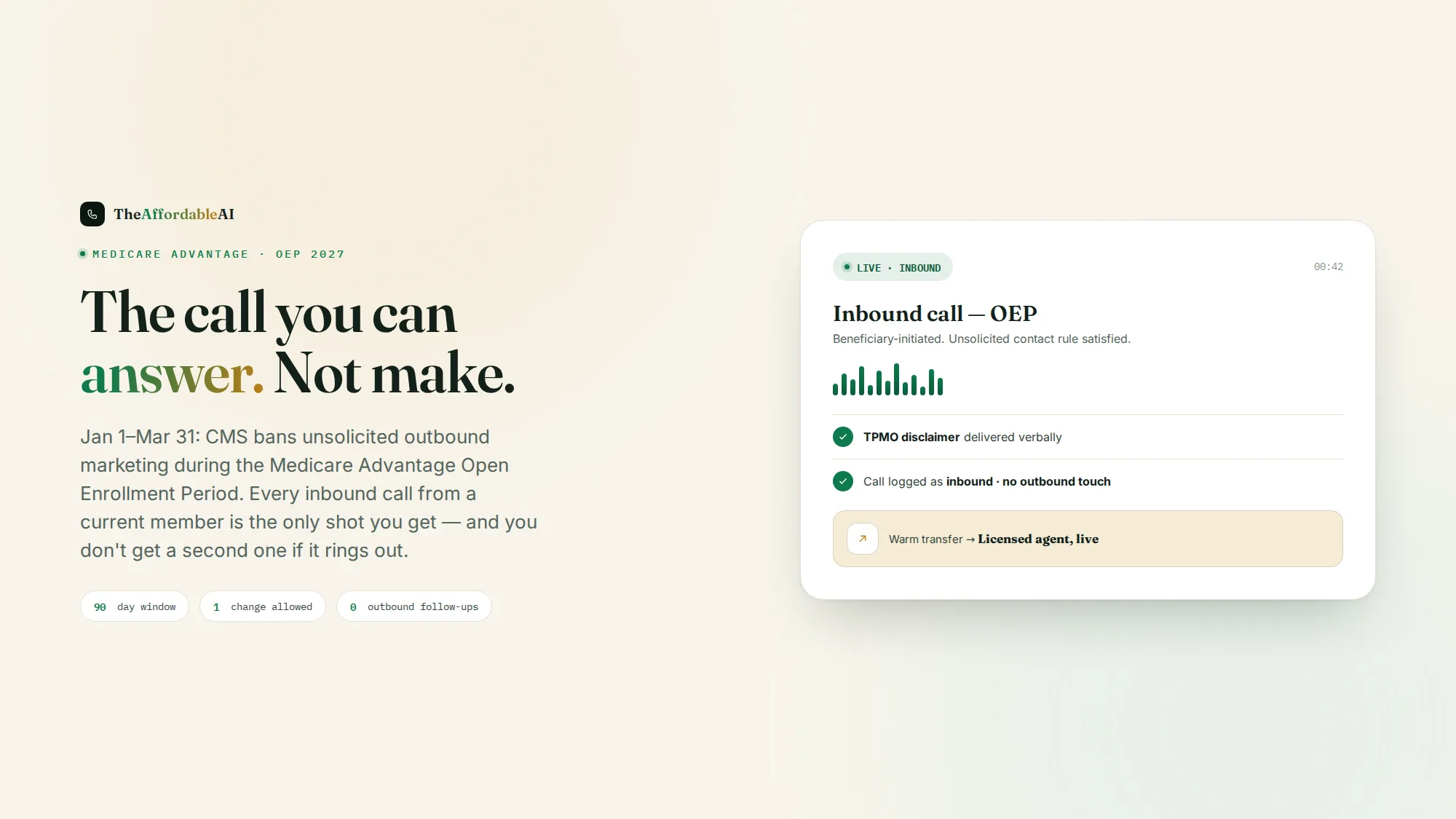
Medicare OEP 2027: What Agents Can (and Can't) Do
Medicare's Open Enrollment Period runs January 1 to March 31 and bans unsolicited marketing. Here's what agents can legally do, and why every call matters.

CMS 2027 Medicare Rules: The 48-Hour Wait Is Gone
CMS eliminated the 48-hour Scope of Appointment wait, changed the TPMO disclaimer timing, and cut call retention to 6 years ahead of AEP 2027.